



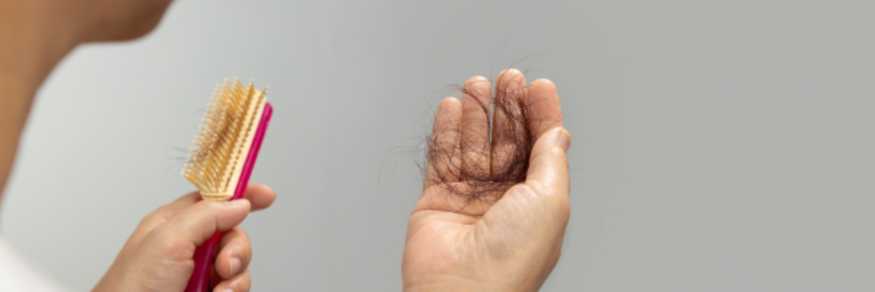
Hair thinning during menopause is very common. Many women notice their ponytail feels smaller, their parting looks wider, or their hair doesn’t grow as thick as it used to. Although these changes can feel sudden and worrying, several treatments can slow shedding and support regrowth.
The treatments that help most include checking for underlying causes such as low iron or thyroid changes, considering HRT, and using topical minoxidil. Some women also benefit from targeted supplements or supportive scalp care alongside these treatments.
Treatment works best when approached step by step, starting with simple checks and moving towards targeted treatments where needed. Here’s what can help, and what to consider trying first.
In this article:
Could something else be causing menopausal hair thinning?
What treatments can help with menopausal hair loss?
How can you maximise your results?
Which menopausal hair loss treatment is right for you?
Where can you get help choosing a treatment?
Explore our hair loss treatments or speak with our pharmacy team for personalised advice.
Could something else be causing menopausal hair thinning?
While hair loss in women often occurs around the time of the menopause, it isn’t always caused by menopause alone. Around midlife, several other conditions can affect hair growth or make shedding more noticeable, including:
Low iron levels
Thyroid changes
Vitamin D deficiency
Vitamin B12 deficiency
If one of these is contributing, treating the underlying cause can improve shedding without needing specific hair loss treatment. For example, iron deficiency is usually treated with iron supplements, while thyroid problems require medical treatment from a GP.
A GP can arrange simple blood tests to check for these before treatment begins. Once other causes of thinning have been ruled out or treated, menopausal hair loss treatments can be considered.
What treatments can help with menopausal hair loss?
Several treatment options can help slow shedding and support regrowth. These are often considered in order, beginning with treating underlying causes or general menopause symptoms, and then adding targeted hair loss treatments if thinning continues.
1. Hormone replacement therapy
Hormone replacement therapy (HRT) replaces oestrogen levels that naturally fall during menopause (1). It’s this drop in oestrogen, along with other hormonal shifts, that are responsible for symptoms like hot flushes, sleep changes, mood changes, and, for some women, hair thinning (2).
Oestrogen levels affect the hair as this hormone helps keep hair in its growth phase for longer (3). As levels drop, hair follicles spend less time growing and more time shedding, which can make hair appear finer. By restoring hormone levels, HRT may support gradual improvements in hair thickness.
However, HRT is only suitable if you have other menopause symptoms (4). It can be used alongside targeted hair loss treatments such as minoxidil if further support for regrowth is needed.
2. Topical minoxidil
Topical minoxidil is the first-line treatment for female pattern hair thinning, which commonly develops during menopause as hormone levels change (3,5). It works by increasing blood flow around hair follicles and helping keep them in their growth phase for longer.
Most women apply minoxidil once daily to the scalp, although some formulations are used twice daily. It’s normal to notice increased shedding during the first few weeks of treatment as older hairs are replaced by new ones (6). But over time, the medicine slows shedding and supports thicker regrowth.
Results develop gradually (7):
Early changes may appear after 4 months
Clearer improvement is often seen after 6 months
Continued use is needed to maintain results
Minoxidil can be used on its own or alongside HRT and supplements if these are also recommended. Compared with many prescription-only treatments, it is usually one of the more affordable medical options for menopausal hair thinning.
Explore our hair loss treatments or speak with our pharmacy team for personalised advice.
3. Targeted hair growth supplements
Some supplements are designed specifically to support hair growth rather than correct specific deficiencies. Products such as Florisene and Nourkrin Women fall into this category:
Florisene contains iron and the amino acid L-lysine, which can support hair growth in women with low or borderline iron levels. Studies suggest that improving iron availability, particularly when combined with L-lysine, may help reduce ongoing hair shedding in some women (8).
Nourkrin Woman contains a marine-derived protein complex called Marilex that supports the hair growth cycle. Some studies suggest it may improve hair growth and appearance for women with general thinning and female pattern baldness (9,10).
These treatments are not generally a replacement for treatments such as minoxidil, but are an option if you don’t want to use a medicine, as both are drug-free. For some women, combining a targeted supplement with minoxidil provides extra support while hair thickness gradually improves.
4. Supportive shampoos
Supportive shampoos do not treat menopausal hair loss in the same way as medicines such as minoxidil, but they can help improve scalp condition and support the hair growth cycle while longer-term treatments take effect.
Caffeine-based shampoos are commonly used for hormone-related thinning. For example:
Alpecin Liquid Caffeine contains a caffeine complex along with niacin and zinc, which support scalp circulation and follicle function (11). It is applied directly to the scalp after washing and left in place rather than rinsed out.
Plantur 39 is formulated specifically for women experiencing hair thinning during and after menopause. It contains a phyto-caffeine complex designed to support follicles affected by falling oestrogen levels, leaving many women with thicker-feeling hair (12).
Some women also use ketoconazole shampoo (such as Nizoral). Ketoconazole helps reduce scalp inflammation and may support hair growth during and after menopause, particularly if you’re experiencing female pattern thinning (3).
How can you maximise your results?
When it comes to treating hair loss, the best way to maximise your results is to stay consistent with treatment. All hair loss treatments take time to work because they depend on the natural hair growth cycle and need to be used for several months before improvements become noticeable.
Menopausal hair thinning also often improves when treatments are combined rather than used on their own. For example:
HRT can help stabilise hormonal shedding (and improve other menopause symptoms)
Minoxidil is a licensed hair loss medicine that supports thicker regrowth over time
Targeted supplements may support the hair growth cycle
Shampoos improve scalp condition while longer-term treatments begin working
Lifestyle factors can also play a role in supporting healthier hair (13). Eating a balanced, nutritionally complete diet, managing stress where possible, and avoiding tight hairstyles that pull on the scalp can all help reduce additional strain on follicles and prevent hair breakage.
Explore our hair loss treatments or speak with our pharmacy team for personalised advice.
Which is the right hair loss treatment for you?
There isn’t a single “best” treatment for menopausal hair thinning. The right option usually depends on what is contributing to the change in your hair, as well as what feels realistic to use consistently.
For example:
HRT may be helpful if thinning starts alongside other menopause symptoms (4). There are several options for HRT, including tablets, patches, gels, or sprays, but it requires GP assessment and isn’t suitable for everyone (1,14).
Minoxidil is the most effective treatment that directly targets hair thinning and can be used for both general thinning and pattern hair loss. However, you need to apply it once or twice daily (depending on the product) for several months to see results.
Florisene may be useful if iron levels are borderline but not low enough to be treated as a deficiency. It’s taken as a daily tablet, which some women find easier to continue than topical treatments like minoxidil.
Nourkrin Women supports the hair growth cycle in women with thinning hair and is taken as a daily tablet. It’s drug-free and simple to take, but results are gradual and vary between individuals.
Supportive shampoos are one of the easiest treatments to introduce because they replace your usual shampoo, but they aren’t clinically proven and work best alongside medical treatments rather than on their own.
Where can you get help choosing a treatment?
If you’re unsure where to start, a pharmacist or GP can help you decide which treatment approach is most appropriate. Menopausal hair thinning often has more than one cause, so personalised advice can be helpful when choosing between options or combining treatments.
The team at Oxford Online Pharmacy can advise on suitable treatment options and help you choose products that fit your symptoms, preferences, and routine.
Explore our hair loss treatments or speak with our pharmacy team for personalised advice.
Sign up to our newsletter and get 10% off your first order.
FAQs
Is minoxidil safe to use during menopause?
Yes. Topical minoxidil is licensed to treat female pattern hair loss and is suitable for women experiencing thinning during menopause. It can be used alongside other treatments, including HRT and targeted hair supplements.
Can you use HRT and minoxidil together?
Yes. These treatments are often used together by menopausal women experiencing hair thinning or shedding (15). HRT helps correct hormone-related changes that affect the hair growth cycle, while minoxidil directly supports follicle activity.
Are supplements enough to treat menopausal hair thinning?
If a nutritional deficiency is confirmed with a blood test, treating that directly can be an effective approach. Targeted supplements like Florisene and Nourkin can also support hair growth on their own, but are usually more effective when taken alongside treatments like minoxidil.
When should I speak to a GP about menopausal hair loss?
You should speak to a GP if hair loss is new during menopause, especially if you’re not already discussing menopause symptoms, or if it starts suddenly, as it may indicate thyroid disease, iron deficiency, autoimmune conditions, or medication effects.
References
NHS. Treatment - Menopause [Internet]. NHS. 2019.
Gatenby C, Simpson P. Menopause: physiology, definitions, and symptoms. Best Practice & Research Clinical Endocrinology & Metabolism [Internet]. 2023 Dec 1;38(1):101855–5.
Gupta AK, Economopoulos V, Mann A, Wang T, Mirmirani P. Menopause and hair loss in women: Exploring the hormonal transition. Maturitas [Internet]. 2025 May 2;198:108378.
Zouboulis CC, Blume-Peytavi U, Kosmadaki M, Roó E, Vexiau-Robert D, Kerob D, et al. Skin, hair and beyond: the impact of menopause. Climacteric. 2022 Apr 4;25(5):1–9.
NHS. Hair loss [Internet]. NHS. 2017.
NICE Clinical Knowledge Summary. Female pattern hair loss (female androgenic alopecia) – Prescribing information - Topical minoxidil. [Internet]. NICE. 2025.
Müller Ramos P, Melo DF, Radwanski H, de Almeida RFC, Miot HA. Female pattern hair loss: therapeutic update. Anais Brasileiros de Dermatologia. 2023 Mar;98(4).
Goluch-Koniuszy ZS. Nutrition of women with hair loss problem during the period of menopause. Menopausal Review [Internet]. 2016;15(1):56–61.
Thom E. Nourkrin ® Woman with Marilex ® Enhances Hair Growth and Appearance and Improves Hair Confidence in Women with Diffuse Hair Loss from Brazil: An Investigator- initiated Clinical Study Clinical & Investigative Dermatology. J Clin Investigat Dermatol. 2020 Jul; 8(1).
Wadstein J, Thom E, Gadzhigoroeva A. Integral Roles of Specific Proteoglycans in Hair Growth and Hair Loss: Mechanisms behind the Bioactivity of Proteoglycan Replacement Therapy with Nourkrin® with Marilex® in Pattern Hair Loss and Telogen Effluvium. Dermatology Research and Practice. 2020 May 5;2020:1–17.
Kesika P, Sivamaruthi BS, Thangaleela S, Bharathi M, Chaiyasut C. Role and Mechanisms of Phytochemicals in Hair Growth and Health. Pharmaceuticals [Internet]. 2023 Feb 1;16(2):206.
Plantur 39. Efficacy of a caffeine-containing shampoo formulation of Plantur 39 against menopausal hair loss in women [Internet]. Plantur39.com. 2022 [cited 2026 Apr 17].
Huang F, Tang L, Zhou X, Fu Q, Lu Y. Lifestyle factors affecting the pathogenesis of androgenetic alopecia: a literature review. Frontiers in Public Health [Internet]. 2026 Feb 4;14.
NHS. Types of hormone replacement therapy (HRT) [Internet]. nhs.uk. 2023.
Choe SJ, Lee S, Choi J, Lee WS. Therapeutic Efficacy of a Combination Therapy of Topical 17α-Estradiol and Topical Minoxidil on Female Pattern Hair Loss: A Noncomparative, Retrospective Evaluation. Annals of Dermatology. 2017;29(3):276.