

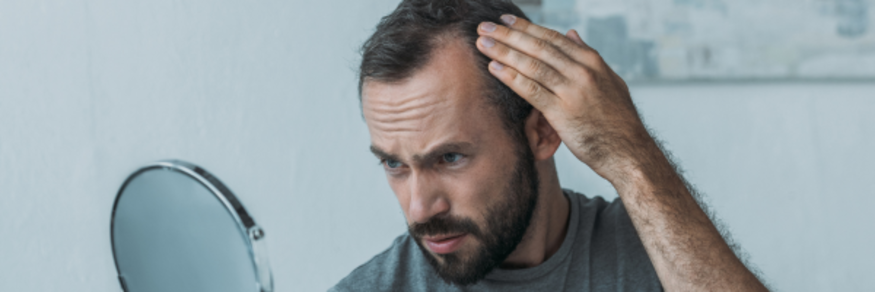
Steroids are often talked about in gyms, changing rooms, and online forums – sometimes with admiration, sometimes with concern. But while most people know they can help build muscle fast, fewer realise they can also have side effects that aren’t so appealing… including hair loss (1).
We ran a national survey to find out more about steroid use in the UK, how much people know about the risks, and whether hair loss is enough to make them think twice. The results might surprise you.
How common is steroid use among gym-goers?
It turns out that using (or at least considering) anabolic steroids isn’t unusual. 61% of men told us they have used, or may consider using, steroids in the gym. For men aged 25–34, that figure jumps to a striking 75%, making them the most likely age group to try steroids for muscle gain.
Steroid use also varies depending on where you live. Men in Greater London came out on top, with 72% saying they have used or might use steroids, followed by:
- 67% in Yorkshire and the Humber
- 66% in Wales
- 65% in the West Midlands
- 64% in the North West

When we looked at individual cities, the top spots were:
- Leeds: 69%
- Manchester: 68%
- Sheffield: 67%
- Cardiff and London: 65%
- Bristol: 64%
Do men know steroids can cause hair loss?
Our survey found that 33% of men are unsure, indifferent, or don’t believe that anabolic steroids can cause hair loss, despite scientific links between steroid use and
increased levels of DHT (dihydrotestosterone), a hormone associated with male pattern baldness (more on this below).

This lack of awareness is more common in some parts of the UK than others. Men in the East Midlands (46%) and West Midlands (37%) were least likely to know about the connection.
Age also plays a role: 32% of 25–34-year-olds said they didn’t think or weren’t sure if steroid use could lead to hair loss – despite being the age group most likely to take them. This lack of awareness could mean many are unknowingly risking their hair for bigger muscles.
Is risking hair loss worth the muscle gain?
For many men, the answer is yes. 42% of those we surveyed said they would risk hair loss for muscle gain, with younger age groups far more likely to take the gamble:
- 50% of men aged 25–34
- 46% of men aged 16–24
- 43% of men aged 35–44
The numbers dropped in older groups, with 27% of men aged 45–54 and just 17% of men aged 55+ willing to risk their hair for muscle.

Regionally, men in Greater London (51%) were most likely to say they’d take the risk, followed by:
- 48% in Yorkshire and the Humber
- 47% in Wales
- 46% in the West Midlands
- 44% in the North West
At the city level, Sheffield topped the list at 52%, followed by Cardiff (50%), Manchester (47%), and Birmingham and London (45%).
How much does hair loss affect self-confidence?
For most men, the answer is: a lot. 70% told us that steroid-related hair loss would have an extreme impact on their self-confidence or body image.

This concern was highest among men aged 35–44 and 45–54 (both 71%), but it’s still significant among younger groups (69% of both 16–24 and 25–34-year-olds) and even those aged 55+ (61%).
Location made a difference here too: men in Northern Ireland (82%) were the most concerned, while men in Wales (58%) were least concerned. Relationship status also played a role, with 72% of men in relationships saying they’d be concerned, compared to 67% of divorced men.
Why do steroids cause hair loss?
Steroids don’t directly “cause” hair loss in everyone – around 14% of men taking steroids experience thinning and shedding, whereas others don’t (2). Instead, they can speed up a process you may already be genetically prone to.
Why does this happen? Anabolic steroids raise testosterone levels in the body, which can convert into dihydrotestosterone (DHT), a hormone linked to male pattern baldness. This DHT binds to hair follicles, causing them to shrink and shortening the hair growth cycle (3). This causes hair to become finer and shed more easily.

Some men’s hair follicles are more sensitive to DHT than others. If you have this sensitivity, the high DHT levels due to steroids are enough to cause visible, unwanted changes to your hairline, hair thickness, and confidence.
What are the worst steroids for hair loss?
Not all anabolic steroids are equal when it comes to hair loss. Those with the strongest “androgenic” effects carry the highest risk. This is because they're more likely to turn
into DHT or act like it, and high DHT is the threat to your hair.
Examples of the most androgenic steroids include Dianabol (methandienone) and Trenbolone. DHT-based steroids like Masteron (drostanolone propionate), Winstrol (stanozolol) and Primobolan (mesterolone enanthate) are also some of the worst for potential hair loss.
Some users try to avoid these in favour of “milder” steroids like Nandrolone (deca-durabolin) (4), but no anabolic steroid is completely risk-free when it comes to your hair.
Steroids that don’t cause hair loss don’t exist, and any form of prolonged use can tip the balance if you’re genetically susceptible.
Does weight lifting cause hair loss?
No, weightlifting itself won’t make your hair fall out. The myth likely comes from the fact that gyms are one of the most common places people use anabolic steroids. Because hair loss is a known steroid side effect, it’s easy to wrongly assume the exercise is to blame.
If you’re training naturally, you can lift as heavy and as often as you like without worrying about it affecting your hair. The real issue is the hormonal impact of steroids, not the workout itself.
Will hair loss from steroids grow back?
Hair loss from steroids won’t grow back for as long as you continue to take them. Even if you stop taking them, while you’ll prevent further damage to your hair follicles, there is no guarantee that you can undo the damage.
Many men do notice improvements in their hair over the following months, but whether it fully grows back depends on how much permanent damage has been done. The sooner you stop taking anabolic steroids, the better your chances of regrowth.
How long after stopping steroids will my hair stop falling out?
For most people, shedding begins to slow within a few weeks to a couple of months of stopping steroids, as hormone levels return to normal and no new hairs are affected in the same way. But hair growth is a slow process, and it can take several months before you see visible regrowth.
It’s also worth keeping in mind that not all hair loss is purely down to steroid use. If the problem began after you started taking them, steroids are likely playing a major role – but other factors such as genetics, stress, poor diet, or illness can contribute too (5).
If these other causes are also in play, getting all your hair back might not be possible. Still, removing steroids from the equation gives your scalp the best possible environment to recover.
You can learn more about hair regrowth after stopping steroids here.
How to stop hair loss after a steroid cycle
If you’ve finished a steroid cycle and want to protect your hair, nothing beats stopping steroid use altogether. From there, you can focus on improving scalp health and giving your hair the best chance to recover. Here are some options to consider:
- Topical treatments: Caffeine-based shampoos and liquids, such as Alpecin C1 or Alpecin Caffeine Liquid, can help strengthen hair at the root and reduce shedding (6).
- Nutrition: Hair health is closely linked to your diet (7). Aim for a nutrient-rich menu with plenty of protein, iron, antioxidants, and vitamins.
- Supplements: If it’s tricky to get all the nutrients you need from food alone, hair supplements such as Nourkin may help support scalp and follicle health.
- Stress management: Chronic stress can worsen hair loss. Building in stress-reducing habits like regular exercise, meditation, or yoga can make a difference over time.
It’s also worth speaking to a healthcare professional about hair loss treatments like finasteride or topical minoxidil, which can slow thinning and, in some cases, encourage regrowth – but these should only be used under proper medical guidance and after stopping steroids for good.
At Oxford Online Pharmacy, our clinical team can help you explore safe, prescription-only treatments for hair loss, with discreet delivery straight to your door. Because muscle is one thing, but confidence is harder to rebuild.
About the survey
The research was conducted on behalf of Oxford Online Pharmacy by Censuswide on 1,000 adult male gym-goers in the UK in July 2025.
References
- NHS. Anabolic Steroid Misuse [Internet]. NHS. NHS; 2022.
- Albaker W, Alkhars A, Elamin Y, Jatoi N, Boumarah D, Al-Hariri M. Anabolic–Androgenic Steroid Abuse among Gym Users, Eastern Province, Saudi Arabia. Medicina. 2021 Jul 10;57(7):703.
- Ho CH, Zito PM. Androgenetic Alopecia [Internet]. Nih.gov. StatPearls Publishing; 2019.
- Pan MM, Kovac JR. Beyond testosterone cypionate: evidence behind the use of nandrolone in male health and wellness. Translational Andrology and Urology [Internet]. 2016 Apr 1;5(2):213–9.
- NHS. Hair loss [Internet]. NHS. NHS; 2017.
- Bussoletti C, Tolaini MV, Celleno L. Efficacy of a cosmetic phyto-caffeine shampoo in female androgenetic alopecia. Giornale Italiano Di Dermatologia E Venereologia: Organo Ufficiale, Societa Italiana Di Dermatologia E Sifilografia [Internet]. 2020 Aug 1; 155(4):492–9.
- Rajput R. Influence of nutrition, food supplements and lifestyle in hair disorders. Indian Dermatology Online Journal. 2022;13(6):721.