



Over the past few months, you may have seen headlines about a new 7.2mg dose of Wegovy, a higher strength expected to launch in the UK in 2026. If you’re using a GLP-1 medicine already, or have been thinking about starting one, it’s natural to wonder what this new dose means for you.
Here’s a look at what the new 7.2mg strength of Wegovy is, what early research shows us about its safety and effectiveness, and how it may fit into your treatment pathway.
What is the 7.2mg version of Wegovy?
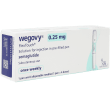
The new, higher-strength Wegovy contains 7.2mg of semaglutide, the same active ingredient as the existing doses. Wegovy is currently available in five strengths, ranging from a starting dose of 0.25mg to a maximum “maintenance” dose of 2.4mg (1):
0.25 mg → 0.5 mg → 1 mg → 1.7 mg → 2.4 mg
The 7.2mg version won’t replace these existing doses. Instead, it will add another progression beyond 2.4mg, with no additional steps between.
Importantly, this new dose provides another option, not a new target. Not everyone will need to (or should) increase to 7.2mg of Wegovy. People respond differently to GLP-1s, and many achieve meaningful weight loss at lower maintenance doses. Many of our current patients, for example, remain on a maintenance dose of 1.7mg long-term with great results.
So, why introduce a higher dose? Research suggests that for some people, the 7.2mg option may help them lose weight beyond what’s possible with the existing maximum (2).
What early trial data tell us
The new 7.2mg dose of Wegovy was tested in a large study called STEP UP (2). It involved over 1,400 adults with obesity (BMI ≥30) and ran for 72 weeks across 11 countries. The trial compared the current highest dose (2.4mg) to the new 7.2mg strength. Here is what researchers found:
People lost more weight on the higher dose: Participants taking 7.2mg injections lost 18.7% of their body weight on average, compared to 15.6% in the 2.4mg group. About 50% of people on 7.2mg lost 20% or more of their starting weight.
Higher doses don’t guarantee more weight loss: Results varied from person to person. For example, around 15% of those on 2.4mg still managed 25% weight loss, showing that for some people, the lower dose is already enough.
Digestive side effects are slightly more common at higher doses: Around 70% of people on 7.2mg of Wegovy experienced side effects like nausea, constipation, and bloating, compared to 60% of participants taking the 2.4mg dose.
Serious side effects are not more common at 7.2mg: Serious side effects occurred in 7% of people on 7.2mg, 11% of people on 2.4mg, and 6% of people on placebo. This suggests the overall safety profile remained similar despite the higher dose.
In summary, the 7.2mg dose helped people lose more total body weight and did so without unexpected safety issues. But it was less well-tolerated than 2.4mg, and a higher dose doesn’t guarantee better results for everyone.
Overall, the research suggests the 7.2mg option may be valuable for some people, but far from essential for all. It’s about finding what’s right for you.
How do these results compare with other GLP-1s?
Until now, the GLP-1 that has performed best in terms of weight loss in clinical studies for obesity treatment is Mounjaro (tirzepatide). In a large study called SURMOUNT-1, participants taking the highest 15mg dose of tirzepatide achieved an average of 21% weight loss (3).
It was these results, previously unheard of in the field of weight loss management, that sparked the research into higher-dose Wegovy. And indeed, early data from the STEP UP suggest that the new 7.2 mg Wegovy dose could place semaglutide’s effectiveness in a similar territory to tirzepatide’s highest dose, potentially narrowing the gap between the two medicines.
It’s important to emphasise that:
These comparisons are between different trials, with different populations and conditions.
STEP UP is the first major trial evaluating semaglutide at this dose, so more data will help confirm how it truly compares in the real world.
Still, from what we’ve seen so far, 7.2 mg semaglutide has the potential to become one of the most effective GLP-1 options available once approved.
Where the 7.2mg dose fits into treatment
The fundamentals of the Wegovy treatment pathway are not changing. You still start on a low 0.25mg starting dose and gradually increase every four weeks, assuming side effects have settled.
The 7.2mg is to be added to the end of the current treatment pathway as a possible next step. But it’s not a universal next step, won’t be right for everyone, and will not become the “new standard.” The right maintenance dose will always depend on your individual response.
Who might be eligible for the new strength?
The eligibility criteria for Wegovy will remain the same when the new dose is here. In the UK, it’s prescribed to people with a BMI of 30+ (obese), or a BMI of 27+ (overweight) with a weight-related condition like high blood pressure or diabetes (4).
Whether you progress to the 7.2mg dose will depend on your prescriber, who will consider:
How well you are responding to 2.4mg of Wegovy
Whether your weight loss has plateaued before reaching your target weight
Current side effects and how well you are tolerating lower doses
If you have any relevant medical conditions or risk factors
Even if you are eligible, you might not be able to access the new, higher-strength dose immediately after its release. Availability will depend on supply, which is expected to build gradually once the dose launches in the UK in 2026.
What this might mean for you
If you’re thinking about starting Wegovy or are early on in treatment, the new 7.2mg option won’t change anything for now. You can’t skip steps or jump ahead. To support healthy, sustainable weight loss, you need to progress gradually and work your way slowly through the treatment pathway.
However, if you’ve worked your way up to 2.4mg and your weight loss has slowed, the arrival of the stronger dose might be a helpful future option. The higher strength may offer the extra support needed to achieve your weight loss goals.
Pricing has not yet been confirmed, but you may want to discuss the 7.2mg option with your prescriber if the following apply:
You are currently taking 2.4mg Wegovy injections
You are tolerating the medicine well with no or minimal side effects
Your weight loss has slowed and you have reached a plateau
You still have weight-related health goals to reach
The bottom line
Whether the 7.2mg Wegovy dose ends up being right for you or not, its arrival is an encouraging sign. It signals that the field of weight loss medicines is expanding and evolving, and suggests that more tailored options may emerge in the future.
If you’re already on or considering Wegovy, talk to your prescriber or a specialist service run by experts, like ours, to see if this new strength might be appropriate. Our team is here to answer questions, offer guidance, and prescribe treatment tailored to you.
Explore Wegovy or speak to our team to find out more about your options
References
Wegovy® Dosing Schedule | Wegovy® (semaglutide) Injection 2.4 mg [Internet]. www.wegovy.com.
Wharton S, Freitas P, Jøran Hjelmesæth, Kabisch M, Kandler K, Ildiko Lingvay, et al. Once-weekly semaglutide 7·2 mg in adults with obesity (STEP UP): a randomised, controlled, phase 3b trial. The Lancet Diabetes & Endocrinology [Internet]. 2025 Sep 1
Jastreboff AM, Aronne LJ, Ahmad NN, Wharton S, Connery L, Alves B, et al. Tirzepatide Once Weekly for the Treatment of Obesity. New England Journal of Medicine [Internet]. 2022 Jun 4;387(3):205–16.
NICE. Information about semaglutide | Semaglutide for managing overweight and obesity | Guidance [Internet]. www.nice.org.uk. 2023.