


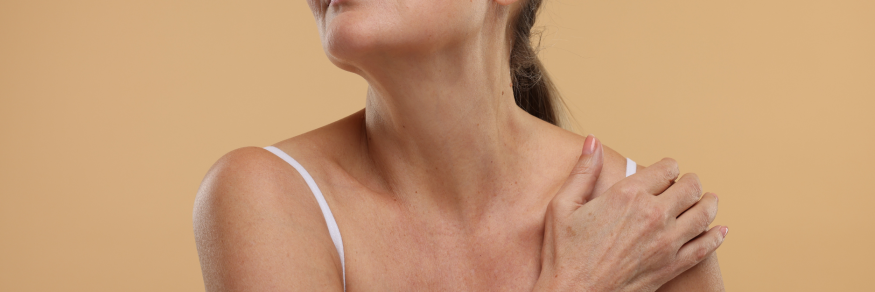
If you’re suddenly dealing with persistent itching that seems to have appeared out of nowhere, you’re not alone in feeling frustrated and confused by this unexpected change.
Key points:
Declining oestrogen during menopause reduces skin moisture and collagen, causing itching in up to 64% of women
Women can lose up to 30% of their skin collagen in the first 5 years after menopause
The best relief creams contain ceramides, hyaluronic acid and low-dose Hydrocortisone for barrier repair
Formication (crawling sensations) affects some women and requires a different treatment from standard itching treatments
Cool bedrooms, cotton bedding and pre-bedtime moisturising may provide nighttime relief
In this article:
What causes itchy skin during menopause?
What is the best cream for menopause itching?
How can I stop menopause itching from keeping me awake at night?
Can HRT help with itchy skin and what are my other treatment options?
When should I see a doctor urgently about menopause itching?
What causes itchy skin during menopause?
As oestrogen levels fall as you age, your skin holds less moisture and makes less collagen and this is what causes itching in as many as 64% of women going through the menopause.
The main reason for itchy skin is falling oestrogen levels during and after the menopause. Oestrogen is essential for maintaining the skin’s natural moisture and producing collagen. Without enough oestrogen, skin tends to get thinner, feels drier and is more easily irritated.
A 2022 study by Zouboulis CC and colleagues found a reduction of approximately 30% in the first 5 years of menopause, followed by a further decline of 2% per year for the next 15 years (1). This collagen loss happens alongside your skin producing less of its natural moisturisers and its oil glands producing less oil.
The physiological changes don’t stop there. Your skin’s ability to hold onto water is greatly reduced, which means more water escapes from the skin. This begins a pattern: dry skin is much more likely to be irritated, and irritation causes more itching, and more itching then irritates the skin further.
Cortisol and other stress hormones can make your skin more easily irritated during menopause. Hot flushes and night sweats disturb sleep, and this may get in the way of the skin repairing itself while you’re resting, which may worsen any dryness or sensitivity you already have.
Research published in the journal Clinical and Experimental Dermatology (5) showed that as many as 64% of women presenting at menopause clinics reported skin problems, which highlights how common the issue is. Differences in hormone levels, genetics and external factors from your surroundings may be why everyone finds menopause impacts their skin differently.
How do I know if I have formication or regular menopause itching?
Formication feels like insects crawling under your skin, while regular menopause-related itching feels like typical dry, irritated skin that you want to scratch.
Formication gives you feelings of crawling, tingling or pins and needles under the skin. You may be convinced that something is moving underneath the skin, even though there is nothing actually there. A shift in hormones can affect how your nervous system processes signals but can also be due to other factors.
Itching related to the menopause, on the other hand, is much more like the feeling of eczema or very dry skin. Your skin will look visibly dry, flaky or red, and you’ll get some temporary relief when you scratch it. It is generally in places that feel tight or uncomfortable.
Formication tends to be at its worst when your hormone levels are going up and down, especially at night or when you’re stressed. It’s linked to how falling oestrogen levels impact your nerves and the balance of chemicals in your brain.
As a result, they’re treated in very different ways. Medications that work on nerve signalling are more likely to help with formication, while normal itching responds better to moisturisers and topical treatments that help repair the skin’s barrier.
What is the best cream for menopause itching?
Look for creams with ceramides, hyaluronic acid and 1% Hydrocortisone for menopause itching relief and skin barrier repair.
Ceramides are essential lipids that are really important for restoring your skin’s natural moisture barrier back to normal (6). As you go through the menopause, your skin makes fewer ceramides by itself, so you may need to get them in the form of topical creams. For the best repair of your skin’s barrier, look for products with ceramide 1, ceramide 3, and ceramide 6-II.
Hyaluronic acid can hold up to 1,000 times its weight in water, making it excellent for moisturising dehydrated menopausal skin. It’s best to choose products with both high and low molecular weight hyaluronic acid for surface hydration and deeper penetration.
The NHS guidance on hydrocortisone for skin (4) states that a 1% Hydrocortisone cream is a mild steroid for the skin and can provide quick relief of inflammation and itching. You only apply a very thin layer up to twice a day for a maximum of 7 days. Because long term steroid use isn't recommended but should be reviewed regularly by prescriber, you should only continue using it for longer if a prescriber allows it. You’ll need a prescription and medical supervision for stronger steroid creams.
If you want some cooling relief, but without causing additional irritation, look for menthol as an ingredient in amounts of 0.25% to 0.5%. Higher amounts than this can be too strong for the more sensitive skin that often comes with menopause.
You can also look out for emollients like glycerin, petrolatum and dimethicone which are ingredients that form a protective layer over your skin and stop it losing water while the other active ingredients are doing their job. You’re best to stay away from products containing fragrances, alcohol or sulphates because they can make the dryness much worse.
Remember to apply cream to slightly damp skin within a few minutes of getting out the bath or shower to lock in the moisture. At night, a heavier ointment is advised and for daytime, when you’re wearing clothes, a lighter cream may be better.
How can I stop menopause itching from keeping me awake at night?
A cool bedroom, cotton bedding, moisturiser 30 minutes before bed, and cold compresses may provide nighttime itching relief.
To give your skin good prep, begin your bedtime routine half an hour earlier than usual. On clean skin, apply a thick, ceramide-rich moisturiser or overnight treatment, especially where you get most of your itch. It needs this time to absorb before you get into bed.
The temperature of your bedroom should ideally be between 16 and 18°C, and a fan can help if needed. Heat can make itching worse, because it increases blood flow to the skin and causes histamines to be released. Cold air provides natural relief and can also help with other symptoms that happen during the menopause, like hot flushes.
For your bed sheets and sleepwear, go for 100% cotton with a thread count of around 200 to 400. Higher thread counts trap more heat, while synthetic fabrics don't let your skin breathe, so can make the skin more irritated. When you wash your bedding, use a fragrance-free detergent and try not to use fabric softener.
It’s a good idea to keep a cold compress or cooling gel pack wrapped in a thin towel on your bedside table for emergency relief. Apply it for 10-15 minutes if itching happens in the middle of the night. Some women find that frozen peas wrapped in a pillowcase can also do the trick.
If advised by a doctor, some people may take antihistamines (e.g. Cetirizine or Loratadine) before bed. The NHS guidance on antihistamines and menthol creams for itchy skin relief (2) says that these can lower the histamine reaction that makes itching at night much worse.
If you are scratching in your sleep without realising, keep your fingernails short and try wearing cotton gloves or long-sleeved pyjamas to avoid damaging your skin as much as possible.
Can HRT help with itchy skin and what are my other treatment options?
HRT can restore skin moisture within 3-6 months by replacing oestrogen, alongside topical treatments and antihistamines.
Hormone Replacement Therapy (HRT) addresses the root cause of menopause itching by replacing falling oestrogen levels. Oestrogen therapy helps restore collagen production, improve skin thickness and enhance natural moisturisers in the skin. In fact, most women notice that their skin is better after 12 to 16 weeks of being on HRT.
Oestrogen gel, applied directly to the skin, gives your whole body a boost in hormones and it can help the skin directly. If you still have a uterus, you'll need combined HRT (oestrogen and progestogen); if you've had a hysterectomy, HRT with only oestrogen might be enough.
To understand what sort of HRT would be best for you, taking into account your individual needs and medical history, you can explore hormone replacement therapy in detail.
Topical treatments may work alongside or instead of HRT. Prescription-strength moisturisers containing urea or lactic acid may help remove dead skin cells while providing hydration to the skin. You can also get oestrogen creams which are specifically designed for skin problems and won't affect the hormone levels in your body.
Antihistamines like Cetirizine antihistamine tablets, Loratadine or Fexofenadine can reduce the inflammation that makes itching worse. They are particularly useful if you have allergies as well or if your itch is worse when pollen counts are high.
Making lifestyle changes can also help support all other treatments too. Taking shorter, cooler showers, using fragrance-free products and a humidifier in dry environments all help preserve skin moisture. You could also try taking omega-3 supplements to help your skin's outer layer work better, although the evidence on this is still developing.
For some women, menopause and eczema symptoms can overlap and they need specialist treatment approaches because of the multiple skin issues involved.
When should I see a doctor urgently about menopause itching?
Contact a medical professional urgently if you experience jaundice, facial swelling, breathing problems or signs of infection from scratching.
Jaundice (yellowing of skin or whites of eyes) alongside itching can indicate liver problems that may require immediate medical attention. This is different from normal menopause itching and needs urgent investigation.
Swelling of the face, especially around the eyes or mouth, together with itching, could be a sign of serious allergic reaction. If you’re also having trouble breathing or swallowing, or your heart is racing, dial 999 straight away.
Signs of skin infection from scratching include spreading redness, warmth, red streaks extending from scratched areas, pus, and/or fever, and these could mean that you have a bacterial infection and you’ll need antibiotics.
Sudden itching all over with no obvious skin changes, particularly when you also have unexpectedly lost weight, feel exhausted or have pain in your stomach, can be a sign of a more serious illness, even lymphoma or another form of cancer.
For a general health check-up, make an appointment with your GP if the itching is severely affecting your quality of life, is stopping you from sleeping well, or if it hasn't improved after 4 weeks of using an over-the-counter treatment.
Your GP may be able to prescribe you stronger creams, look at what is causing the itching, and talk about whether HRT would be suitable for you. They can also refer you to a dermatologist or a menopause specialist if they think you should see one.
If you’re considering HRT for multiple menopause symptoms including skin changes, you can check if you qualify for an online consultation as a convenient first step. For more information about managing menopause symptoms, explore our menopause-related content, with details on all sorts of treatments and ways to adjust your lifestyle.
Frequently asked questions about menopause itching
How long does menopause itching last?
NHS guidance on itchy skin (3) lists menopause as a common cause for itchiness, and this itching generally improves when the underlying cause is dealt with. For the majority of women, symptoms tend to calm down as their hormone levels become more stable after they’ve gone through the menopause. With appropriate treatments including moisturisers and possibly HRT, many women see significant improvements within 3-6 months.
Is menopause itching worse at certain times of day?
Yes, itching is often worse at night when skin temperature rises and you’re not distracted by daily activities. Many women also find it’s worse when hormone levels are changing around the time of peri-menopause.
Can I use antihistamines every day for menopause itching?
Modern antihistamines like Cetirizine or Loratadine are available to use daily and in the long term in most people. However, it is best to check with your GP first, especially if you take other medications or have kidney problems.
Will the itching stop once I’m through menopause?
The itching will typically improve after you’ve been through menopause and your hormones have settled down, although your skin might still be a bit dry. Sticking to a good skincare routine will help to make sure any improvements continue.
Can stress make menopause itching worse?
Yes, when you’re stressed, your cortisol levels increase and this can make your skin more easily irritated and itchy. Stress also disrupts your sleep too, and that interferes with your skin’s ability to repair itself. Relaxation techniques for stress relief will often help reduce the itching sensation.
Are there any foods that help with menopause itching?
Foods rich in omega-3 (e.g. salmon and walnuts) can help your skin hold onto moisture. Drinking plenty of water is also beneficial. It’s important to realise that eating certain foods may only help when used alongside topical treatments designed to address the problem specifically
Is it normal to have itching without other menopause symptoms?
Yes, some women experience skin changes as their first or primary menopause symptom. Up to 64% of menopausal women have skin symptoms, and these can occur before experiencing any hot flushes or period changes.
Can I use steroid creams long-term for menopause itching?
Mild steroid creams like 1% Hydrocortisone can be used every now and then over a long period of time, but continuous use should be limited to 7 days in a row. Stronger prescription steroid creams require medical supervision to avoid skin thinning.
References
Zouboulis CC, Blume-Peytavi U, Kosmadaki M, Roó E, Vexiau-Robert D, Kerob D, Goldstein SR. Skin, hair and beyond: the impact of menopause. Climacteric. 2022 Oct;25(5):434–42. Available at: https://pubmed.ncbi.nlm.nih.gov/35377827/
NHS. Itchy skin: causes and treatments. Available at: https://www.nhs.uk/symptoms/itchy-skin/
NHS. Itchy skin: common causes including menopause. Available at: https://www.nhs.uk/symptoms/itchy-skin/
NHS. Hydrocortisone for skin: steroid for skin conditions. Available at: https://www.nhs.uk/medicines/hydrocortisone-for-skin/
Kamp E, Ashraf M, Musbahi E, DeGiovanni C. Menopause, skin and common dermatoses. Part 2: skin disorders. Clinical and Experimental Dermatology 2022;47(12):2117–2122. Available at: https://pmc.ncbi.nlm.nih.gov/articles/PMC10092853/
Kono T, Tsuji G, Ito T, Kataoka Y, Funakoshi Y. Clinical significance of the water retention and barrier function-improving capabilities of ceramide-containing formulations: a qualitative review. J Dermatol. 2021;48(9):1237–46. Available at: https://pubmed.ncbi.nlm.nih.gov/34596254/