

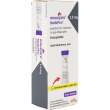

Routinely prescribed by the NHS and private pharmacies, Finasteride is a highly effective treatment for male pattern baldness (1). However, many people who take it share the same concern: what happens when you stop taking it? In this blog we will explore the reasons why some men choose to stop Finasteride treatment, what to expect if you do, and what your alternative options are.
In this article:
Why do some men stop taking Finasteride?
How long does Finasteride actually stay in your body?
What happens when you stop Finasteride?
Stopping Finasteride and Post Finasteride Syndrome
How to stop taking Finasteride
What happens if you accidentally just miss a dose of Finasteride?
Can you go back to using Finasteride after stopping?
Can you use an a different hair loss treatment after stopping Finasteride?
Why do some men stop taking Finasteride?
Everyone’s experience with Finasteride is different and there can be a range of reasons why you may choose to temporarily pause or permanently stop your treatment. Some of the most common reasons why men stop taking Finasteride include:
Struggling with side effects
Like all medications, Finasteride can cause a variety of different side effects. While Finasteride is mostly well-tolerated, it’s estimated that between 1% and 4% of men who take the medication experience sexual and mood-related side effects (2). The MHRA has issued advice stating that men who take Finasteride should remain vigilant, particularly for mental health related side effects (3). This follows a comprehensive review into the safety of 1mg oral Finasteride.
Other side effects that can occur include sexual dysfunction (erectile dysfunction), reduced libido, and fertility issues (3).
Uncommon side effects (affects up to 1 in 100 people) also include, breast tenderness and breast enlargement (gynaecomastia), depression and skin rash (2). Rare/very rare or reported with unknown frequency are testicular pain, hypersensitivity reactions (including lip swelling and facial swelling), male infertility and/or poor semen quality (reported to improve or normalise after stopping treatment in some cases) and palpitations (2).
Trying for a baby
While the link between Finasteride and fertility is still being studied, it is generally recommended that men stop taking Finasteride before trying to conceive. One of the reasons for this is because there is some evidence to suggest that using it may affect sperm count and semen volume (4). This could have an impact on your ability to conceive.
With limited studies into Finasteride during conception and pregnancy, it is best avoided. Find out more about why you must stop using Finasteride when trying to conceive.
Personal choice
If a condition is no longer having a significant impact on your quality of life, you may just decide that you no longer want to take medication. This is another common reason why some men stop taking Finasteride. Your body, your choice.
Whatever your reason for stopping Finasteride, your choice is completely valid. Your hair loss journal is personal, and so are the decisions that you make along the way.
How long does Finasteride actually stay in your body?
Finasteride has a relatively short elimination half-life* of 5 to 6 hours, though this can range from 3 to 16 hours depending on the individual, and may extend to around 8 hours in patients over 70 (2). This means the drug is cleared from the bloodstream fairly quickly – within roughly a day for most people (2).
However, as we've stated above, the biological effect of the medication can take significantly longer to stop than the drug itself takes to clear. This is because finasteride doesn't need to remain in the bloodstream to keep working and its effect on DHT suppression persists for a period afterwards. Levels of dihydrotestosterone (DHT) typically return to baseline within about 14 days of stopping treatment (2).
*Elimination half-life is the time it takes for the concentration of a drug in the bloodstream to fall by half, once absorption is complete and the drug is only being cleared (via metabolism and excretion).
What happens when you stop Finasteride
Finasteride only works while you are taking it. When you stop, the effects of the medicine will start to gradually wear off as any remaining Finasteride leaves your body. This also means that you can expect certain things to happen.
Your DHT levels will return to normal
Finasteride works by blocking the enzyme 5-alpha reductase, which is responsible for converting testosterone into dihydrotestosterone (DHT) – the hormone primarily responsible male pattern hair loss. While you're taking finasteride, this conversion is significantly suppressed: research has shown that finasteride reduces the amount of DHT in your bloodstream by around 70% (2).
Once you stop taking finasteride, that enzyme blockade is lifted and the conversion of testosterone to DHT resumes. Without finasteride blocking DHT, your levels will return to normal. This usually happens within about two weeks (2).
Hair shedding resumes
Hair grows and sheds in a biologically controlled cycle. This means that you probably will not notice hair shedding right away, but within a few months, it will become more obvious. Usually by 6 to 12 months after stopping Finasteride, most or all of the hair that was kept or regrown on Finasteride is lost (1). This means that your hair pattern will probably look as if you had never taken it (1).
Side effects begin to disappear
For most men, common side effects experienced while taking Finasteride tend to improve after they stop treatment, though the timeline varies from person to person — some patients report a quicker resolution than others.
Common reactions such as sexual dysfunction typically improve within weeks of stopping the medication for most men, and uncommon side effects such as breast tissue tenderness or swelling tend to resolve similarly once treatment ends (5). However, a subset of patients have reported sexual side effects that persist for many months or even years after stopping — in one study, a fifth of affected men reported symptoms continuing for six years or more (6).
Every patient is unique and may have a different experience with stopping Finasteride. If you have any concerns at any point, we strongly recommend that you speak to your prescriber or another licensed healthcare professional.
Stopping Finasteride and Post Finasteride Syndrome
Though rare, a small number of men develop a condition called Post Finasteride Syndrome (PFS) which are severe reactions to Finasteride treatment that continue causing problems for at least three months after stopping the medication, without another clear cause (7).
There is currently very little research into Post Finasteride Syndrome and exactly how common it is, or the longer-term impact of it, are clinically unsubstantiated. Find out more about what post-finasteride syndrome is and what current research says.
How to stop taking Finasteride
There are no official tapering (gradually reducing) guidelines for Finasteride, and most men can just stop taking their medication. However, it is generally advised to speak with your prescribing clinician before you do. This is to help ensure that you are making an informed decision about stopping Finasteride hair loss treatment, give you an opportunity to explore alternative hair loss therapies if that is something you are interested in, let you know what to expect and provide a chance for you to ask any questions that you may have.
Once you have stopped taking Finasteride, if you have any concerns at any point, even several months later, always speak to your prescriber or another healthcare professional.
What happens if I accidentally just miss a dose of Finasteride?
Life gets in the way sometimes, and it can be easy to forget a dose of your usual medication. If you miss a single dose of Finasteride, but are not intending stopping treatment permanently, do not worry. You can get back on track.
If it has been less than six hours since you usually take your Finasteride, take it as soon as you remember. You can then continue your treatment by taking your next tablet at the usual time.
If it has been more than six hours since your usual Finasteride dose, skip that dose and take your next tablet at the normal time. Do not double up (8).
Can you go back to using Finasteride after stopping?
If you have previously stopped Finasteride and want to restart your treatment, you will need to have a new consultation with a prescribing clinician first. This is to ensure that it is still a safe and effective treatment for hair loss for you. Health can change quite quickly, and your prescriber will want to be certain that there is no new information that they need to consider when deciding if Finasteride is the best hair loss therapy for you to take.
Can you use an a different hair loss treatment after stopping Finasteride?
If you decide to stop Finasteride but you still want to use a hair loss treatment, Minoxidil is a well-established alternative that is often used as a substitute or alongside other therapies (9).
Minoxidil works in a different way to Finasteride. Instead of lowering DHT levels, it prolongs the growth (agagen) phase of your hair cycle, and increases follicle size to encourage thicker hair (10).
A 2025 meta-analysis, directly comparing oral minoxidil with topical minoxidil solution in the treatment of androgenetic alopecia (11), no significant difference was found between the two routes of administration for either hair density or hair diameter, indicating broadly effectiveness. Oral minoxidil was, however, associated with a significantly higher frequency of abnormal hair growth in other parts of the body than the topical formulation. When comparing oral and topical minoxidil, the findings suggest that for patients choosing between the two options, the deciding factor is more likely to be tolerability and how you prefer to take medication, than any meaningful difference in hair growth outcomes (11).
However, this does not mean everyone will respond the same way, and oral minoxidil has different side-effects and monitoring needs compared with topical minoxidil, so it should only be used under a clinician’s supervision (11).
Some men who choose to stop taking Finasteride consider Dutasteride as an alternative treatment, although it works in the same way. You can read more about switching from Finasteride to Dutasteride in our blog.
If you would like more advice about stopping Finasteride, or you would like to see what alternative hair loss therapies are available, visit our Hair Loss Hub or start a consultation to see which treatment is suitable for you.
References
Kaufman KD, Olsen EA, Whiting D, Savin R, DeVillez R, Bergfeld W, et al. Finasteride in the treatment of men with androgenetic alopecia. Journal of the American Academy of Dermatology [Internet]. 1998 Oct 1 [Cited 2026 Aug 16];39(4):578–89. Available from: https://www.sciencedirect.com/science/article/abs/pii/S0190962298700076
Zito PM, Bistas KG, Syed K. Finasteride [Internet]. PubMed. Treasure Island (FL): StatPearls Publishing; 2021 [Cited 2026 Aug 16]. Available from: https://www.ncbi.nlm.nih.gov/books/NBK513329/
Men on finasteride asked to stay vigilant for possible psychiatric and sexual side effects [Internet]. GOV.UK. [Cited 2026 Aug 16]. Available from: https://www.gov.uk/government/news/men-on-finasteride-asked-to-stay-vigilant-for-possible-psychiatric-and-sexual-side-effects
Samplaski MK, Lo K, Grober E, Jarvi K. Finasteride use in the male infertility population: effects on semen and hormone parameters. Fertility and Sterility. 2013 Dec;100(6):1542–6. [Cited 2026 Aug 16]. Available from: https://pubmed.ncbi.nlm.nih.gov/24012200/
Mysore V. Finasteride and sexual side effects. Indian Dermatology Online Journal [Internet]. 2012 [Cited 2026 Aug 16];3(1):62. Available from: https://www.ncbi.nlm.nih.gov/pmc/articles/PMC3481923/?tool=pmcentrez&report=abstract
Irwig MS. Persistent Sexual Side Effects of Finasteride: Could They Be Permanent? The Journal of Sexual Medicine. 2012 Nov;9(11):2927–32. [Cited 2026 Aug 16]. Available from: https://pubmed.ncbi.nlm.nih.gov/22789024/
Leliefeld HHJ, Debruyne FMJ, Reisman Y. The post-finasteride syndrome: possible etiological mechanisms and symptoms. International journal of impotence research [Internet]. 2025 June [Cited 2026 Aug 16];37(6):414–21. Available from: https://pubmed.ncbi.nlm.nih.gov/37697052/
NHS. How and when to take finasteride [Internet]. nhs.uk. 2023 Aug [Cited 2026 Aug 16]. Available from: https://www.nhs.uk/medicines/finasteride/how-and-when-to-take-finasteride/
Mariana Alvares Penha, Hélio Amante Miot, Kasprzak M, Paulo Müller Ramos. Oral Minoxidil Vs Topical Minoxidil for Male Androgenetic Alopecia. JAMA dermatology. 2024 Apr 10;160(6). [Cited 2026 Aug 16]. Available from: https://jamanetwork.com/journals/jamadermatology/fullarticle/2817326
Chen S, Li L, Ding W, Zhu Y, Zhou N. Androgenetic Alopecia: An Update on Pathogenesis and Pharmacological Treatment. Drug Design, Development and Therapy [Internet]. 2025 Aug [Cited 2026 Aug 16]; Volume 19:7349–63. Available from: https://pmc.ncbi.nlm.nih.gov/articles/PMC12380480/
Sobral et al. Efficacy and safety of oral minoxidil versus topical solution in androgenetic alopecia: a meta-analysis of randomized clinical trials. Int J Dermatol. 2025. [Cited 2026 Aug 16]. Available from: https://pubmed.ncbi.nlm.nih.gov/39425514/