

Going Away? How To Prevent Malaria.



Explore our range of over-the-counter and prescription malaria medication, and compare pack sizes and medication types below.
Start your online consultation today.
To get up-to-date guidance for your specific destination, visit Travel Health Pro or speak to a member of our clinical team.
Malaria is a serious and potentially life-threatening infectious disease that is found in some parts of the world. It’s spread by certain types of mosquitos, and can take just one bite to become infected, meaning that it’s very difficult to protect yourself against it unless you actively take malaria prevention treatment. If you do become infected, urgent treatment is essential. (1)
If you’re travelling to an area where malaria is even a remote possibility, we strongly advise that you consider making sure that your travel vaccinations are up to date and getting anti-malaria tablets to help keep yourself safe.
Malaria is a disease spread by an infected female mosquito. When someone is bitten by this type of mosquito, parasites are passed into the bloodstream. These parasites travel to the liver, where they grow and multiply before returning to the blood and infecting red blood cells (1). Malaria cannot be spread directly from person to person like a cold, but it can be passed on through infected blood, such as in rare cases of blood transfusion or shared needles.
Malaria is very common in tropical regions of some parts of the world, including:
Large areas of Africa and Asia
Central and South America
Dominican Republic and Haiti
Parts of the Middle East
Some Pacific Islands
It’s important to be aware that risk and recommendations for the right antimalaria treatment vary by country. This means that you can’t assume that your previous anti-malarial treatment will be the right one for your next trip.
To get up-to-date guidance for your specific destination, visit Travel Health Pro or speak to a member of our clinical team.
Certain people are more at risk of getting malaria, and becoming seriously ill from the infection, than others. This includes:
People who are pregnant
Young children
Anyone over the age of 65
If you have a weak immune system
People without a spleen
If you identify with any of these categories, it’s especially important that you get advice on which anti-malaria medications you should take before you travel.
There are a wide range of anti-malaria tablet options available in the UK. However, before you can obtain most anti-malaria treatments, you’ll first need to have a conversation with a licensed pharmacist to ensure it’s a safe and suitable option for you. The exception to this is for Maloff Protect, which is available over the counter from most pharmacies without a prescription - but only if it’s suitable for your destination and health needs. This is something your pharmacist will check with you at the point of purchase.
It’s also important to note that malaria symptoms can occur for up to a year after you return from a high-risk area. For this reason, if you become unwell, it’s essential that you seek medical help and that you disclose your travel history to your doctor in full.
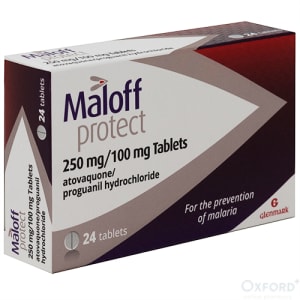
Maloff Protect is an over-the-counter treatment that contains the active ingredients Atovaquone and Proguanil 250mg/100mg which, until recently, were only available as a combination medication on prescription.
This medication works by stopping the malaria parasite from growing and multiplying inside your body. The dual action of the two active ingredients kills the parasite, preventing you from developing the disease.
For best protection, start taking one Maloff tablet daily at least 1-2 days before entering a Malaria-risk area. You should continue taking them every day while there, and for another 7 days after you leave.
Maloff protect is available from Oxford Online Pharmacy in 24 and 36 tablet boxes.
See the Maloff Patient Information Leaflet
Note: Maloff Protect should not be supplied without referral to a prescriber to people who are under 18, weigh less than 40kg, have known kidney or liver disease, have a history of depression or seizures, or are pregnant, planning pregnancy, or breastfeeding.
Atovaquone/Proguanil is only available on prescription in the UK, this anti-malaria treatment also contains the active ingredients Atovaquone and Proguanil 250mg/100mg.
They work in the same way as Maloff protect, preventing the parasite from developing and destroying it. These tablets are the unbranded version of Malarone anti-malaria tablets and are available in a 12-tablet pack.
See the Atovaquone and Proguanil Patient Information Leaflet
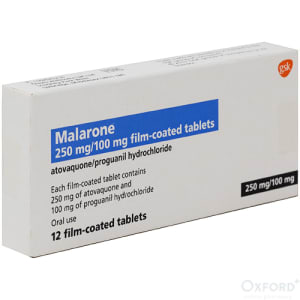
Malarone Adult is the branded version of Atovaquone and Proguanil 250mg/100mg, Malarone is also only available on prescription and is supplied in a 12-tablet pack.
See the Malarone Patient Information Leaflet
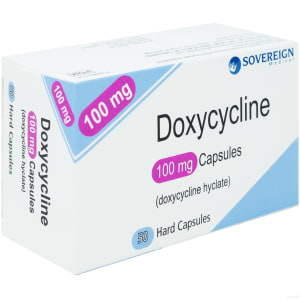
Doxycycline capsules are in a class of drugs called Tetracyclines, which are broad-spectrum antibiotics. It works in the same way as the other anti-malarial treatments we’ve listed. However, while you also start it several days before entering an area with malaria and continue while you are away, you will need to continue taking it for 4 weeks after you leave. (2)
See the Doxycycline Patient Information Leaflet
Feature | Maloff 24/36 | Atovaquone/Proguanil (generic) | Malarone 12 | Doxycycline 100mg |
|---|---|---|---|---|
Active ingredients | Atovaquone 250mg & Proguanil 100mg per tablet | Atovaquone 250mg & Proguanil 100mg per tablet | Atovaquone 250mg & Proguanil 100mg per tablet | Doxycycline 100mg |
Adult dose | 1 tablet daily | 1 tablet daily | 1 tablet daily | 1 tablet daily |
Dose timing | Start 1-2 days before travel, take during and continue for 7 days after returning home | Same as Maloff | Same as Maloff | Start 1-2 days before travel, take during and continue for 4 weeks after returning home |
Pack sizes commonly sold | 24 tablets (up to 2 weeks’ worth of travel) and 36 tablets (up to 3 weeks) | 12 tablet pack | 12 tablet pack | 50 capsule pack |
Typical side effects | Abdominal pain, nausea, vomiting, diarrhoea, headaches. Side effects usually mild and improve with food (3) | Same as Maloff | Same as Maloff | Nausea, abdominal pain, photosensitivity (sunburn-like rash), oesophageal irritation (2) |
Important note: No anti-malarial medicine is 100% effective, so it’s important to combine your tablets with other bite-prevention measures.
There are other steps you should also take alongside anti-malaria medications to help protect you against infection.
Use insect repellent liberally, making sure it is at least 50% DEET-based.
Sleep under mosquito nets treated with insecticide.
Wear long-sleeved clothing and trousers as much as possible, particularly in the evenings when mosquitos are most active.
NHS. Malaria [Internet]. NHS. NHS; 2022 [cited 2026 July 8]. Available from: https://www.nhs.uk/conditions/Malaria/
Tan KR, Magill AJ, Arguin PM, Parise ME. Doxycycline for Malaria Chemoprophylaxis and Treatment: Report from the CDC Expert Meeting on Malaria Chemoprophylaxis. The American Journal of Tropical Medicine and Hygiene [Internet]. 2011 Apr 5 [cited 2026 July 8];84(4):517–31. Available from: https://www.ncbi.nlm.nih.gov/pmc/articles/PMC3062442/
Medicines for the Prevention of Malaria While Traveling Atovaquone-Proguanil (MalaroneTM) [Internet]. [cited 2026 July 8]. Available from: https://www.cdc.gov/malaria/resources/pdf/fsp/drugs_2017/atovaquoneproguanil_2017.pdf
Symptoms of Malaria. Centers for Disease Control and Prevention. 2024. Available from:
Authored on August 13, 2026

Robert Bradshaw (Pharmacist) — MRPharms BSc(Hons) Pharmacy
Superintendent Pharmacist
GPhC Number: 2036118
GMC Number: 20399999
Reviewed on August 14, 2026

Not sure which treatment option is right for you? Fill out your details and an Oxford Online Pharmacy expert will get in touch.