

Female Hair Loss


-
 UK-registered clinical team
 -
Confidential & secure
-
No GP visit needed
-
Fast & discreet delivery

Science-backed hair loss treatments for women
1 in 2 women experience hair loss at some point in their lives (1), yet most hair loss solutions are made for men. We understand you probably feel alone and frustrated.
This is why our hair loss service treats every woman as an individual.
New to treatment with us? Start with the Oxford Female Hair Loss Programme. Hair loss can have different causes, so we begin with an at-home blood test and a clinical review. If treatment is suitable, we'll create a plan for you. If it isn't, we'll explain why and advise on your next steps.
GPhC-registered UK pharmacy · GMC-registered UK doctors · Trustpilot 4.7/5 from 33,000+ reviews


What causes hair loss in women?
Hair loss in women rarely has a single cause. It's usually a combination of genetics, hormones, and life events. These are the most common reasons experienced:
Genetic sensitivity to androgens (testosterone and DHT). Up to 50% of males and females are affected by this type of hair loss (2). It is caused by a genetic sensitivity to DHT, the hormone that causes this type of hair loss (2). It can be passed down from either parent, which is why a family history of thinning is a strong predictor of the condition (2).
Menopause and perimenopause. Around 50% of women notice female hair loss during menopause, as falling oestrogen shortens the growth phase of each hair (3). A 2022 clinical study of 178 postmenopausal women found a female pattern hair loss prevalence of 52.2%.
Stress, illness or sudden change. Major stress can cause female hair loss, as well as severe illness, surgery, crash dieting, or stopping the pill, which can all push more hairs than usual into the resting phase. It is a delayed onset reaction, meaning shedding typically happens 2–3 months after the life change or stressful event (4). Acute cases (under 6 months) usually resolve once the trigger is addressed (5). Rapid weight loss, including with GLP-1 medication like Mounjaro and Wegovy, can also cause hair loss (23).
Postpartum hair loss. A specific form of hair loss triggered by the hormonal shift after giving birth. Shedding usually peaks around 3-4 months postpartum and resolves on its own within 6-12 months (6).
PCOS. Polycystic ovary syndrome can cause hair thinning alongside acne, irregular periods and excess body hair, driven by elevated androgens (testosterone and DHT) (7).
Iron deficiency and low ferritin. Common in menstruating women, and a frequently missed cause. A blood test can rule this in or out and is worth doing before starting any treatment (8).
Thyroid disorders. Both under and overactive thyroid can cause diffuse hair loss across the whole scalp. Hair usually regrows once the thyroid is treated, though it can take several months (9).
Hairstyling. Wearing tight hairstyles regularly can also cause hair loss which is usually seen at the temples (10).
What are the different types of female hair loss?
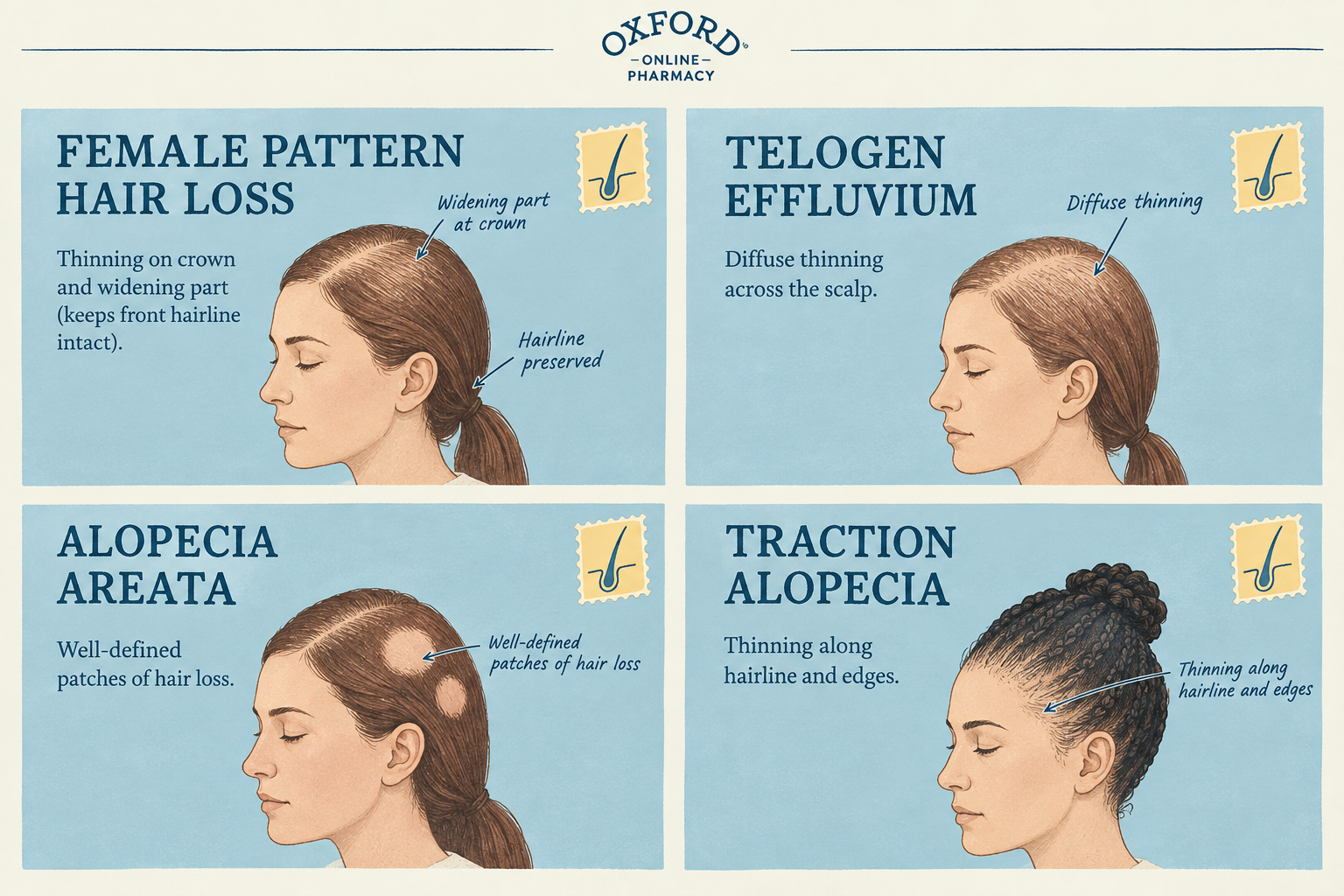
There are four common types of hair loss in women:
Female pattern hair loss:
This hair loss is characterised by a widening of your parting, whilst maintaining your hairline (12). Severity is graded on the three-stage Ludwig Scale: stage I begins with thinning on the crown, stage II shows visible scalp coming through, and by stage III extending across most of the crown of the scalp (13). Even at this advanced stage, a denser band of hair usually remains at the sides and back. Complete baldness is uncommon in female pattern hair loss.
Telogen Effluvium:
Instead of a widening at the parting, Telogen Effluvium causes an even shedding of hair across the scalp, rather than a localised pattern (14). This is noticeable by an overall drop in thickness and volume of the hair. Women tend to notice this as extra hair on their hairbrush, in the shower or plughole or on their pillow. This is typically caused by illness, childbirth, stress, crash dieting or stress and typically resolves itself in 6 months (14). Continued hair loss beyond 6 months is considered chronic telogen effluvium.
Alopecia Areata:
Alopecia areata is characterised by well-defined, coin-sized round patches of hair loss (15). It's an autoimmune condition, where the immune system mistakenly attacks the hair follicle and the skin within the bald patches usually looks normal, sometimes with short, broken hairs visible at the edges (16). In most cases it stays as one or a few patches, but it can progress to cover the whole scalp (alopecia totalis) or the entire body (alopecia universalis) (16). For this type of hair loss, it's not possible to predict how much hair will be lost or whether it will regrow (15).
Traction Alopecia:
Traction alopecia is caused by repeated pulling or tension on the hair (16). It typically follows the pattern of the hairstyle causing it. Tight ponytails, buns or headscarves tend to cause hair loss in the front of the head and temples in females, while tight braids, cornrows and dreadlocks often cause loss in the gaps between them – the risk increases further when combined with chemical treatments such as relaxers (16). Caught early, the hair usually regrows fully once the tight styling stops, if left, the repeated tension can permanently scar the follicle, at which point the hair loss becomes irreversible (16).
How much hair loss is normal for women?
Losing 50 to 100 hairs a day is often considered completely normal, it's part of the hair's natural growth cycle (11). It’s important to take notice when you experience: more shedding than usual, a widening parting, more hair in the shower than usual, patchy hair loss or a thinner ponytail.
It is also completely normal to go through stages of increased hair loss which can stop after a period of time (11), but it is always worth talking to a medical professional if you are worried.
Treatments for female hair loss
Hair growth products for women vary depending on the type of hair loss you are experiencing. Here are the treatments we offer and the evidence behind them.
Blood test
The causes of female hair loss are as unique as the individual. Because of this, it is really helpful to identify the cause to make sure you find the right treatment for you. This is why we offer our blood test service which measures a variety of markers like low ferritin, iron, vitamin D. Depending on your results, we may refer you to your GP to treat certain deficiencies or underlying conditions or if you are eligible, we can prescribe you hair loss treatment. All customers starting our oral hair loss treatment will need to complete a blood test.
Minoxidil
Regaine for Women (topical Mindoxidil) is currently licensed in the UK specifically for female pattern hair loss in women aged 18–65. Applied directly to the scalp once or twice daily, it works by extending the growth phase of the hair cycle and improving blood flow to the follicles. Studies of low dose oral minoxidil also show increasing evidence of minoxidil tablets for female hair loss (18), however this is prescribed ‘off-label’ meaning it is prescribed for a different condition than what it is licensed for.
Supplements and nutritional support
If your hair loss is linked to iron deficiency, low vitamin D, or general nutritional shortfall, addressing the underlying gap can make a real difference. Female hair loss vitamins, biotin for female hair loss and supplements like Florisene for Women or Viviscal, aren't a cure for genetic hair loss, but they can support healthier hair growth when used alongside clinical treatment.
What about Finasteride for women?
Finasteride is sometimes mentioned in connection with women's hair loss, but isn’t straightforward. Currently, Finasteride is not licensed for women in the UK and is not suitable for women who could become pregnant, because it can cause serious harm to a developing baby (19). If you've read about Finasteride and wondered whether it’s right for you, our clinical team can talk you through safer, licensed alternatives during your assessment.
How to prevent hair loss
Genetics and hormones play a huge role and are often not something you can totally control. But you can slow the progression and protect the hair you have if you:
Start treatment early. Minoxidil works best on hair follicles that are still active. It can’t bring back the follicles that are already lost. The earlier you act, the more you keep.
Be gentle with your hair. Avoid tight ponytails, braids and extensions that pull on the hairline. Avoid heat as much as possible and avoid harsh chemical treatments.
Look after the underlying causes. If you suspect iron deficiency, thyroid issues, or PCOS, a blood test will help identify these causes. Treating the root cause is the most effective way to treat the symptom.
Eat well and sleep well. Hair is one of the first things to suffer when your body is under stress or nutritionally deficient.
Manage stress where you can. You can't always avoid them, try your best to avoid common stressors and rest regularly.
References
Piraccini BM, Alessandrini A. Androgenetic alopecia. G Ital Dermatol Venereol. 2014;149(1):15–24. PMID: 24566563. Available from: https://pubmed.ncbi.nlm.nih.gov/24566563/
Ho CH, Sood T, Zito PM. Androgenetic alopecia. In: StatPearls [Internet]. Treasure Island (FL): StatPearls Publishing; 2024 Jan [updated 2024 Jan 7]. Available from: https://www.ncbi.nlm.nih.gov/books/NBK430924/
Chaikittisilpa S, Rattanasirisin N, Panchaprateep R, Orprayoon N, Phutrakul P, Suwan A, et al. Prevalence of female pattern hair loss in postmenopausal women: a cross-sectional study. Menopause. 2022;29(4):415-420. doi:10.1097/GME.0000000000001927. Available from: https://pubmed.ncbi.nlm.nih.gov/35357365/
Malkud S. Telogen effluvium. In: StatPearls [Internet]. Treasure Island (FL): StatPearls Publishing; 2024. Available from: https://www.ncbi.nlm.nih.gov/books/NBK430848/
International Society of Hair Restoration Surgery. Telogen effluvium: a guide to temporary hair loss [Internet]. [cited 2026 Sep 16]. Available from: https://ishrs.org/telogen-effluvium/
Hirose A, Terauchi M, Odai T, Fudono A, Tsurane K, Sekiguchi M, et al. Investigation of exacerbating factors for postpartum hair loss: a questionnaire-based cross-sectional study. Int J Womens Dermatol. 2023;9(2):e084. doi:10.1097/JW9.0000000000000084. Available from: https://pubmed.ncbi.nlm.nih.gov/38323220/
National Health Service. Polycystic ovary syndrome (PCOS) [Internet]. London: NHS; [cited 2026 Sep 16]. Available from: https://www.nhs.uk/conditions/polycystic-ovary-syndrome-pcos/
Olsen EA, Reed KB, Cacchio PB, Caudill L. Iron deficiency in female pattern hair loss, chronic telogen effluvium, and control groups. J Am Acad Dermatol. 2010;63(6):991-999. doi:10.1016/j.jaad.2009.12.006. Available from: https://pubmed.ncbi.nlm.nih.gov/20947203/
Popa A, Carsote M, Cretoiu D, Dumitrascu MC, Nistor CE, Sandru F. Study of the thyroid profile of patients with alopecia. J Clin Med. 2023;12(3):1115. doi:10.3390/jcm12031115. Available from: https://pmc.ncbi.nlm.nih.gov/articles/PMC9918246/
British Association of Dermatologists. Traction alopecia [Internet]. Patient information leaflet. London: BAD; 2019 Feb [reviewed 2024 Oct]. Available from: https://cdn.bad.org.uk/uploads/2021/12/29200250/Traction-Alopecia-February-2019-Lay-reviewed-February-2019-1.pdf
National Health Service. Hair loss [Internet]. London: NHS; [cited 2026 Sep 16]. Available from: https://www.nhs.uk/symptoms/hair-loss/
British Association of Dermatologists, British Hair and Nail Society. Hair loss – female pattern (androgenetic alopecia) [Internet]. London: British Association of Dermatologists; 2024 [cited 2026 Sep 16]. Available from: https://www.bad.org.uk/pils/hair-loss-female-pattern-androgenetic-alopecia
Ludwig E. Classification of the types of androgenetic alopecia (common baldness) occurring in the female sex. Br J Dermatol. 1977;97(3):247–254. Available from: https://pubmed.ncbi.nlm.nih.gov/921894/
British Association of Dermatologists. Telogen effluvium [Internet]. London: British Association of Dermatologists; 2025 [cited 2026 Sep 16]. Available from: https://www.skinhealthinfo.org.uk/condition/telogen-effluvium/
British Association of Dermatologists. Alopecia areata [Internet]. London: British Association of Dermatologists; 2024 [cited 2026 Sep 16]. Available from: https://www.bad.org.uk/pils/alopecia-areata
British Association of Dermatologists. Alopecia areata living guideline for managing people with alopecia areata 2024. Br J Dermatol. 2025;192(2):190–225. Available from: https://pubmed.ncbi.nlm.nih.gov/39432739/
British Association of Dermatologists. Traction alopecia [Internet]. London: British Association of Dermatologists; 2019 [cited 2026 Sep 16]. Available from: https://www.skinhealthinfo.org.uk/wp-content/uploads/2019/03/Traction-alopecia-PIL-Feb-2019.pdf
Rodrigues-Barata R, Moreno-Arrones OM, Saceda-Corralo D, et al. Low-dose oral minoxidil for female pattern hair loss: a unicenter descriptive study of 148 women. Skin Appendage Disord. 2020;6(3):175–176. doi:10.1159/000505820. Available from: https://pubmed.ncbi.nlm.nih.gov/32656239/
electronic Medicines Compendium. Finasteride 1mg tablets: summary of product characteristics [Internet]. Datapharm; 2024 [cited 2026 Sep 16]. Available from: https://www.medicines.org.uk/emc/product/7068/smpc
Ramírez-Marín HA, Tosti A. Role of oral minoxidil in patterned hair loss. Indian Dermatol Online J. 2022;13(6):729–733. doi:10.4103/idoj.idoj_246_22. Available from: https://pubmed.ncbi.nlm.nih.gov/36386734/
Messenger AG, Rundegren J. Minoxidil: mechanisms of action on hair growth. Br J Dermatol. 2004;150(2):186–194. doi:10.1111/j.1365-2133.2004.05785.x. Available from: https://pubmed.ncbi.nlm.nih.gov/14996087/
electronic Medicines Compendium. Regaine for Women Regular Strength: summary of product characteristics [Internet]. McNeil Products Ltd; 2024 [cited 2026 Sep 16]. Available from: https://www.medicines.org.uk/emc/product/102/smpc
Gupta AK, Teasell EM, Economopoulos V, Mirmirani P. GLP-1 therapies and hair loss: a systematic review of current evidence and implications for counseling. Sci Prog. 2026;109(2):00368504261444578. doi:10.1177/00368504261444578. Available from: https://pmc.ncbi.nlm.nih.gov/articles/PMC13100445/
Electronic Medicines Compendium. Regaine for Women Once a Day Scalp Foam 5% w/w cutaneous foam: summary of product characteristics [Internet]. McNeil Products Ltd; [year] [cited 2026 Sep 24]. Available from: https://www.medicines.org.uk/emc/product/5082/smpc
Almohanna HM, Ahmed AA, Tsatalis JP, Tosti A. The role of vitamins and minerals in hair loss: a review. Dermatol Ther (Heidelb). 2019;9(1):51–70. doi:10.1007/s13555-018-0278-6. Available from: https://pubmed.ncbi.nlm.nih.gov/30547302/
-
There's no single best product for female hair loss, because the right choice depends on what's causing it. For female pattern hair loss, minoxidil scalp treatments are a well-established option.(12,22,24) Supplements may help if you're low in certain nutrients,(25) and shampoos can support a healthy scalp alongside treatment.
Not sure where to start? Our Female Hair Loss Service begins with an online consultation and blood test to check whether our treatment is suitable for you, or whether you'd be better supported by your GP.
-
Yes. Minoxidil scalp treatments are licensed for female pattern hair loss, as a 2% solution or a 5% once-daily foam.(22,24) They can help slow hair loss and, for some women, help hair grow back.(22,24)
It can take 12 to 24 weeks of daily use before you see results, and you'll need to keep using it to maintain them.(24) Minoxidil should be avoided if you're pregnant, planning a pregnancy or breastfeeding.(12)
-
Vitamins and minerals may help if your hair loss is linked to a deficiency. Low iron, vitamin D and zinc have all been linked with hair loss.(8,25) There's little evidence that supplements help if your levels are already normal, and taking too much of some nutrients can even cause hair loss.(25)
If you're worried you might be low in something, speak to your GP, who can check your levels with a blood test.
-
Yes. Shampoos can help keep your scalp clean and healthy. But there's limited evidence that shampoo alone can regrow hair or treat female pattern hair loss. Because shampoo is rinsed off quickly, it works best as part of a wider routine alongside a licensed treatment such as minoxidil.
Authored on September 22, 2026

Robert Bradshaw (Pharmacist) — MRPharms BSc(Hons) Pharmacy
Superintendent Pharmacist
GPhC Number: 2036118
GMC Number: 20399999
Reviewed on September 24, 2026

Not sure which treatment option is right for you? Fill out your details and an Oxford Online Pharmacy expert will get in touch.