

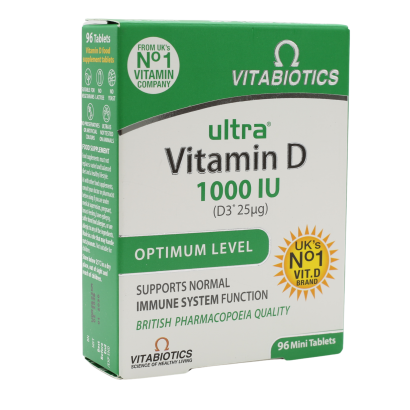
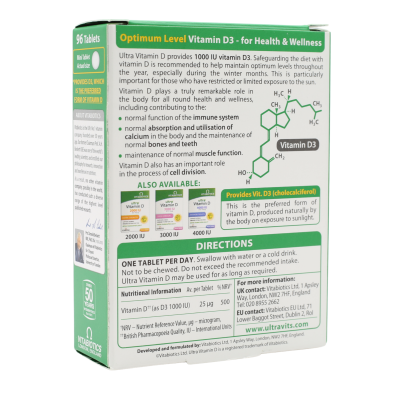
Vitabiotics Ultra Vitamin D 1000IU
Vitabiotics Ultra Vitamin D 1000IU Product information
£9.99 (£0.00 per )
Buy Vitabiotics Ultra Vitamin D
Vitamin D is an important nutrient for many body functions, including calcium absorption, keeping bones, teeth and muscles healthy, and supporting your immune system.
Low vitamin D levels have been linked to hair shedding and autoimmune hair loss, and supplements are sometimes recommended as part of a wider hair loss treatment plan.
One daily tablet can help regulate vitamin D levels in those with an identified deficiency.
Product Information for Vitabiotics Ultra Vitamin D 1000IU
What is Vitamin D?
Vitamin D is a nutrient with a dual function as both a vitamin and a hormone. It occurs naturally in your body when your skin is exposed to sunlight, but this means that people who live in countries with limited sunlight (higher latitudes, long winters or cloudy climate conditions) are more likely to have low Vitamin D. (1) You can also get vitamin D through food sources such as oily fish and egg yolks, or by eating fortified cereals, milks, yoghurts and spreads. (2)
It plays several important roles in your body. (2)
It helps you to absorb calcium and phosphates, which are essential for bone strengthening and growth.
It supports healthy teeth, bone and muscle.
It boosts your immune system to protect you against disease, while also calming excessive internal inflammation (3)
Why has Vitamin D been included in my hair loss treatment?
Vitamin D receptors are found in the hair follicle, where they help control the normal cycle of hair growth, resting, and shedding through Vitamin D receptor (VDR) signalling. When vitamin D levels are low, this signalling can be disrupted. This precisely identifies the mechanism by which vitamin D influences the hair follicle cycle (4)
Studies show that low vitamin D is common in women with telogen effluvium (temporarily increased shedding) and female pattern hair loss, and levels are also frequently low in alopecia areata (patchy hair loss). (4,5)
If you are deficient, correcting vitamin D levels could remove one possible contributor to increased daily hair shedding. This should be checked with a blood test rather than assumed, which is something that your doctor can arrange for you.
When will I see results from taking Vitamin D?
It’s important to understand that vitamin D supplements alone will not regrow lost hair. Instead, it should form part of a wider hair loss treatment plan where it works alongside other supplements (if appropriate) and direct hair loss therapies, such as Minoxidil tablets or topical minoxidil scalp solution.
Hair regrowth is also a biological process that can only occur at a rate that is in keeping with your natural hair growth cycle. This means that you shouldn’t expect any visible improvement in your hair for at least 3 to 4 months. It’s also very normal to experience increased shedding during the first few weeks of treatment, when hair that is sitting in dead follicles becomes loose and falls out, ready to be replaced. (6)
Vitabiotics Ultra Vitamin D 1000IU reviews
How to use Vitabiotics Ultra Vitamin D 1000IU
Take one vitamin D tablet daily with water. If you can, take it alongside food containing fat as this will help it be absorbed by your body. (7)
Never exceed the recommended daily amount. Long term excess of vitamin D can cause hypercalcaemia which can result in symptoms including nausea, vomiting, excessive thirst, weakness and confusion. (8)
Medicines and conditions that interact with Vitamin D
Although you don’t need a prescription to buy vitamin D, we strongly recommend that you ensure your suitability for supplementation before you begin treatment, even with a blood test confirming your deficiency. This is because Vitamin D supplements aren’t safe or suitable for everyone. (9)
Do not start vitamin D supplements without speaking to your GP or pharmacist if you:
Have high calcium levels or a history of kidney stones
Have severe kidney disease or are on dialysis
Have primary hyperparathyroidism
Have sarcoidosis, tuberculosis, or other granulomatous diseases
Have certain cancers that can cause high calcium (including some lymphomas, multiple myeloma etc)
Are already taking prescription vitamin D or medication containing vitamin D (some osteoporosis and kidney treatments)
Are undergoing specialist for renal, endocrine or oncology and have been told to avoid extra vitamin D
Medicines that can interact with vitamin D (which may mean that you require extra monitoring, dose adjustment or special consideration) include:
Thiazide diuretics
Digoxin and other cardiac glycosides
Calcium channel blockers
Corticosteroids
Anti-seizure medications
Cholesterol-lowering bile acid sequestrants
Weight loss/fat-blocking medicines
Rifampicin and other enzyme-inducing drugs
Medicines to treat fungal infections, such as ketoconazole
Long-term laxative use
Medicines containing aluminium
Topical vitamin D creams
Always speak to your doctor or pharmacist if you are taking any of these medications, or if you have any other concerns about taking vitamin D supplements. Always disclose your full health history. (9)
Storing your medicine
Keep this medicine out of the sight and reach of children.
Store below 25ºC.
Store in the original package to protect from light and moisture.
Do not use this medicine after the expiry date which is stated on the label after EXP. The expiry date refers to the last day of that month.
Do not throw away any medicines via wastewater or household waste. Ask your pharmacist how to throw away medicines you no longer use. These measures will help protect the environment.
Side effects of Vitabiotics Ultra Vitamin D 1000IU
For most people, taking the recommended amount of vitamin D is safe and does not cause side effects. However, there are some issues that can arise if you have too much vitamin D in your body, or if you have certain medical conditions. These include:
Stomach pain
Nausea and/or vomiting
Constipation or diarrhoea
Loss of appetite
Metallic taste in your mouth
If you notice these side effects, stop the supplement and speak to your GP or pharmacist.
Note for women of child-bearing age, and those pregnant or breastfeeding
Taken at the recommended dose, vitamin D supplements are actively recommended during pregnancy. (10)
Please note that there may be other medications or supplements that form part of your hair loss treatment plan that may need to be stopped during pregnancy/breastfeeding.
-
Studies show that low vitamin D is common in women with telogen effluvium (temporary increased shedding) and female pattern hair loss, and levels are also frequently low in alopecia areata (patchy hair loss). If a blood test confirms your vitamin D levels are insufficient, correcting them could remove one possible contributor to increased daily hair shedding. (4/5)
-
Vitamin D supplements alone will not regrow lost hair. Instead, it should form part of a wider hair loss treatment plan where it works alongside other supplements and medications to help boost your natural hair growth cycle and counteract shedding. (6)
-
Vitamin D insufficiency doesn’t make hair fall out directly. Instead, it disrupts the normal hair follicle cycle and weakens the cells that build hair, so more hairs shift into shedding and grow back more slowly and thinly. (4)
-
Hair regrowth is a biological process that can only happen at the same rate of your natural hair growth cycle. This means that you shouldn’t expect any visible improvement in your hair for at least 3 to 4 months. (6)
-
Take one tablet each day, with water. It can help to take it with a food that contains fat as this helps it to be properly absorbed by your body. (7)
-
If you miss a dose of vitamin D and remember the same day, take it then. If it’s almost time for your next dose, skip the missed one and take your next dose at the usual time. Don’t take two doses together to try and catch up. (2)
-
It depends on what other medicines you take. You should check the Patient Information Leaflet or consult with your doctor to check for any potential interactions before you start taking vitamin D supplements.
-
Even with a good diet it can be hard to reach optimal levels of Vitamin D from food alone, especially if you have limited sun exposure. However, the only way to tell if you’re actually deficient and would benefit from supplements is by having a blood test.
-
Vitabiotics Ultra Vitamin D 1000IU tablets are vegetarian (but not vegan) friendly. They contain gluten, but not lactose. (11)
-
No, Ultra Vitamin D 1000IU is available over the counter. However, you may need to have a check with our pharmacists to make sure it’s safe and suitable for you to take. You can contact them via our website.
Important - Before taking any medication, it is always important to read the Patient Information Leaflet (PIL)
Vitabiotics Ultra Vitamin D 1000IU - Patient Information Leaflet
Sofia Lizarralde Oliver, Keila, Ribeiro H. The Effect of Sunlight Exposure on Vitamin D Status in Countries of Low and High Latitudes: A Systematic Literature Review. Current Nutrition Reports. 2022 Dec 16;12(1):1–13. Accessed July 2026. Available from: https://pubmed.ncbi.nlm.nih.gov/36522570/
NHS. Vitamin D - Vitamins and Minerals [Internet]. NHS. 2020 [cited 2026 July 10]. Available from: https://www.nhs.uk/conditions/vitamins-and-minerals/vitamin-d/
Aranow C. Vitamin D and the Immune System. Journal of investigative medicine : the official publication of the American Federation for Clinical Research [Internet]. 2011 Aug [cited 2026 July 10];59(6):881. Available from: https://www.ncbi.nlm.nih.gov/pmc/articles/PMC3166406/
Guan L, Yang F, Li M, Chen Y, Zhao Z, Li H, et al. The role of vitamin D receptor signaling in hair follicle health and alopecia: Current understanding and therapeutic implications. Journal of Cell Communication and Signaling [Internet]. 2025 Dec 29 [cited 2026 July 10];20(1). Available from: https://pmc.ncbi.nlm.nih.gov/articles/PMC12747802/
Rasheed H, Mahgoub D, Hegazy R, El-Komy M, Abdel Hay R, Hamid MA, et al. Serum Ferritin and Vitamin D in Female Hair Loss: Do They Play a Role? Skin Pharmacology and Physiology. 2013;26(2):101–7. Accessed July 2026. Available from: https://pubmed.ncbi.nlm.nih.gov/23428658/
Natarelli N, Gahoonia N, Sivamani RK. Integrative and Mechanistic Approach to the Hair Growth Cycle and Hair Loss. Journal of Clinical Medicine. 2023 Jan 23;12(3):893. Accessed July 2026. Available from: https://pmc.ncbi.nlm.nih.gov/articles/PMC9917549/
Dawson-Hughes B, Harris SS, Lichtenstein AH, Dolnikowski G, Palermo NJ, Rasmussen H. Dietary fat increases vitamin D-3 absorption. Journal of the Academy of Nutrition and Dietetics [Internet]. 2015 [cited 2026 July 10];115(2):225–30. Available from: https://www.ncbi.nlm.nih.gov/pubmed/25441954/
Alkundi A, Momoh R, Musa A, Nwafor N. Vitamin D intoxication and severe hypercalcaemia complicating nutritional supplements misuse. BMJ Case Reports. 2022 June;15(7):e250553. Available from: https://pubmed.ncbi.nlm.nih.gov/35793850/
Package leaflet: Information for the Patient Colecalciferol 1 000 IU Capsules Colecalciferol [Internet]. [cited 2026 July 10]. Available from: https://www.medicines.org.uk/emc/files/pil.7247.pdf
NHS. Pregnancy, breastfeeding and fertility while taking colecalciferol [Internet]. nhs.uk. 2023 [cited 2026 July 10]. Available from: https://www.nhs.uk/medicines/colecalciferol/pregnancy-breastfeeding-and-fertility-while-taking-colecalciferol/
Ultra Vitamin D 1000IU [Internet]. Vitabiotics. 2026 [cited 2026 July 10]. Available from: https://www.vitabiotics.com/products/ultra-vitamin-d-1000iu-96-tablets?srsltid=afmbooqvtbxhx2orp-shncjtmv67hxaoucl9xengoi3fvvj276vkaxsc
- Save on Your Treatment This January
- How blood affects erections: the science behind erectile dysfunction
- Why do ED medicines work for some people but not others?
- How do GLP-1 side effects compare between treatments?
- What is the Black Market for Prescription Medication?
- What is GLP-1, and what does it have to do with weight?
- What does Mounjaro do in the body?
- Oral semaglutide for Alzheimer’s: What the EVOKE trial results tell us
- What you need to know about Wegovy 7.2mg
- What is Finasteride and how does it work for hair loss?
Authored on September 22, 2026

Robert Bradshaw (Pharmacist) — MRPharms BSc(Hons) Pharmacy
Superintendent Pharmacist
GPhC Number: 2036118
GMC Number: 20399999
Reviewed on September 24, 2026
