


Vitamin D at Home Blood Test
Vitamin D at Home Blood Test Product information
£41.99
Test your Vitamin D levels at home
Vitamin D can affect hair health and contribute to hair loss. As part of our female hair loss treatment service, you may have been recommended to take vitamin D supplementation. You may wish to check your ongoing vitamin D levels following this. We may also request a test of your Vitamin D levels if your levels were low when you started your hair loss treatment with us.
Simple finger-prick blood test you can take at home
Checks your current vitamin D levels
Laboratory testing by The Doctors Laboratory (TDL)
Pre-paid return packaging included
Results sent directly to Oxford Online Pharmacy
Reviewed by our clinical team as part of your female hair loss treatment
Product Information for Vitamin D at Home Blood Test
What is the vitamin D at home blood test?
The Vitamin D Blood Test is a test that checks how much vitamin D you have in your body using a small finger-prick blood sample collected at home.
Your result is sent directly to Oxford Online Pharmacy, where our clinical team identifies whether your vitamin D levels are healthy, low or deficient. This helps them advise on whether vitamin D supplementation is required to continue.
Treating vitamin D insufficiency is not a standalone hair loss treatment, but correcting low levels can help support healthy hair growth. We’ll review your results alongside your ongoing female hair loss treatment to decide on the best pathway for you.
What does the vitamin D home blood test involve?
The test is completed in three stages, from collecting your sample to hearing back from our team.
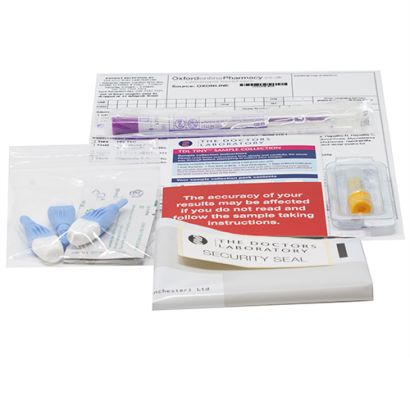
Collect your sample. We’ll send you a TDL TINY self-collection kit containing everything you need to take your blood sample at home. Use the lancet provided to prick the side of your little finger and collect blood in the tube, following the instructions included with your kit.
Send it for analysis. Once you’ve collected enough blood, label and package your sample and return it to The Doctors Laboratory (TDL) using the pre-paid packaging provided. TDL will process your sample in its laboratory and measure your vitamin D level.
Get your results. Your results are sent directly to Oxford Online Pharmacy, you will also get an email with your results. Our clinical team will review your vitamin D level and contact you to explain your result and any next steps.
What does the vitamin D blood test measure?
The test measures the amount of 25-hydroxyvitamin D (25-OH vitamin D) in your blood (1). This is the form of vitamin D usually measured when assessing your levels.
Your result will show whether your levels are:
Healthy: 50 to 125 nmol/L (2,3)
Low: 25 to 49 nmol/L (2)
Deficient less than 25 nmol/L (2)
These ranges help us decide whether vitamin D supplements may be appropriate as part of your treatment plan. If you have already been taking vitamin D following a previous low result, the test can also be used to see how your levels have changed.
How long will it take to get my results?
TDL usually analyses the Vitamin D sample within one day of receiving it (1). But you will also need to allow time for your sample to reach the laboratory and for the result to be returned to and reviewed by our clinical team. We'll contact you as soon as your result has been reviewed.
Why is vitamin D checked during female hair loss treatment?
Vitamin D plays a role in keeping your hair follicles healthy and helping regulate the normal hair growth cycle (4). Several studies have also found a connection between low vitamin D levels and certain types of hair loss in women, such as female pattern hair loss and telogen effluvium (5,6).
Our initial blood test included in the Oxford Female Hair Loss Programme tests your vitamin D levels alongside Ferritin, TSH, Free T4, B12 and Folate to assess whether it is safe for us to treat you. This test may be necessary to re-test your vitamin D levels after supplementation, or if you simply would like to test your own levels at home.
Low vitamin D is one of several factors that can contribute to hair shedding or thinning. Correcting a deficiency won't necessarily treat hair loss on its own, but it means we can rule out or address one possible cause as part of your wider treatment plan.
Vitamin D at Home Blood Test reviews
How to use Vitamin D at Home Blood Test
What’s included in the kit?
Your TDL TINY Self-Collection Vitamin D Home Blood Test kit contains everything you need to collect and return your sample, including:
Finger-prick lancets
Blood collection tube
Alcohol wipes
Plaster
Sample label
Protective packaging wallet
Laboratory request form
Pre-paid return packaging
Full collection instructions are included with your kit. Read these carefully before you begin.
Step-by-step: How to use the home blood test
Always follow the instructions that come with your kit. As a general guide:
Get everything ready. Read the instructions and lay out everything you need before starting.
Warm your hands. Wash your hands in warm water and dry them thoroughly. Warm hands improve blood flow and can make it easier to collect enough blood.
Prick your finger. Use the lancet to prick the side of your little finger as shown in the instructions. Gently massage the finger up from base to tip to encourage blood flow.
Collect the blood sample. Wipe the first drop of blood away, then allow drops of blood to fall into the collection tube until they reach the fill line.
Close and label the tube. Secure the lid and add your details to the sample label. Samples without a label cannot be analysed and you will have to repeat the test (7).
Complete the request form. Make sure all sections have been completed before putting the sample and paperwork into the pre-paid postal packaging provided.
Post it to TDL. Return your sample by posting it in any UK postbox.
Follow the instructions supplied with your kit rather than relying on this overview alone. You can also find the instructions here on YouTube if you prefer video format.
How much blood do I need to collect?
For a successful test result, you need to collect around 400 to 600 microlitres of blood in the sample tube. You don’t need to measure this yourself. The tube is marked with a fill line. Simply keep collecting droplets of blood until it reaches this line.
You must collect enough blood as the laboratory needs a big enough sample to carry out the test.
What happens if I can’t collect enough blood?
If you’re struggling to collect enough blood, the tips below may help improve blood flow:
Drink plenty of water before taking your sample
Make sure your hands are warm—try washing them in warm water before starting
Let your arm hang down before collecting the sample
Take your sample while standing up rather than sitting
Prick your finger on the side rather than the top or pad
Gently massage from the base of the finger to the tip
Avoid squeezing the very tip of your finger repeatedly to get blood to flow. Full instructions on the correct technique are in the physical instructions that come with your kit.
How do I return my blood sample?
Place your labelled sample and the completed request form into the return packaging that comes with your kit. Postage is prepaid and the laboratory address already printed, so you can simply drop the return packaging into your nearest postbox.
Post your sample on the same day you collect it. Avoid taking your sample and posting it right before a weekend or bank holiday, as this can prolong the time it takes to reach the lab.
Full instructions are provided with your kit. Read them carefully before returning your sample.
What happens after I post my sample?
Your sample will be delivered to The Doctors Laboratory (TDL). This is where it will be processed and the levels of 25-OH vitamin D will be measured.
Once testing is complete, TDL sends your result directly back to us at Oxford Online Pharmacy rather than to you. Our pharmacists will add the result to your patient record, and they will be reviewed.
We will then contact you to explain your results and what it means for your treatment plan.
What if my vitamin D level continues to be low?
If your vitamin D level is below the healthy range, it may be contributing to your hair loss and needs correcting. Our clinical team will look at how low it is and decide on the best way to do this.
If your vitamin D level is insufficient (25–49 nmol/L), you should continue to take a standard vitamin D supplement such as Vitabiotics Ultra Vitamin D.
If you have a vitamin D deficiency (less than 25 nmol/L), a short course of higher-dose vitamin D may be needed before moving to a daily supplement (8). This must be discussed with your GP as Oxford Online Pharmacy will not treat very low vitamin D levels.
What if my vitamin D level is normal?
If your results come back as normal, you do not need treatment to correct your vitamin D levels.
If this is a repeat test after treatment for low vitamin D, a normal result shows that your vitamin D levels have improved into the healthy range.
Important - Before taking any medication, it is always important to read the Patient Information Leaflet (PIL)
Vitamin D (25-OH) | The Doctors Laboratory [Internet]. Tdlpathology.com. 2025 [cited 2026 Aug 8]. Available from: https://www.tdlpathology.com/tests/tests-a-z/tests-V/vitamin-d-25-oh/
National Institute for Health and Care Excellence. Vitamin D deficiency in adults: diagnosis [Internet]. Clinical Knowledge Summaries. London: NICE; [cited 2026 Sep 30]. Available from: https://cks.nice.org.uk/topics/vitamin-d-deficiency-in-adults/
Ross AC, Manson JE, Abrams SA, Aloia JF, Brannon PM, Clinton SK, et al. The 2011 report on dietary reference intakes for calcium and vitamin D from the Institute of Medicine: what clinicians need to know. The Journal of Clinical Endocrinology & Metabolism [Internet]. 2011 Jan [cited 2026 Sep 30];96(1):53–8. Available from: https://pmc.ncbi.nlm.nih.gov/articles/PMC3046611/
Guan L, Yang F, Li M, Chen Y, Zhao Z, Li H, et al. The role of vitamin D receptor signaling in hair follicle health and alopecia: Current understanding and therapeutic implications. Journal of Cell Communication and Signaling [Internet]. 2025 Dec 29 [cited 2026 Aug 8];20(1). Available from: https://pmc.ncbi.nlm.nih.gov/articles/PMC12747802/
Saini K, Mysore V. Role of vitamin D in hair loss: A short review. Journal of Cosmetic Dermatology. 2021 Sept 22;20(11):3407–14. Available from: https://pubmed.ncbi.nlm.nih.gov/34553483/
Nahidi Y, Banihashemi M, Meibodi N, Jarahi L, Dolatkhah M. Serum vitamin D3 level in patients with female pattern hair loss. International Journal of Trichology [Internet]. 2016 [cited 2026 Aug 8];8(3):116. Available from: https://www.ncbi.nlm.nih.gov/pmc/articles/PMC5007917/
The Doctors Laboratory. Specimen rejection criteria | The Doctors Laboratory [Internet]. www.tdlpathology.com. 2024 [cited 2026 Aug 8]. Available from: https://www.tdlpathology.com/tests/specimens/specimen-rejection-criteria/
NHS. Colecalciferol: medicine to treat vitamin D deficiency [Internet]. nhs.uk. 2023 Jan [cited 2026 Aug 7]. Available from: https://www.nhs.uk/medicines/colecalciferol/
- Save on Your Treatment This January
- How blood affects erections: the science behind erectile dysfunction
- Why do ED medicines work for some people but not others?
- How do GLP-1 side effects compare between treatments?
- What is the Black Market for Prescription Medication?
- What is GLP-1, and what does it have to do with weight?
- What does Mounjaro do in the body?
- Oral semaglutide for Alzheimer’s: What the EVOKE trial results tell us
- What you need to know about Wegovy 7.2mg
- What is Finasteride and how does it work for hair loss?
Authored on October 8, 2026

Robert Bradshaw (Pharmacist) — MRPharms BSc(Hons) Pharmacy
Superintendent Pharmacist
GPhC Number: 2036118
Reviewed on October 9, 2026
