

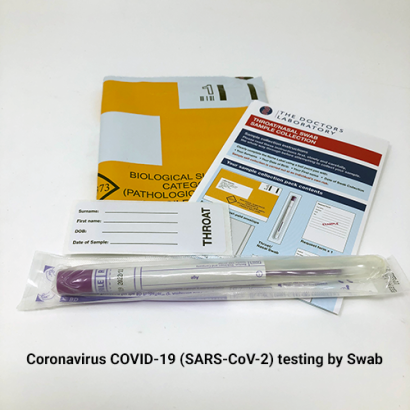
COVID-19 at home swab test for active infection NCOV
COVID-19 at home swab test for active infection NCOV Product information
£109.99
This product has been discontinued.
- You post the sample to the Lab and we then notify you of the results by email / phone call - currently a turnaround of 24 hours from receipt (updated 14.10.20)
- MOST AIRLINES REQUIRE THE TEST TO BE DONE 72 Hours BEFORE FLYING - this the date you take the sample.
- This test is currently only for use if you have had SYMPTOMS for between 1 to 5 days
- If you have any coronavirus symptoms you should self-isolate until the results are confirmed
- We send you the swab test kit and full instructions details here
- Suitable for ages 12 and over only
- Test analysed by the Doctors Laboratory in London full details here
-
TDL is listed on the Capacity Data Site for NHSE – this means all their activity is included in the country’s data and reported by TDL to PHE every morning on a daily basis.
Product Information for COVID-19 at home swab test for active infection NCOV
Specimen
- Nasal/Throat swabs collected using BD dry swabs/Remel M4RT/Copan 321C UTM or Copan 147C.
- Samples should be taken from symptomatic patients between days 1-5 from onset of symptoms.
- Specimens should be sent to the laboratory at ambient temperature in Category B packaging and labelled as containing HIGH RISK specimen.
- Please send samples on the day they are taken for best results, however samples are stable at ambient temperature for 3 days for wet swabs and up to 6 days for dry swabs.
Clinical background and biology
Coronavirus disease 2019 (COVID-19) is a respiratory tract infection caused by a newly emergent coronavirus – Severe Acute Respiratory Syndrome coronavirus 2 (SARS-CoV-2) – which was first recognised in Wuhan, Hubei Province, China, in December 2019. Genetic sequencing of the virus suggests that SARS-CoV-2 is a betacoronavirus closely linked to SARS coronavirus 1.
The outbreak was declared a Public Health Emergency of International Concern on 30 January 2020, and has since spread globally, resulting in the 2019–20 coronavirus pandemic. Current measures are in place globally to reduce the spread of the virus, most commonly from droplets (person-to-person) but also from infected surfaces. The target is to reduce the reproduction number (R0) to <1.0 – i.e. < one person infected by one affected individual.
Infectivity is now recognized to occur before the onset of symptoms and yet high titres of virus can be detected on upper airway surfaces in people who do not develop symptoms.
Infection with SARS-CoV-2, an RNA virus, is diagnosed using reverse-transcriptase PCR. The assays used at TDL show a minimum sensitivity of 98% and a specificity of 100%, with no cross-reactivity with other viruses.
Indications
The majority of people with COVID-19 have uncomplicated or mild illness (81%), with non-specific symptoms such as fever, fatigue, cough (with or without sputum production), anorexia, malaise, muscle pain, sore throat, dyspnea, nasal congestion, or headache. Rarely, patients may also present with diarrhoea, nausea and vomiting. Loss of taste and smell has been reported early in the infection.
A relatively small proportion of people, particularly but by no means exclusively in those aged >70 years, will develop severe illness requiring oxygen therapy (14%) and approximately 5% will require intensive care unit treatment. Time from the onset of the infection to hospitalisation can be up to ~13 days. Of those critically ill, most will require mechanical ventilation. The most common diagnosis in severe COVID-19 patients is severe pneumonia; this can progress to acute respiratory distress syndrome, and life-threatening multi-organ dysfunction and death. Mortality has been estimated at between 1 and 2% of those infected, the higher figure in men./p>
Current testing for COVID-19 (SARS-CoV-2) is rapidly evolving. Laboratory review of new assays as they become available is essential.
COVID-19 at home swab test for active infection NCOV reviews
How to use COVID-19 at home swab test for active infection NCOV
Side effects of COVID-19 at home swab test for active infection NCOV
Limitations and clinical interpretation
As with all viral PCR assays, patients with very low viral loads are less likely to be detected. ‘Not detected’ results do not preclude infection with the SARS-CoV-2 virus and should not be the sole basis of a patient treatment/management or public health decision. Where there is a strong clinical suspicion of an early COVID-19 infection repeat sampling should be considered 24-48 hours later.
Patients with COVID-19 symptoms in intensive care have been shown to no longer carry the virus in the upper respiratory tract. Viral detection tests should assist in the decision on when to discontinue additional precautions for hospitalised patients.
Results should be interpreted by a trained professional in conjunction with the patient’s history and clinical signs and symptoms, and epidemiological risk factors.
- Save on Your Treatment This January
- How blood affects erections: the science behind erectile dysfunction
- Why do ED medicines work for some people but not others?
- How do GLP-1 side effects compare between treatments?
- What is the Black Market for Prescription Medication?
- What is GLP-1, and what does it have to do with weight?
- What does Mounjaro do in the body?
- Oral semaglutide for Alzheimer’s: What the EVOKE trial results tell us
- What you need to know about Wegovy 7.2mg
- What is Finasteride and how does it work for hair loss?
Authored on March 15, 2021

Robert Bradshaw (Pharmacist) - MRPharms BSc(Hons) Pharmacy
Superintendent Pharmacist
GPhC Number: 2036118
Reviewed on March 15, 2021
