

Derma rolling can be used alongside topical minoxidil, and many people combine the two to support healthy hair regrowth. Used correctly, these treatments can complement each other as part of a structured approach to managing hair loss.
However, minoxidil shouldn’t usually be applied immediately after dermarolling, as the scalp can be more sensitive and absorb too much medication. Here, we explore how to safely combine them and the science behind using these two treatments together.
What is dermarolling?
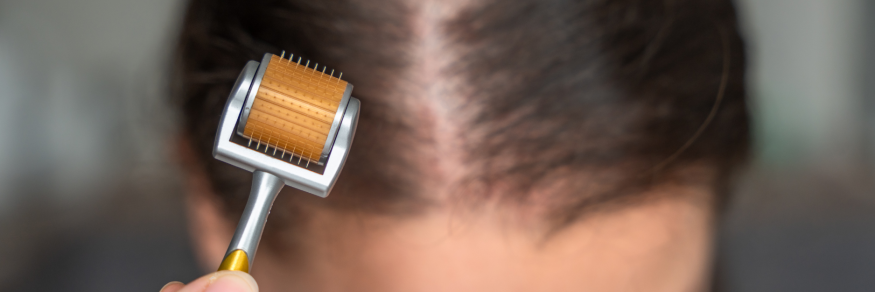
Derma rolling is a form of microneedling, a technique that uses a small roller covered in fine, sterilised needles to make micro-punctures in the skin. These micro-injuries trigger the body’s natural healing process, leading to increased collagen and elastin production.
While this surge in collagen and elastin makes microneedling effective in treating skin conditions such as acne scarring and sun damage, it can support hair growth when used on the scalp.
On the scalp, microneedling may:
Increase blood flow to hair follicles
Stimulate growth factors involved in hair production
Improve absorption of topical treatments like minoxidil
Because of these effects, dermarolling is sometimes used alongside evidence-based medical hair loss treatments for people with male pattern baldness.
Can you combine dermarolling and minoxidil for hair loss?
Yes, you can use dermarolling and minoxidil (often sold under the brand name Regaine) together. Many people combine the two treatments as they work in different ways to support hair growth:
Minoxidil helps extend the growth phase of the hair cycle.
Dermarolling stimulates the scalp and may improve absorption of topical treatments.
Some studies suggest that combining both approaches can lead to better results — but timing matters. Applying minoxidil immediately after dermarolling can increase irritation because the scalp may absorb more medication than usual. Spacing treatments apart helps reduce this risk.
How long should you wait between dermarolling and minoxidil?
This depends on the type of derma roller used. Your pharmacist or microneedling clinician (if done professionally) can advise on what’s most appropriate for your routine. As general guidance:
For at-home dermarollers with shorter needles, waiting at least 30 minutes, and sometimes longer depending on needle length and scalp sensitivity, can help reduce irritation.
For professional microneedling treatments, which use longer needles, clinicians often recommend not using minoxidil on the day of treatment to allow the scalp time to recover.
Minoxidil is usually applied directly to areas of the scalp twice daily (1). Sticking to this routine is important, as it’s this regular application that helps maintain the hair growth cycle over time and makes noticeable improvements in the thickness and appearance of your hair.
Skipping an occasional dose after professional microneedling does not normally affect overall treatment progress, as these sessions are usually spaced several weeks apart. If derma rolling at home, it’s usually possible to continue your regular minoxidil routine by adjusting when you use the roller rather than skipping doses.
The key point is that dermarolling should support your treatment plan — not replace or interrupt regular minoxidil use.
Should you use a derma roller at home or have professional microneedling?
Both having professional microneedling performed at a clinic or using a derma roller at home may support hair growth, and each suits a different type of person.
Professional microneedling for hair growth
You may choose to have microneedling performed by a trained professional if:
You’re new to dermarolling
You’re unsure which needle length to use
You want closer clinical supervision
Clinical microneedling devices can reach greater depths than home rollers and allow treatment to be adjusted more precisely depending on your scalp and pattern of hair loss. Sessions usually involve cleaning the scalp, followed by a numbing agent and controlled microneedling across thinning areas.
Because professional treatments create deeper stimulation, your clinician will advise when it’s safe to apply minoxidil afterwards. In many cases, it’s recommended to skip minoxidil on the day you have the procedure to reduce irritation and allow the scalp time to recover.
Using a derma roller at home
At-home dermarollers can be a more convenient and cost effective way to add microneedling to your routine. Many home rollers have shorter needle lengths, designed for safer self-application.
When used correctly, they may help stimulate the scalp and support minoxidil response. But technique and hygiene are important to reduce irritation or infection risk. If you’re using a dermaroller at home, always:
Clean your scalp before use using a gentle shampoo
Roll gently across thinning areas horizontally, vertically, and diagonally
Use firm pressure, but not so much that it’s painful
Don’t roll over the same area too many times
Clean the device using 70% isopropyl alcohol before and after each use
How often should you use a derma roller with minoxidil?
There isn’t one single schedule that works for everyone. How often dermarolling is recommended depends on factors like:
Needle length
Whether treatment is done at home or in a clinic
How sensitive your scalp is
At-home devices like Sons Derma Roller typically use shorter needles and are gentle enough to be used every other day. For longer needles that require more recovery time between sessions, you may only need to use the derma roller once every week, every other week, or even once a month (2).
Minoxidil should continue to be used as directed alongside microneedling, but it may not be necessary to combine both treatments on the same day.
Does derma rolling work without minoxidil?
Dermarolling may help support hair growth on its own when used consistently. However, it is most often studied alongside minoxidil rather than as a standalone treatment.
Evidence suggests that combining the two produces greater improvements than minoxidil alone, and the results appear faster (3-4). Another research has found that men who don’t respond to topical minoxidil may find it works by adding microneedling into their hair care routine (5).
For this reason, dermarolling is usually considered an adjunct treatment, rather than a replacement for licensed hair-loss medication. It is sometimes recommended for people who feel they are not seeing the results they expected from minoxidil alone.
Should you combine derma rolling with minoxidil?
Many people choose to combine dermarolling with minoxidil to support hair regrowth. Used together, these treatments may improve how the scalp responds compared with using minoxidil alone. However, consistency and correct timing are important, and results can vary from person to person.
If you’re considering adding microneedling to your routine, our independent doctors at Oxford Online Pharmacy can help you decide whether this approach is suitable for you.
Explore our minoxidil hair-loss treatment or at-home derma roller to learn more.
References
BNF. Minoxidil. NICE.
English RS, Ruiz S, DoAmaral P. Microneedling and Its Use in Hair Loss Disorders: A Systematic Review. Dermatology and Therapy. 2021 Dec 1;12(1):41–60.
Abdi P, Awad C, Anthony M, Farkouh C, Kenny B, Maibach HI, et al. Efficacy and Safety of Combinational Therapy Using Topical Minoxidil and Microneedling for the Treatment of Androgenetic Alopecia: A Systematic Review and Meta-analysis. Archives of Dermatological Research. 2023 Sep 4;315(10):2775–85
Ahmed KMA, Kozaa YA, Abuawwad MT, Al-Najdawi AI, Mahmoud YW, Ahmed AM, et al. Evaluating the efficacy and safety of combined microneedling therapy versus topical Minoxidil in androgenetic alopecia: a systematic review and meta-analysis. Archives of Dermatological Research. 2025 Mar 8;317(1).
Dias FR, Yong SS, FitzGerald H, Sinclair RD, Bhoyrul B. Expanding the therapeutic landscape of minoxidil for androgenetic alopecia: topical, oral and sublingual formulations. Frontiers in Pharmacology. 2026 Jan 21;16.