


-
 UK-registered clinical team
 -
Confidential & secure
-
No GP visit needed
-
Fast & discreet delivery

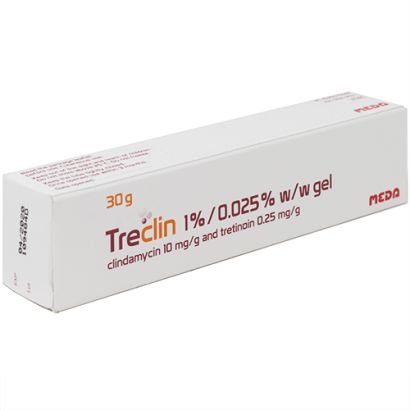
Treclin 1%/0.025% w/w Gel 30g
Treclin 1%/0.025% w/w Gel 30g Product information
£28.98
Product Information for Treclin 1%/0.025% w/w Gel 30g
Buy Treclin Gel Online in the UK
Treclin contains the active substances clindamycin and tretinoin. Clindamycin is an antibiotic. It limits the growth of bacteria associated with acne and the inflammation caused by these bacteria.
Tretinoin normalizes the growth of superficial skin cells and causes normal shedding of the cells that clog the hair follicles in areas with acne. This prevents the build-up of sebum and the formation of early acne lesions (blackheads and whiteheads).
These active substances (clindamycin and tretinoin) are more effective when combined than when used separately.
Treclin Gel is applied topically to the skin to treat acne in patients 12 years old and over.
Treclin 1%/0.025% w/w Gel 30g reviews
How to use Treclin 1%/0.025% w/w Gel 30g
The recommended dose is: A pea-sized amount of Treclin should be applied once daily at bedtime.
Method of administration: Wash your face gently with mild soap and warm water and pat your skin dry with a towel. Squeeze a pea-sized amount of gel onto the fingertip. Dab the gel on your forehead, chin, nose and both cheeks, and then gently spread it evenly over your whole face. Do not use more than the amount that has been suggested by your doctor, or apply the product more frequently than instructed. Too much medication may irritate the skin, and will not give faster or better results.
Duration of treatment: To get the best results with Treclin, it is necessary to use it properly and not stop using it as soon as your acne starts to get better. Typically, it may take several weeks to have an optimal effect. In some cases, it may take up to 12 weeks. Please contact your doctor if symptoms persist for more than 12 weeks,
Side effects of Treclin 1%/0.025% w/w Gel 30g
Please read the patient information leaflet before starting treatment.
Like all medicines, this medicine can cause side effects, although not everybody gets them.
Uncommon: may affect up to 1 in 100 people
- Acne, dry skin, redness of the skin, increased sebum production, photosensitivity reaction, itching, rash, scaly rash, scaling of the skin, sunburn
- Application site reactions such as burning, inflamed skin, dryness, and redness of the skin
Rare: may affect up to 1 in 1,000 people
- Hypersensitivity
- Underactive thyroid gland (symptoms may include fatigue, weakness, weight gain, dry hair, rough pale skin, hair loss, and increased sensitivity to cold).
- Headache
- Eye irritation
- Gastroenteritis (inflammation of any part of the gastrointestinal tract), nausea
- Inflamed skin, herpes simplex (cold sore), macular rash (small, flat, red spots), skin bleeding, skin burning sensation, loss of skin pigmentation, skin irritation
- Application site symptoms such as irritation, swelling, superficial skin damage, discolouration, itching, scaling
- Feeling hot, pain
Important - Before taking any medication, it is always important to read the Patient Information Leaflet (PIL)
- How to treat perioral dermatitis
- What is post-inflammatory hyperpigmentation?
- Understanding the different types of acne and solutions
- How An Online Consultation Can Help You
- How much should you pay for treating your skin condition?
- Acne treatments, what works and what to avoid
- Save on Your Treatment This January
- How blood affects erections: the science behind erectile dysfunction
- Why do ED medicines work for some people but not others?
- How do GLP-1 side effects compare between treatments?
Authored on March 13, 2023

Robert Bradshaw (Pharmacist) — MRPharms BSc(Hons) Pharmacy
Superintendent Pharmacist
GPhC Number: 2036118
GMC Number: 20399999
Reviewed on March 14, 2023
