



Coping with menopause symptoms can be a very stressful time, and many people turn to Hormone Replacement Therapy (HRT) to help them cope. However, as with any medication, there are side effects to consider. Many people delay or avoid HRT because they believe that it may cause them to gain weight, but is this true?
Let’s explore the HRT weight gain myth, what the scientific evidence says about weight and HRT, and how and when to get support.
Key Takeaways: | ||
|---|---|---|
| ||
In this article:
Hormone Replacement Therapy: What is it and how does it work?
Why weight changes during menopause, with or without HRT
What does the evidence actually say about HRT and weight?
Could HRT help rather than hinder weight management?
Does the type of HRT make a difference?
When to speak to a doctor about weight changes
Hormone Replacement Therapy: What is it and how does it work?
Also known as HRT, Hormone Replacement Therapy is a medical treatment designed to replace female hormones when they decline, which happens during menopause. There are several types of HRT that contain different hormones, as well as different ways of taking it (1).
HRT works by topping up the hormones that naturally decline as your body enters menopause, and this helps it to function more comfortably by reducing or preventing some of the side effects that occur when hormone levels fall. This includes things like hot flushes, night sweats, sleep issues, itchy skin and vaginal dryness (2).
Why weight changes during menopause, with or without HRT
During menopause, your body goes through many changes. This is because hormones, which as we know drop during this period of your life, play a huge role in the regulation of many different body functions. This includes, but isn’t limited to (3):
Metabolism, and how your body uses and stores energy
Maintaining blood sugar levels, as well as fluid and salt balance
Supporting sleep, mood and body temperature
Helping your body respond to stress
Each of these functions can also have a direct impact on body weight, even without taking HRT. You can read more on our Menopause and Weight Gain blog which will explain menopause weight gain in more detail, including how much you could reasonably expect to gain.
What does the evidence actually say about HRT and weight?
The short answer is that there is no clinical evidence to support the idea that HRT is the cause of any meaningful weight gain. Instead, it shows that weight and body composition naturally changes during menopause regardless of treatment.
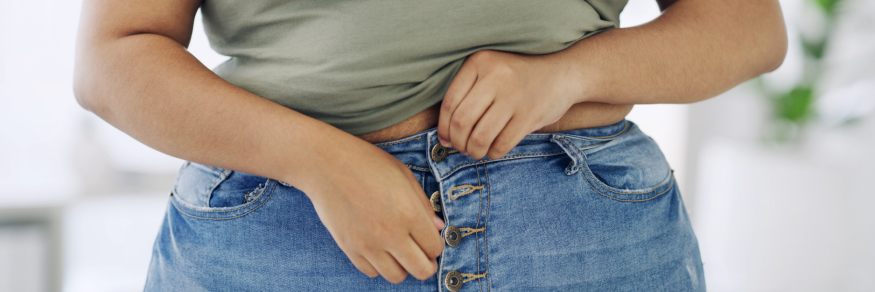
Studies have found that fat mass increased and lean mass decreased during the menopause transition, with many women noticing more body fat developing around their abdomen (4,5).
If you then start HRT around the same time as this happens, it may make it seem like HRT is causing your weight gain, especially if you are someone who experiences fluid retention or bloating, which are both very common side effects at the start of HRT treatment and typically settle within the first few months as your body adjusts to treatment (6).
When you start any new medication it’s important to take note of all the possible side effects. These will help you to know what to expect, and when to speak to your prescriber. Always refer to the Patient Information Leaflet for your specific medication for more details.
Could HRT help rather than hinder weight management?
HRT is designed to create better balance in your hormone levels and stop them fluctuating so much, not as a weight management tool. It should never be seen as a solution to help you either maintain or lose weight. Always remember that HRT is prescribed for symptom relief, rather than as a primary tool for weight management.
However, by balancing your hormones and helping to regulate some of the body systems we’ve listed above, HRT could have an indirect impact on weight and body composition. For example, sudden drops in blood sugar levels are known to cause intense cravings since your brain sees the sudden drop in fuel as an emergency and tells you that you need a quick burst of energy via carbohydrates or sugary foods (7). By levelling out your hormones, HRT could help to reduce or prevent blood sugar fluctuations that cause frequent cravings and could contribute to weight gain if they lead to more snacking, larger portions or more calorie-dense foods (8).
Does the type of HRT make a difference?
One study suggests that oral oestrogen may have more significant effects on fat distribution and less mass than using transdermal patches. This is believed to be because oral distribution means that oral oestrogen goes through your liver first. However, evidence is still limited and not compelling enough to clearly pitch one type of HRT over another (9). However, transdermal options are often clinically preferred for patients with higher clotting risks.
When to speak to a doctor about weight changes
If you are concerned about weight gain during menopause, there is support available. Positive lifestyle changes, improved nutrition, regular exercise and good sleep can all help support weight management. You could also explore the idea of weight loss treatments such as tablets or injections.
If you’re struggling with weight gain during menopause or want to speak to a licensed clinician about HRT, our online pharmacy is here to help. Book a consultation and get expert support, tailored to you.
References
NHS. About hormone replacement therapy (HRT) [Internet]. nhs.uk. 2023 July [cited 2026 Aug 2]. Available from: https://www.nhs.uk/medicines/hormone-replacement-therapy-hrt/about-hormone-replacement-therapy-hrt/
Harper-Harrison G, Shanahan MM, Carlson K. Hormone Replacement Therapy [Internet]. National Library of Medicine. StatPearls Publishing; 2023 [cited 2026 Aug 2]. Available from: https://www.ncbi.nlm.nih.gov/books/NBK493191/
Hiller-Sturmhöfel S, Bartke A. The Endocrine System: An Overview. Alcohol Health and Research World [Internet]. 1998 [cited 2026 Aug 2];22(3):153. Available from: https://pmc.ncbi.nlm.nih.gov/articles/PMC6761896/
Greendale GA, Sternfeld B, Huang M, Han W, Karvonen-Gutierrez C, Ruppert K, et al. Changes in body composition and weight during the menopause transition. JCI Insight. 2019 Mar 7;4(5). https://pmc.ncbi.nlm.nih.gov/articles/PMC6483504/
M. Gambacciani, M. Ciaponi, B. Cappagli, L. Piaggesi, L. De Simone, R. Orlandi, A. R. Genazzani, Body Weight, Body Fat Distribution, and Hormonal Replacement Therapy in Early Postmenopausal Women, The Journal of Clinical Endocrinology & Metabolism, Volume 82, Issue 2, 1 February 1997, Pages 414–417, https://doi.org/10.1210/jcem.82.2.3735
Younglove C, Clinical review: Menopause hormone therapy in weight management [Internet]. National Library of Medicine. Obes Pillars; 2026 [cited 2026 Aug 2]. Available from: https://pmc.ncbi.nlm.nih.gov/articles/PMC13010941/
Rania M, Caroleo M, Elvira Anna Carbone, Ricchio M, Maria Chiara Pelle, Zaffina I, et al. Reactive hypoglycemia in binge eating disorder, food addiction, and the comorbid phenotype: unravelling the metabolic drive to disordered eating behaviours. Journal of eating disorders. 2023 Sept 19;11(1). https://pmc.ncbi.nlm.nih.gov/articles/PMC10507855/
Myers CA, Martin CK, Apolzan JW. Food cravings and body weight. Current Opinion in Endocrinology & Diabetes and Obesity. 2018 Oct;25(5):298–302. https://pmc.ncbi.nlm.nih.gov/articles/PMC6411047/
Hänggi W, Lippuner K, Jaeger P, Birkhäuser MH, Horber FF. Differential impact of conventional oral or transdermal hormone replacement therapy or tibolone on body composition in postmenopausal women. Clinical endocrinology [Internet]. 1998 June [cited 2026 Aug 3];48(6):691–9. Available from: https://pubmed.ncbi.nlm.nih.gov/9713556/