





Weight gain is a common experience during menopause, but it isn't simply a result of getting older or lifestyle changes alone. Hormonal shifts, changes in metabolism and body composition, alongside factors such as sleep, stress and reduced physical activity, can all make maintaining a healthy weight more challenging.
In this short guide, we'll explain why menopause can affect your weight, how these changes happen, and share practical, evidence-based advice to help you manage your weight with confidence and support.
What is menopause?
Menopause is a natural biological change that occurs in people who are born female that marks the end of them being able to naturally conceive a baby. It’s officially diagnosed after experiencing 12 months without a menstrual period, which usually happens between the ages of 45 and 55. Menopause occurs when your ovaries stop releasing eggs, which causes levels of two key hormones – oestrogen and progesterone – to drop (1).
Perimenopause is the term given to the transitional stage that happens before menopause, when your body starts to make less of these hormones. It most commonly begins during a woman's 40s, although some women notice changes slightly earlier and continues until you stop having periods. Menopause symptoms can start gradually during this time (2).
Why does menopause cause weight gain?
Your body goes through many changes when you enter menopause. Although not guaranteed, weight gain is one of the most common. According to the British Menopause Society, weight gain affects at least 50% of women in perimenopause and menopause (3).
There are several reasons why weight gain happens. They include, but aren’t limited to:
Hormone changes
Oestrogen and progesterone are two of the key hormones involved in menopause. However, oestrogen also helps to regulate where your body stores fat and how it uses energy. As your oestrogen levels fall, fat tends to move from your hips and thighs to your abdomen. Your body also becomes less effective at using energy, making weight gain more likely (4).
Metabolic changes and muscle loss
Your metabolism changes with menopause too. This mostly happens due to muscle loss. Studies show that we lose around 3-8% of muscle per decade from around the age of 30 onwards (5). Since muscle burns more calories than fat, the combination of less muscle and less oestrogen mean your body needs fewer calories to fuel it. If you continue eating the same diet as before, you may be eating too many calories, the excess which will be stored in your body as fat (6).
Sleep and stress issues
Hunger can be affected by many external factors, including sleep and stress. Failing to get enough sleep can alter your hunger hormones to make you feel hungrier and crave fast-release energy (7). Meanwhile, stress raises your natural cortisol levels, which slows your metabolism and increases your appetite, making weight gain more likely (8).
How much weight could I gain during menopause?
Studies suggest that on average, women gain around 1.5kg per year during perimenopause, adding up to roughly 10kg in total by the time they reach menopause (16). Weight gain is one of the most common and frustrating symptoms of menopause and can leave women feeling like they have lost control of their bodies. It affects over half of all menopausal women (16).
However, the number on the scale only tells part of the story. DXA scans (imaging that measures body composition and bone density) show it’s not just weight gain that changes during menopause, it’s the type of weight that changes (9). At the start of menopause transition, fat gain increases whilst lean muscle mass simultaneously declines (9). This can mean that overall weight can stay relatively stable as body composition changes under the surface.
The biggest shift is where in your body the fat begins to be stored. As oestrogen levels decline, fat storage shifts from the hips and thighs to the abdomen, creating more internal fat around the middle rather than more even distribution typical before perimenopause (9). This abdominal fat carries greater health risks, including a reduced sensitivity to insulin, impacts on blood sugar, cholesterol and blood pressure (9).
Simultaneously, the loss of lean muscle mass reduces resting metabolic rate (the rate at which the body burns calories while resting), which makes weight gain more likely and weight loss harder than previously to the menopause transition (9).
The cumulative effect of fat increase in certain areas, loss of muscle mass, a general trend towards less activity during perimenopause and menopause and appetite changes are the largest drivers of weight gain and require an adjustment in lifestyle to manage (9).
Can I stop menopause weight gain or reverse it?
Although it may not be possible to prevent yourself from gaining any weight at all during menopause, making some healthy lifestyle changes can help minimise the risk of weight gain and improve your overall wellbeing.
Regular physical activity, particularly combining aerobic exercise (for high calorie burn and cardiovascular health) and resistance training (to preserve and/or build muscle mass), alongside a balanced, nutritious and calorie-controlled diet can help to control body fat and keep weight stable (10). Find out more about calories and weight maintenance and loss.
Some people also choose to explore weight loss injections or weight loss tablets to help them to lose excess weight gained before or during menopause.
Can HRT help prevent weight gain in menopause?
Hormone Replacement Therapy (HRT) is the primary treatment recommended for some women during menopause. It works by replacing some of the hormones that your body stops producing. Not all women can take HRT, but for those that can, it can help relieve some of the symptoms of menopause, such as hot flushes, mood swings and vaginal dryness (11).
HRT as a standalone treatment won’t prevent weight gain. However, studies have shown that it can help to prevent fat being redistributed to your abdomen (12). Research also suggests that women gain less weight on HRT compared to those who don’t take it, which is thought to be a result of better sleep, less stress and more energy, which could make it easier to maintain healthy lifestyle choices (13).
Will my diet affect my weight in menopause?
It’s not specifically what you eat that plays a significant role in weight gain (during menopause or at any other time), but how many calories you consume. If you regularly eat more calories than your body needs each day, the surplus energy will be stored by your body as fat, and this will cause you to gain weight.
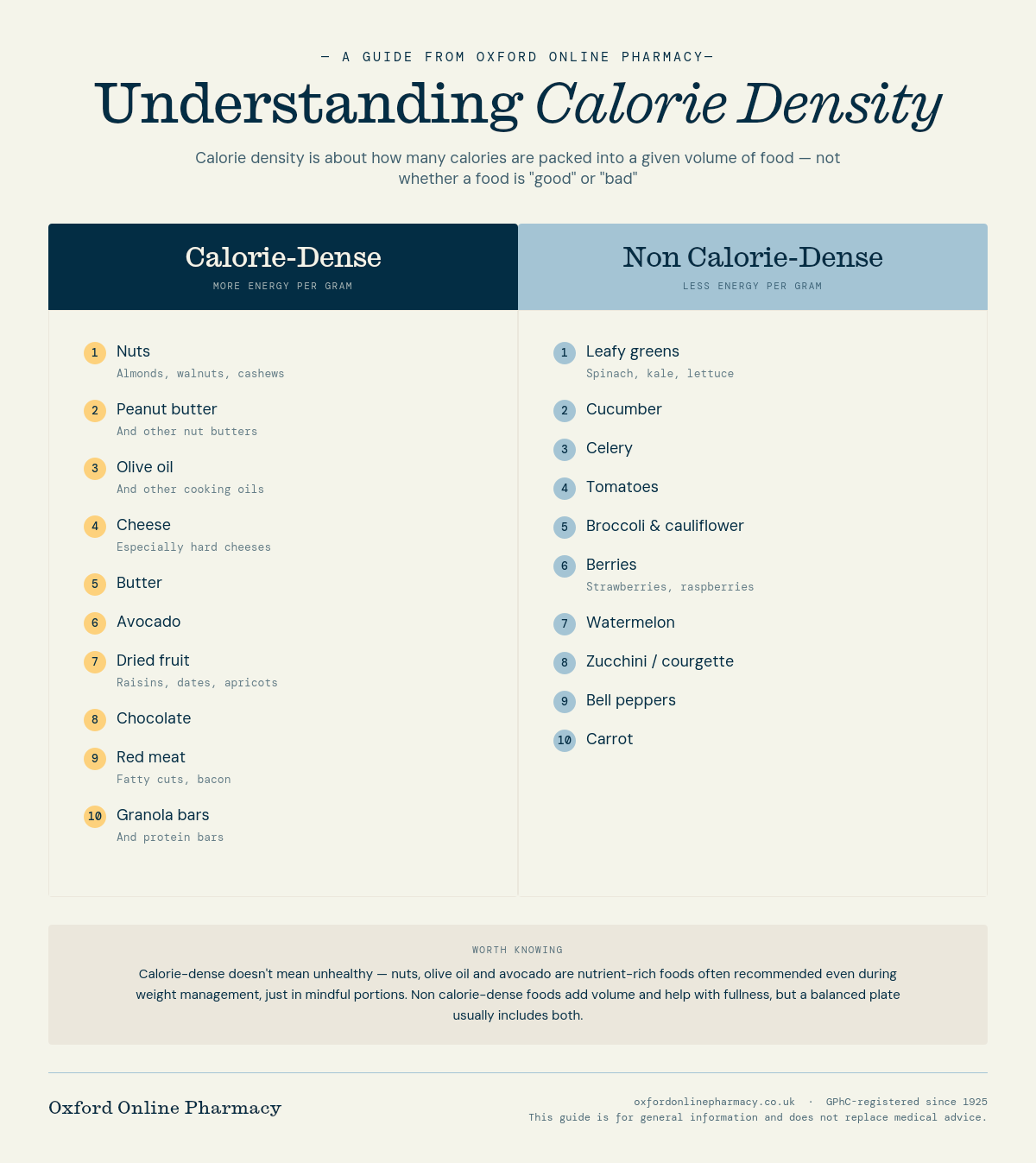
Some foods contain more calories than others. This is sometimes referred to as calorie density. Choosing foods with lower calories means you can eat more of them, which could make you less likely to feel hungry. For example, 250 calories of carrot will be a much larger portion size than 250 calories of chocolate.
However, sticking to a strict daily calorie count can be difficult, especially if you have social plans or are a small woman who needs a fairly low number of calories to maintain your current weight. Many people choose to work out a weekly calorie allowance by combining their daily totals together and then use this to help them stay on track. Weekly calorie budgeting allows you to eat more on certain days. For example, by reducing your daily calories by 100 per day, you have an extra 700 to “spend” at the end of the week – ideal if you have eating plans that could put you over your usual daily allowance (12).
Can I use weight loss medications to lose weight during menopause?
Potentially, yes. Weight loss medications aren’t for everyone, and there are strict criteria that you need to meet to be able to use them. However, studies have shown that weight loss medications such as GLP-1 weight loss injections could be helpful in supporting long-term weight loss goals in eligible candidates (14). Equally, a post hoc analysis (analysis after the initial study) of the SURMOUNT-1 trial found that postmenopausal women taking tirzepatide lost an average of 23% of their body weight at 72 weeks, compared with just 3% among those taking a placebo (17).
You can find out more about whether you qualify for weight loss medication here.
If you are struggling with weight gain during menopause and you would like advice and support, our friendly pharmacy team is happy to help. Please get in touch to find out how we can help.
References
NHS website. Menopause and perimenopause [Internet]. nhs.uk. 2026.
NHS website. Symptoms of menopause and perimenopause [Internet]. nhs.uk. 2026.
Zhu J, Zhou Y, Jin B, Shu J. Role of estrogen in the regulation of central and peripheral energy homeostasis: from a menopausal perspective. Therapeutic Advances in Endocrinology and Metabolism. 2023 Jan 1;14.
Mitchell WK, Williams J, Atherton P, Larvin M, Lund J, Narici M. Sarcopenia, Dynapenia, and the Impact of Advancing Age on Human Skeletal Muscle Size and Strength; a Quantitative Review. Frontiers in Physiology [Internet]. 2012;3(260).
Marcantei C, Metz L, O’Donnell E, Isacco L. A narrative review of energy expenditure and substrate oxidation during menopause. Climacteric : the journal of the International Menopause Society [Internet]. 2026 Apr;29(2):140–50.
Stern JH, Grant AS, Thomson CA, Tinker L, Hale L, Brennan KM, et al. Short sleep duration is associated with decreased serum leptin, increased energy intake and decreased diet quality in postmenopausal women. Obesity. 2014 Jan 9;22(5):E55–61.
Hewagalamulage SD, Lee TK, Clarke IJ, Henry BA. Stress, cortisol, and obesity: a role for cortisol responsiveness in identifying individuals prone to obesity. Domestic Animal Endocrinology [Internet]. 2016 July;56:S112–20.
Greendale GA, Sternfeld B, Huang M, Han W, Karvonen-Gutierrez C, Ruppert K, et al. Changes in body composition and weight during the menopause transition. JCI Insight. 2019 Mar 7;4(5).
M. Khalafi, Aref Habibi Maleki, Mohammad Hossein Sakhaei, Rosenkranz SK, Mohammad Javad Pourvaghar, Mahsa Ehsanifar, et al. The effects of exercise training on body composition in postmenopausal women: a systematic review and meta-analysis. Frontiers in Endocrinology. 2023 June 14;14.
Hormone Replacement Therapy. (2019). Medlineplus.Gov; National Library of Medicine.
Costa, G. L. B., Carneiro, G., Luciana Mela Umeda, Pardini, D., & Maria Teresa Zanella. (2020). Influence of Menopausal Hormone Therapy on Body Composition and Metabolic Parameters. BioResearch Open Access, 9(1), 80–85.
Costa, G. L. B., Carneiro, G., Luciana Mela Umeda, Pardini, D., & Maria Teresa Zanella. (2020). Influence of Menopausal Hormone Therapy on Body Composition and Metabolic Parameters. BioResearch Open Access, 9(1), 80–85.
Espeland, M. A., Stefanick, M. L., Kritz-Silverstein, D., S. Edwin Fineberg, Waclawiw, M. A., James, M. N., & Greendale, G. A. (1997). Effect of Postmenopausal Hormone Therapy on Body Weight and Waist and Hip Girths1 [Review of Effect of Postmenopausal Hormone Therapy on Body Weight and Waist and Hip Girths1]. 82(5), 1549–1556.
Jastreboff, A. M., Aronne, L. J., Ahmad, N. N., Wharton, S., Connery, L., Alves, B., Kiyosue, A., Zhang, S., Liu, B., Bunck, M. C., & Stefanski, A. (2022). Tirzepatide Once Weekly for the Treatment of Obesity. New England Journal of Medicine, 387(3), 205–216.
Weight gain and menopause [Internet]. Women's Health Concern (British Menopause Society); 2023.
Tchang BG, Mihai AC, Stefanski A, García-Pérez L-E, Mojdami D, Jouravskaya I, Gurbuz S, Taylor R, Karanikas CA, Dunn JP, et al. Body weight reduction in women treated with tirzepatide by reproductive stage: a post hoc analysis from the SURMOUNT program [Internet]. Obesity; 2025.