






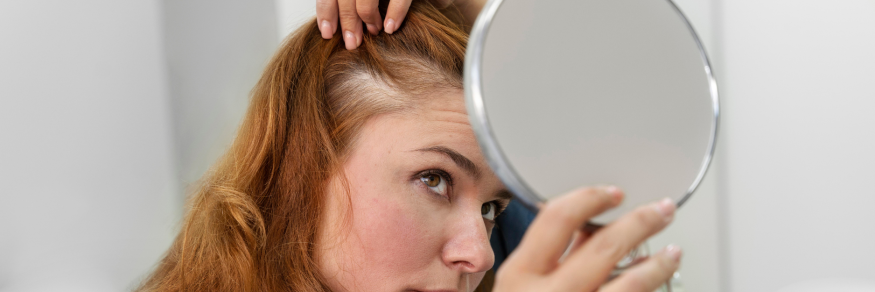
Losing your hair can feel incredibly isolating. While male pattern baldness receives a lot of focus, female hair loss often comes as a surprise. Many women aren't sure whether what they're going through is normal, what could be causing it, and whether it’s something they simply have to accept.
That uncertainty is reflected in the latest research from Oxford Online Pharmacy. We found women in the UK search for information about female hair loss more than 4.3 million times every year, with many looking for answers about the causes, symptoms and treatments available.
One reason so many women are searching is that female hair loss isn't a single condition. It can have several different causes, and the best treatment depends on understanding what's behind it.
View our full hair loss treatment range or check out our Hair Loss Hub for more support.
In this article:
What did our female hair loss research find?
Why are more women searching about female hair loss?
What does this mean for women experiencing hair loss?
Frequently asked questions
What did our research reveal about female hair loss?
To better understand how women are looking for information about hair loss, we analysed more than 800 female hair loss-related search terms between June 2025 and June 2026.
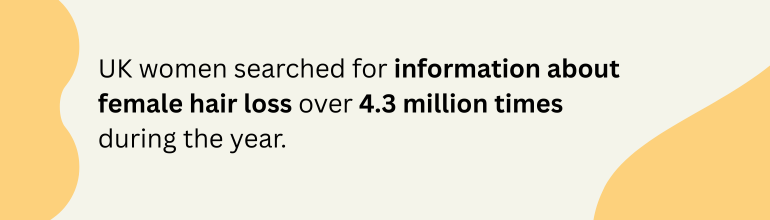
Our research found that women in the UK searched for information about female hair loss over 4.3 million times during the year. The headline figure is striking, but looking a little deeper reveals three insights into how women are experiencing female hair loss today.
Female hair loss is more common than many people realise
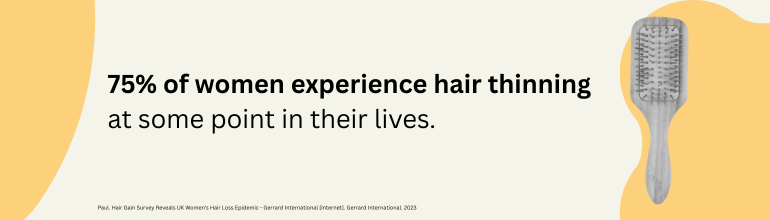
More than four million searches in a year highlight just how many women are looking for answers. This reflects findings from other research, with one UK survey reporting that 75% of women experience hair thinning at some point in their lives (1).
Although hair loss is often associated with men, these figures suggest it's a concern for a huge number of women too.
Female hair loss has a real emotional impact
People don't usually spend time researching a health condition unless it's affecting them in some way. Other research supports this, with 55% of women saying hair loss had affected their self-confidence, while 26% reported it had negatively affected their love life or relationships (1).
While some hair thinning and shedding is normal, severe hair loss can have a significant impact on emotional wellbeing and quality of life.
Women are looking for answers, not just treatments
While over 2.5 million searches related to treatment options like Regaine for Women and post-hair transplant care for women, almost 1.8 million searches focused on understanding the causes and symptoms of female hair loss.
This suggests that many women aren't simply looking for a solution. They want to understand what's causing their hair loss before deciding how to treat it. And that's important, because the best treatment depends on what's causing the hair loss in the first place.
Why are more women searching about female hair loss?
Our research can't tell us exactly why searches have increased, but wider evidence offers clues.
Women's health is receiving more attention. Topics such as menopause, postpartum recovery and hormonal health are being discussed more openly, helping women recognise that hair loss can be a symptom worth investigating.
Awareness of female hair loss is improving. Hair thinning is no longer viewed as simply part of ageing, and more women are recognising that conditions such as female pattern hair loss and stress-related shedding can often be diagnosed and treated.
More women are seeking advice online. Online pharmacies have made it easier to research symptoms and explore hair loss treatment options, such as topical Minoxidil for female pattern baldness and Florisene for iron deficiencies, and treat hair loss online.
Social media has helped reduce stigma. More women are sharing their experiences of hair loss online, encouraging others to seek advice rather than suffer in silence. Women now recognise that thinning hair isn't always something they have to accept.
What does this mean for women experiencing hair loss?
Whether you're noticing more hair falling out when brushing, a widening parting, gradual thinning, or hair falling out in clumps, it's completely understandable to start searching for answers. Our research suggests that's exactly what millions of women are doing.
The important thing to remember is that female hair loss isn't one condition. Some of the most common causes include (1-5):
Stress-related hair loss, which affects around half of women experiencing hair loss
Postpartum hair loss, experienced by more than 90% of new mothers
Hormonal changes that happen during perimenopause and menopause
Female pattern hair loss, the most common cause of hair thinning in women
Iron deficiency (specifically stored iron levels) and other nutritional deficiencies like B12
Alopecia areata, one of the best-known causes of hair loss but actually relatively uncommon
Searching for answers is a good first step, but because these conditions can look similar, it's not always possible to work out the cause – and therefore, the most appropriate treatment – yourself.
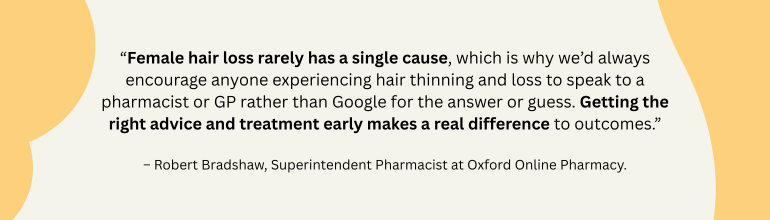
If you're concerned about female hair loss, speaking to a healthcare professional can help identify the underlying cause and determine whether treatment is appropriate. Getting advice early can help identify the cause sooner and, where needed, start treatment before hair loss progresses further. Any concerns about sudden or dramatic hair loss should always be investigated medically.
View our full hair loss treatment range or check out our Hair Loss Hub for more support.
Frequently asked questions
Is female hair loss becoming more common?
It's difficult to say whether female hair loss is becoming more common, but our research found women in the UK searched for information about female hair loss more than 4.3 million times in a year. This suggests more women are actively seeking information than ever before.
What did your research reveal about female hair loss treatments?
More than 2.5 million searches related to female hair loss treatments, showing that many women are actively looking for ways to counteract hair thinning and shedding. However, because female hair loss has several causes, the most appropriate treatment depends on the underlying diagnosis.
What is the best treatment for female hair loss?
This depends on the type of hair loss you have. Topical minoxidil is the only licensed treatment for female pattern baldness, and some women choose to combine minoxidil with a derma roller. Other types are managed by treating the root cause, such as correcting deficiencies or reducing stress.
Can diet help improve female hair loss?
While diet won't treat every type of female hair loss, eating the best diet for healthy hair growth can support healthy hair. If you think nutritional deficiencies may also be contributing to your hair thinning, supplements like Florisene and Nourkrin may help but they should not replace a balanced diet.
Why is there more research into female hair loss treatment now?
Researchers now know that female hair loss is far more complex than previously thought. It isn't one condition with one treatment. As that understanding has grown, so has research into more personalised ways to diagnose and manage different types of hair loss.
References
Paul. Hair Gain Survey Reveals UK Women’s Hair Loss Epidemic - Gerrard International [Internet]. Gerrard International. 2023 Mar [cited 2026 July 27].
Hirose A, Masakazu Terauchi, Tamami Odai, Fudono A, Kotoi Tsurane, Sekiguchi M, et al. Investigation of exacerbating factors for postpartum hair loss: a questionnaire-based cross-sectional study. International Journal of Women’s Dermatology [Internet]. 2023 June 1 [cited 2026 July 27];9(2):e084–4.
Thamotharan N, Harikumar MV, Sundaram M, Swaminathan A, Rangarajan S. Assessment of Serum Ferritin Levels in Female Patients With Telogen Effluvium. Cureus [Internet]. 2025 Dec 28 [cited 2026 July 27];.
Huang Z, Zhao WJ, Gao YJ, Huang ZR, Huang QR, Cai SZ, et al. Botanical drug preparations for alleviating hair loss in menopausal women: a global ethnopharmacological mini-review. Frontiers in Pharmacology. 2025 Nov 26;16.
British Association of Dermatologists. Hair loss female pattern (androgenetic alopecia) [Internet]. Bad.org.uk. 2021 [cited 2026 July 27].
Harries M, Macbeth AE, Holmes S, Chiu WS, Gallardo WR, Nijher M, et al. The epidemiology of alopecia areata: a population‐based cohort study in UK primary care. British Journal of Dermatology. 2021 Oct 21;.