


-
 UK-registered clinical team
-
Confidential & secure
-
No GP visit needed
-
Fast & discreet delivery


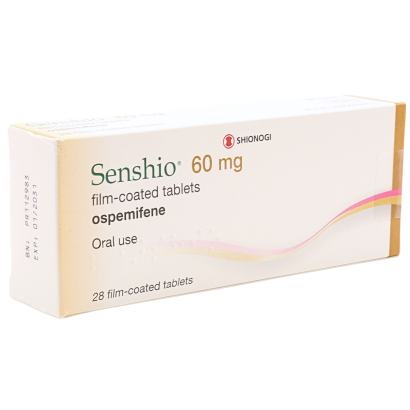
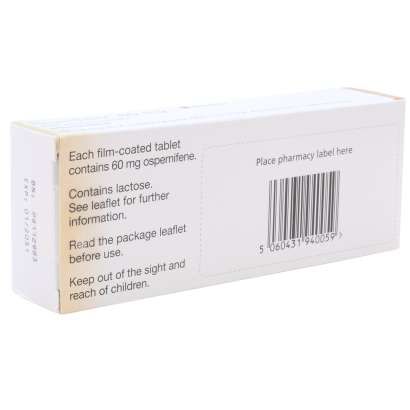
Senshio 60mg Tablets
Senshio 60mg Tablets Product information
£69.89
Hormone fluctuations during menopause can be responsible for a variety of painful and frustrating symptoms. Senshio is a non-hormonal daily tablet that:
Helps relieve vaginal dryness, irritation and pain during sex
Works in a similar way to natural oestrogen in vaginal tissue
Works to make the lining of your vagina healthier and more comfortable
Product Information for Senshio 60mg Tablets
What is Senshio (ospemifene)?
Senshio is a non-hormonal selective oestrogen receptor modulator (SERM) which is a type of medication that works selectively like oestrogen in some tissues of your body, while having different or blocking the effects of oestrogen in others (1). The active ingredient is ospemifene, but it is sold under the brand name Senshio in the UK.
SERM treatments are prescribed for conditions affected by oestrogen, including treating some hormone-positive breast cancers and osteoporosis (2,3). It is also used to help manage menopause-related vaginal symptoms (4).
What is Senshio used for?
Ospemifene is used to treat vulvar and vaginal atrophy that happens after the menopause. Lower oestrogen levels can make the vaginal walls thinner and drier, which may cause itching, burning, soreness, and pain during sex. Ospemifene helps relieve these symptoms by acting in a similar way to oestrogen in the vaginal tissue (5).
How does Senshio work?
Ospemifene works by binding to oestrogen receptors in your body. It acts differently depending on the tissue. In your vagina, it has an oestrogen-like effect that helps your vaginal lining mature and can lower vaginal pH, helping to improve dryness, soreness, and pain during sex.
As a selective oestrogen receptor modulator, its effects elsewhere in your body can differ. Non-clinical studies suggest that it mainly has an anti-oestrogen effect in breast tissue, while clinical trials found a small average increase in womb lining thickness (5).
Who is Senshio suitable for?
Senshio is usually recommended for post-menopausal women who are experiencing vaginal dryness or pain during sexual activity that is affecting their quality of life. As an oral tablet, it may be a better option for you if you are unable to, or don’t want to, use a vaginal product. (5)
You should not take Senshio if you (5):
are still able to become pregnant (you are having periods)
are pregnant or breastfeeding
were born male
are allergic to ospemifene or any of the other ingredients
have a current or have had a past blood clot in a vein (VTE), including a deep vein thrombosis, pulmonary embolism or retinal vein thrombosis
have suspected breast cancer, or are currently being treated for breast cancer (including adjuvant therapy)
have suspected or active sex-hormone-dependent cancer, such as cancer of the womb
have signs or symptoms of endometrial hyperplasia (excessive thickening of the womb lining)
You should speak to a prescriber before taking Senshio if you have (5):
a close relative with a history of blood clots
a BMI over the age of 30
systemic lupus erythematosus (SLE)
previously had a stroke, or a high risk of stroke
a gynaecological condition other than vaginal atrophy
previously been diagnosed with breast cancer
severe liver impairment
have a galactose intolerance, total lactose deficiency or glucose-galactose malabsorption as Senshio contains 1.82mg lactose per tablet
How long does Senshio take to work?
Some people begin to notice an improvement in vaginal dryness, soreness or pain during sex around 4 weeks after starting Senshio. In clinical trials, benefits were seen to continue to improve over the complete 12-week treatment period (6).
Senshio vs vaginal oestrogen
Senshio and vaginal oestrogen both treat menopause-related vaginal dryness, soreness and pain during sex. Vaginal oestrogen is usually the first-choice treatment and is applied directly into your vagina as a cream, pessary, tablet or ring. In comparison, Senshio is a once-daily oral tablet, so may be preferred by people who do not want to, or are unable to use, vaginal treatments (5,7).
Vaginal oestrogen is a topical treatment that works directly where your symptoms occur and is generally recommended ahead of other therapies. It is effective for many people, including if you are taking systemic (whole body) Hormone Replacement Therapy (HRT) (8). Senshio is taken as a tablet and absorbed through the digestive system into the bloodstream. Because it circulates around the body rather than acting only in the vagina, systemic side effects such as hot flushes can occur (9). However, vaginal oestrogen can sometimes cause vaginal bleeding, discharge or breast tenderness (10).
The choice as to which is right for you will depend on your symptoms, preferences, medical history and the recommendation of your clinician.
Senshio 60mg Tablets reviews
How to use Senshio 60mg Tablets
Take one tablet per day with food, at the same time each day, swallowed whole. Taking it at the same time every day will help make your medication a routine. It is important to take Senshio with food as it helps with absorption.
If you miss a dose of Senshio, take it as soon as you remember. Never taken more than one Sensio tablet in the same 24-hour period.
Your treatment should be reviewed at least once every year and only continued if the benefits outweigh any risks associated with treatment.
Medicines that interact with Senshio
There are some medicines that interact with Senshio. For this reason, it is important to let your prescriber know about any other medications that you take before starting it.
You should not combine Senshio with oestrogens (including HRT or any vaginal oestrogens) or other SERM medications like Tamoxifen, Toremifene, Bazedoxifene and Raloxifene.
You should speak to your prescriber if you are taking (5):
Fluconazole, which is an oral antifungal treatment. Fluconazole increases ospemifene levels, so your prescriber may want to pause Senshio while you are taking it.
Rifabutin, rifampicin, carbamazepine and phenytoin, St John’s Wort and Orlistat, as these may reduce Senshio’s effects.
Metformin, acyclovir, ganciclovir and oxaliplatin, as Senshio could increase the levels of these medications.
Additional cautions
If you have an upcoming surgery or other procedure that could affect your mobility, you should stop Senshio at least 4-6 weeks before the start date and only recommence once you are fully mobile again. This is because being immobile naturally increases your risk of developing a blood clot (11).
Storage
Keep Senshio out of the sight and reach of children. Do not use after the expiry date, which refers to the last day of the month and year on the packaging. Return any unused tablets to the pharmacy, do not dispose of with household waste (5).
Side effects of Senshio 60mg Tablets
Like all medications, Senshio can cause some side effects, although you are not guaranteed to get them. Their severity can also vary between different people.
Common side effects
Common side effects can affect up to 1 in 10 people and include:
Vaginal thrush
Hot flushes, including excessive sweating
Muscle cramps
Vaginal or genital discharge
Rash
Headache
Vaginal bleeding (5)
Hot flushes are the most reported side effect, occurring in around 7.5% of patients (5). Please note that this medication does not treat hot flushes.
Uncommon side effects
Uncommon side effects occur in up to 1 in 100 people and include:
Thickening of womb lining (visible on ultrasound examination)
Allergic reaction, with symptoms including rash, itching, hives, swelling of the lips, tongue, mouth, eyes or throat (5)
Please note that if you experience the signs of an allergic reaction, you should cease taking Senshio immediately and contact 111/999 for urgent medical advice.
Note for women of childbearing age:
Senshio is only for women after the menopause. It must not be taken by anyone who is pregnant, could become pregnant or is breastfeeding (5).
Warnings
There are some instances in which you should seek urgent medical advice. You should stop Senshio and contact 999 immediately if you notice:
Signs of a blood clot. Symptoms include painful swelling and redness in a leg, sudden chest pain or difficulty breathing.
Signs of a stroke. Symptoms include face drooping, arm weakness, slurred speech.
Signs of a severe allergic reaction. This includes swelling of your lips, mouth, tongue or throat, severe rash that is spreading, fever, difficulty breathing or swallowing.
If you experience any vaginal bleeding during treatment or soon after stopping, you should also speak to your GP. Any unusual bleeding should always be investigated (5).
-
No, Senshio is neither a hormone nor a form of hormone replacement therapy. It is a non-hormonal treatment that binds to oestrogen receptors to produce oestrogen-like effects in specific tissues within the body (1). It does not contain the conventional hormones usually found in HRT.
The SmPC also explicitly states that the safety of combining ospemifene with oestrogens or other SERMs has not been studied, and so is not recommended (5).
-
No, you should not take Senshio with HRT or a vaginal oestrogen unless specifically advised to by your doctor or another healthcare professional. This is because Senshio’s license is for postmenopausal women who are not candidates for vaginal oestrogen therapies.
-
No. In fact, hot flushes are the most reported side effect associated with using ospemifene, affecting around 7.5% of people who take it (5).
-
You can only take Senshio if you have previously had breast cancer if your treatment has fully finished and your oncologist agrees that the benefit of taking it outweighs any risks. You must not take Senshio if breast cancer is suspected, or active (5).
-
If you decide to stop taking Senshio, the continued underlying oestrogen deficiency suggests that your symptoms are likely to return. However, there is not currently any clinical evidence that has measured how quickly or reliably symptoms have returned after stopping ospemifene. It is recommended that you speak to your prescriber before stopping treatment.
-
The general recommendation is for your prescriber to undertake annual monitoring while you are on Senshio to ensure that the benefit of treatment outweighs any risks involved.
If you have any concerns at any point during your treatment, you should speak to your prescriber or your GP for advice and support.
Important - Before taking any medication, it is always important to read the Patient Information Leaflet (PIL)
National Cancer Institute. Definition of SERM. In: NCI Dictionary of Cancer Terms [Internet]. Bethesda (MD): National Cancer Institute; 2011 [cited 2026 Nov 4]. Available from: https://www.cancer.gov/publications/dictionaries/cancer-terms/def/serm
Kulak Júnior J, Kulak CAM, Taylor HS. SERMs in the prevention and treatment of postmenopausal osteoporosis: An update. Arquivos Brasileiros de Endocrinologia & Metabologia. 2010 Mar;54(2):200–5. [cited 2026 Nov 4]. Available from: https://pmc.ncbi.nlm.nih.gov/articles/PMC3109295/
NHS. Osteoporosis – Treatment. [Internet]. London: National Health Service; 2022 [cited 2026 Nov 4]. Available from:
https://www.nhs.uk/content-widgets/health-a-to-z/osteoporosis/treatment
Selective estrogen receptor modulators [Internet]. PubMed. Bethesda (MD): National Institute of Diabetes and Digestive and Kidney Diseases; 2012 [cited 2026 Nov 4]. Available from: https://www.ncbi.nlm.nih.gov/books/NBK548475/
CHMP. Senshio 60 mg film-coated tablets [Internet]. 2022 [cited 2026 Nov 4]. Available from: https://ec.europa.eu/health/documents/community-register/2022/20220224155017/anx_155017_en.pdf
Nappi RE, Panay N, Bruyniks N, Castelo-Branco C, De Villiers TJ, Simon JA. The clinical relevance of the effect of ospemifene on symptoms of vulvar and vaginal atrophy. Climacteric [Internet]. 2015 Apr [cited 2026 Nov 4];18(2):233–40. Available from: https://pubmed.ncbi.nlm.nih.gov/25335119/
About vaginal oestrogen [Internet]. nhs.uk. 2023 [cited 2026 Nov 4]. Available from: https://www.nhs.uk/medicines/hormone-replacement-therapy-hrt/vaginal-oestrogen/about-vaginal-oestrogen/ [cited 2026 Nov 4].
NHS. Types of hormone replacement therapy (HRT) [Internet]. nhs.uk. 2023 [cited 2026 Nov 4]. Available from: https://www.nhs.uk/medicines/hormone-replacement-therapy-hrt/types-of-hormone-replacement-therapy-hrt/
DeGregorio M, Wurz G, Kao CJ. Safety and efficacy of ospemifene for the treatment of dyspareunia associated with vulvar and vaginal atrophy due to menopause. Clinical Interventions in Aging. 2014 Nov;1939. [cited 2026 Nov 4]. Available from: https://pmc.ncbi.nlm.nih.gov/articles/PMC4235480/
Side effects of vaginal oestrogen [Internet]. nhs.uk. 2023 [cited 2026 Nov 4]. Available from: https://www.nhs.uk/medicines/hormone-replacement-therapy-hrt/vaginal-oestrogen/side-effects-of-vaginal-oestrogen/
National Institute for Health and Care Excellence (NICE). Venous thromboembolism in adults: Diagnosis and management (QS29) [Internet]. NICE; 2021 [cited 2026 Nov 4]. Available from: https://www.nice.org.uk/guidance/qs201/documents/previous-version-of-quality-standard-2
- What is HRT gel?
- What are body-identical hormones?
- What can help with menopausal hair loss?
- HRT alternatives during the Utrogestan shortage in the UK
- How to use Evorel Sequi patches
- Evorel Sequi side effects: what to expect from this HRT
- Burning when I use Ovestin
- Vaginal Lubricants and Moisturisers
- Am I Eligible For The HRT Prepayment Certificate?
- Can I buy Yuvafem in the UK?
Authored on November 5, 2026

Robert Bradshaw (Pharmacist) — MRPharms BSc(Hons) Pharmacy
Superintendent Pharmacist
GPhC Number: 2036118
Reviewed on November 6, 2026
