


Microlife Home Blood Pressure Monitor
Microlife Home Blood Pressure Monitor Product information
£24.98
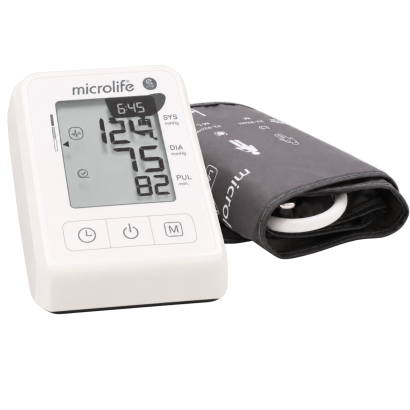
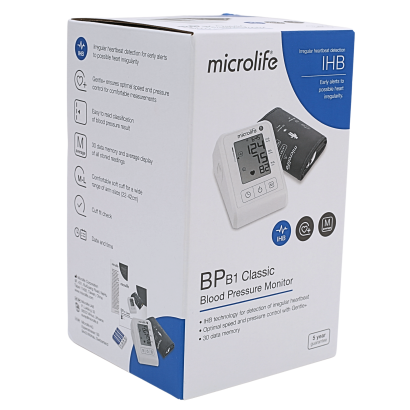
The Microlife BP B1 fully automatic, classic upper arm blood pressure monitor provides accurate blood pressure readings in the comfort of your own home.
Simple to use
Keeps record of your last 30 blood pressure values
Gentle+ technology helps to increase comfort and eliminate the white coat syndrome
Includes irregular heartbeat detection
Product Information for Microlife Home Blood Pressure Monitor
Why monitor at home?
Blood pressure can fluctuate throughout the day and is often higher than normal when taken in a clinical environment. This is referred to as “white coat syndrome” and can happen because you are anxious, often subconsciously, about your medical appointment.
Taking your blood pressure at home is one of the best ways of getting accurate readings during the course of a normal day, without the external pressure of a clinical setting (1).
If your doctor suspects that you have high blood pressure, they will ask you to keep a record of your blood pressure at home to support or refute a diagnosis (2).
What is the Microlife Blood Pressure Monitor?
The Microlife blood pressure monitor is a fully automatic, upper arm blood pressure monitor for home use. It is battery powered (4 x AAA batteries), with an optional mains adapter sold separately.
Simply place the cuff onto your arm, press the button and watch the cuff inflate. Sensors within the cuff measure your systolic pressure, diastolic pressure and pulse to give you a blood pressure and pulse reading.
The Microlife BP B1 has several key features (3):
Gentle+
This advanced technology controls how quickly and high the cuff inflates, aiming to use only the pressure needed to take an accurate reading. This makes taking the measurement more comfortable, particularly if you are sensitive to tight blood pressure cuffs.
Irregular heartbeat detection
This feature monitors your pulse pattern during the reading and will show an IHB/heart symbol if it detects any irregularities. This warns you that the reading may be less reliable, and you should repeat the process. If the symbol appears regularly, speak to your GP.
Cuff fit check
If you are not sure if the cuff is positioned properly, this feature will tell you. It is important because a poorly fitting cuff can distort your results.
Traffic light classification
Understand your results with ease with the traffic light classification system, that will place your reading into an “normal”, “elevated” or “high” category. This makes it simple to understand what your result means.
Memory and average
The BP B1 automatically saves your recent readings, storing a maximum of 30. It can also show the average of your stored values to give you a picture of your blood pressure over time.
Date and time stamps
To add to that, each reading is date and time stamped, so that you can see any developing patterns between morning and evening results (3).
Who is it for?
The Microlife BP B1 is designed for adults and young people over the age of 12 who have an upper arm circumference of between 22 and 42cms. An incorrectly sized cuff may give inaccurate readings, and no alternative cuff size is compatible with this blood pressure machine (4).
You should not use this device:
If you are under the age of 12
On an arm with an injury or open wound, IV drip or any condition or treatment that makes its use unsuitable
On a limb with restricted or impaired circulation
On the arm on the side of a mastectomy or lymph node clearance
In a moving vehicle
On people who are unable to sit still or communicate clearly
You should speak to your doctor before using this device if you:
Have significant cardiac arrythmia, as this may affect the reliability of your readings
Have perfusion or blood disorders
Have a pacemaker, as the pulse display is not suitable for checking pacemaker frequency
Are pregnant, unless otherwise instructed by a licensed medical professional
If you are unsure about using this device, always speak to a medical professional beforehand (4).
What’s in the box?
Your Microlife BP B1 comes with everything you need to start taking readings at home straight away:
Blood pressure monitor unit
Upper arm cuff suitable for arms between 22 and 42cms only
4 x AAA batteries to power the unit
Instruction manual, which explains setup, correct cuff placement and how to read your results
Depending on the exact B1 version you have, your box may also include a blood pressure diary for writing down readings (4).
Microlife Home Blood Pressure Monitor reviews
How to use Microlife Home Blood Pressure Monitor
Setting up your Microlife BP B1 is simple and takes just a few steps:
Insert the batteries into the main unit. These are supplied in the box. Make sure to place them the correct way up, matching the + and – ends with the symbols displayed.
Set the date and time. As soon as the batteries are inserted, you should be prompted to set the current year, month, day, hour and minute, and can use the buttons on the front of the main unit to do this. It is important to do this accurately since every reading you take will be time-stamped.
Plug the cuff’s air tube firmly into the socket on the side of the main unit. It must be secure so that it does not leak air and affect your reading.
Place the cuff onto your bare upper arm, around 2-3cms above your elbow. It should be positioned so that the tube runs down the inside of your arm towards your hand. Make sure it fits snugly, with space for just a fingertip underneath.
You are now ready to use your at-home blood pressure monitor (4).
How do I take an accurate reading?
There are a few things that you should do to make sure that your reading is as accurate as possible. Prepare yourself for the measurement. Start by sitting quietly for around 5 minutes, with your arm at rested so that it is at heart-height and your feet are flat on the floor. This is the optimal position for taking your blood pressure (5).
Other tips for taking an accurate blood pressure reading at home include (6):
Avoid activity, eating or smoking just before taking your measurement.
Sit in the chair with your legs uncrossed and feet flat on the floor for at least 5 minutes before taking your first reading.
Use the same arm each time.
Fit the cuff around 1-2cms above the crook of your elbow, with the artery mark over your inner arm artery and the tube running down your inner arm. Make sure it is fitted snugly, but there is still space to insert a finger between your arm and the cuff.
Stay still, breathe normally and don’t speak while the machine is working.
You are now ready to take your reading.
Press the ON/OFF button. The cuff will inflate gradually, with the GentleX technology helping to keep you comfortable during this process. Once it has reached the correct pressure, it will deflate automatically and show your systolic pressure, diastolic pressure and pulse on the screen. You can record this manually, but your device will also store and time-stamp the last 30 readings that you take (3).
How often should I measure my blood pressure?
General guidance for measuring your blood pressure that is provided with the Microlife BP B1 is to take at least two readings each time you measure, leaving at least 5 minutes between each reading. You should take readings in the morning before you eat or take any medicines, and in the evening, before taking any nighttime medicines, bathing or bed. Once you have two or more readings, take the average of these (4).
NICE guidelines for monitoring your blood pressure at home recommend that you take at least two consecutive readings at least one minute apart, for at least 4 and no more than 7 days. You should discard the first reading, which is usually higher, and then average the results (7).
However, we suggest that you always follow the recommended schedule of home blood pressure monitoring provided by your doctor.
How to read a blood pressure monitor
The Microlife BP B1 makes it easy to read and understand your blood pressure reading. Not only does the display show your systolic, diastolic and pulse readings, but it also categories your blood pressure into one of three categories as follows:
Normal: systolic <130 and diastolic <80
Elevated: systolic 130-134 and diastolic 80-84
Too high: systolic >135 and diastolic >85
( < = less than / > = more than )
If your blood pressure is repeatedly in the too high category, you should seek medical advice. This is not a definitive diagnosis of high blood pressure but should be investigated.
If you are experiencing low readings that are below the normal range, particularly if they are accompanied by dizziness or fainting, you should speak to your doctor.
If your blood pressure is in the too high category and you are also experiencing chest pain, severe headache, breathlessness, confusion, vision changes or weakness/numbness, seek urgent medical help by calling 999. You could be having a medical emergency.
Do not start/stop any new medications based on home readings.
Error messages, batteries and storage
The Microlife BP B1 may display several error messages during a failed measurement. These are:
ERR 1: This means that the pulse signal is too weak to get accurate reading. Reposition the cuff ensuring it is correctly placed, and repeat.
ERR 2: This error may occur if a movement, muscle tension or other disturbance has interefered with the measurement.
ERR3: There is abnormal or not enough cuff pressure. This can happen if there is an air leak, loose connection, loose cuff or low battery life. Repair/replace as needed.
ERR5: This indicates an abnormal or unreadable result because the measurement signals were inaccurate. Restart the process and try again.
You may also see a battery symbol on the display. If this appears, the batteries are low and should be replaced. This device takes 4 x AAA batteries which are supplied in the box. There is also an optional mains adapter (DC 6v 600mA) which can be purchased separately. The battery life is approximately 400 measurements. Please note that all stored measurements will be lost when the batteries are replaced (5).
Care, storage and service life
Clean the monitor with a soft, dry cloth only. Spot-clean the cuff with a damp cloth and soapy water. Do not machine-wash or tumble-dry the cuff.
Protect the device from liquids, extreme temperatures, impacts, direct sunlight and dust.
Remove batteries if storing for a long period.
Keep away from children aged 0-3 (small parts, strangulation risk from tubing).
Guarantee: 5 years (monitor), 2 years (cuff).
NHS. Check your blood pressure reading - NHS [Internet]. nhs.uk. 2023 [cited 2026 Oct 29]. Available from: https://www.nhs.uk/health-assessment-tools/check-your-blood-pressure-reading
National Institute for Health and Care Excellence (NICE). Hypertension in adults: Diagnosis and management [Internet]. Nice.org.uk. NICE; 2023 [cited 2026 Oct 29]. Available from: https://www.nice.org.uk/guidance/ng136
Microlife AG. BP B1 classic - blood pressure monitor [Internet]. Microlife AG. MASSIVE ART WebServices GmbH; [cited 2026 Oct 29]. Available from: https://www.microlife.com/consumer-products/blood-pressure/upper-arm-automatic/b1-classic
Microlife AG. BP B1 Standard blood pressure monitor: instruction manual [Internet]. Widnau: Microlife AG; 2025 [cited 2026 Oct 30]. Available from: https://www.microlife.com/media/5868/download/IB%20BP%20B1%20Standard%20S-V11%203125.pdf?v=3
Muntner P, Shimbo D, Carey RM, Charleston JB, Gaillard T, Misra S, et al. Measurement of blood pressure in humans: A scientific statement from the American Heart Association. Hypertension. 2019 Mar 4;73(5). [cited 2026 Oct 29]. Available from: https://www.ahajournals.org/doi/10.1161/HYP.0000000000000087
Blood Pressure UK. Blood pressure UK [Internet]. www.bloodpressureuk.org. 2021 [cited 2026 Oct 30]. Available from: https://www.bloodpressureuk.org/your-blood-pressure/how-to-lower-your-blood-pressure/monitoring-your-blood-pressure-at-home/how-to-measure-your-blood-pressure-at-home/
NICE. Recommendations | hypertension in adults: Diagnosis and management | guidance | NICE [Internet]. Nice.org.uk. NICE; 2023 [cited 2026 Oct 30]. Available from: https://www.nice.org.uk/guidance/ng136/chapter/recommendations
- How often should you check your health?
- DIY health - tests for taking care of yourself at home
- Save on Your Treatment This January
- How blood affects erections: the science behind erectile dysfunction
- Why do ED medicines work for some people but not others?
- How do GLP-1 side effects compare between treatments?
- What is the Black Market for Prescription Medication?
- What is GLP-1, and what does it have to do with weight?
- What does Mounjaro do in the body?
- Oral semaglutide for Alzheimer’s: What the EVOKE trial results tell us
Authored on November 5, 2026

Robert Bradshaw (Pharmacist) — MRPharms BSc(Hons) Pharmacy
Superintendent Pharmacist
GPhC Number: 2036118
Reviewed on November 6, 2026
