

SELFCheck Liver Health Test
SELFCheck Liver Health Test Product information
£17.99
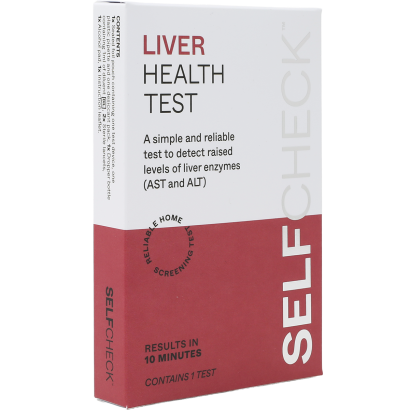
The SELFCheck Liver Health Test is a simple finger-prick blood test that lets you check your liver health at home in just 10 minutes. It checks for raised levels of two liver enzymes, ALT and AST, which can increase when your liver is damaged or inflamed (1).
Liver disease often develops without symptoms, so you may not realise anything is wrong (2,3). If you drink more alcohol than recommended, are living with obesity or want to be more proactive about your liver health, this test offers a quick way to check for signs of possible liver problems from home.
Tests two liver enzymes: ALT and AST, with a separate result for each
At-home testing: Uses a small finger-prick blood sample
Quick results: Read your results at home after 10 minutes.
Easy-to-read format: Coloured lines indicate whether either enzyme is raised.
Single-use kit: One test per pack, with no laboratory return required.
This is a screening test, not a diagnosis of liver disease. A positive result requires medical follow-up, and a negative result does not rule out liver disease.
Product Information for SELFCheck Liver Health Test
What is the SELFCheck Liver Health Test?
The SELFCheck Liver Health Test checks for raised levels of two enzymes in your blood, called ALT and AST. These enzymes are normally found inside liver cells. When cells become damaged, the enzymes can leak into your bloodstream, causing their levels to rise (4).
The liver function test checks each enzyme separately, using coloured lines to show whether ALT, AST or both are higher than expected. It doesn't give you exact enzyme levels like a laboratory test would, only whether they're above a certain threshold of 80 IU/L (1,4).
The test cannot diagnose liver disease, but it can give insight into whether something might be wrong.
Why should you check your liver health?
Your liver works hard every day, processing alcohol and medicines, helping digest food and removing waste products from your blood. Unfortunately, liver problems often develop without any noticeable signs. By the time symptoms appear, significant liver damage may already have occurred (2).
Many common causes of liver disease are preventable (5), so looking after your liver health is worthwhile even when you're feeling well. The SELFCheck Liver Health Test offers a simple way to check for raised liver enzymes to get a glimpse into your liver health from home.
Liver damage is also more common in certain people, so you may be particularly interested in the ALT AST home blood test if you (2,3,5):
Drink alcohol regularly, especially if you sometimes exceed the recommended limits.
Are overweight or living with obesity, which increases the risk of fat building up in your liver.
Have a history of hepatitis, which can cause liver inflammation and damage.
If you have symptoms such as unexplained weight loss, loss of appetite or yellowing of your skin or eyes (jaundice), speak to your GP rather than relying on self-testing kits.
What do ALT and AST tell you about your liver?
ALT and AST can both rise when liver cells are damaged, but there is an important difference (4):
ALT (alanine transaminase) is found mainly in your liver, so raised levels are more likely to suggest liver damage or inflammation.
AST (aspartate transaminase) is found in your liver, but also in your muscles, heart and other parts of your body. Raised AST levels don't always point to a liver problem.
If your liver health test result is positive for one or both of these enzymes, you'll need to speak to your GP about further blood testing.
A laboratory liver function test usually measures ALT alongside other markers, including bilirubin, albumin and alkaline phosphatase (ALP). These give your doctor a more complete picture of your liver health so they can decide what to do next (5).
How accurate is the SELFCheck Liver Health Test?
In manufacturer testing, the SELFCheck Liver Health Test agreed with laboratory results 95.83% of the time (4). This is a measure of how closely the home test matches laboratory ALT and AST results, not how accurately it diagnoses liver disease.
However, all medical tests can give false positive or negative results, including this one (4):
False positive: The test suggests your ALT or AST is raised when laboratory testing would not identify a raised level. If you get a positive result, speak to your GP about further testing to confirm whether your liver enzymes are actually raised.
False negative: The test suggests your ALT and AST are not raised when laboratory testing would identify a raised level. If you have symptoms or risk factors for liver disease, speak to your GP even if your result is negative.
Follow the instructions supplied with your liver function test kit exactly. Using the wrong amount of blood, missing a step or reading your result at the wrong time could give you an incorrect result.
When should you speak to a doctor?
Speak to your GP if you receive a positive result, even if you feel well (4). They can arrange further blood tests and investigate why your liver enzymes may be raised.
You should also speak to your GP if you have symptoms that could suggest a liver problem, such as:
Loss of appetite
Unexplained weight loss
Yellowing of your skin or the whites of your eyes (jaundice) (2)
Don't ignore symptoms because your home test is negative. If you develop jaundice, seek urgent medical advice, regardless of your test result.
If you are concerned about your liver health or unsure what your result means, your GP or pharmacist can advise you.
SELFCheck Liver Health Test reviews
How to use SELFCheck Liver Health Test
Each kit contains everything you need to complete one test at home:
One test device in a sealed foil pouch
One plastic pipette for collecting your blood sample
One dropper bottle containing 1 ml of diluent (testing solution)
Two sterile lancets for pricking your finger
One alcohol pad
An instruction leaflet
The SELFCheck Liver Health Test is quick and easy to use at home. You only need a small blood sample from your fingertip, and your results are ready in 10 minutes (1).
Collect your blood sample: Clean your fingertip with the alcohol pad, then use a lancet to prick your finger and collect blood using the pipette.
Prepare your test: Add your blood sample and testing solution to the test device, following the instructions that come with your testing kit.
Wait 10 minutes: Allow the test to develop, then check the coloured lines to read your result.
Follow the manufacturer's instructions exactly, including how much blood to use, when to add any testing solution and when to read your result. Missing a step or using the test incorrectly could give you a false positive or false negative result.
Store the kit according to the temperature, packaging and expiry instructions provided by the manufacturer. Do not use the kit after its expiry date or if the packaging is damaged.
How do you read your liver health test results?
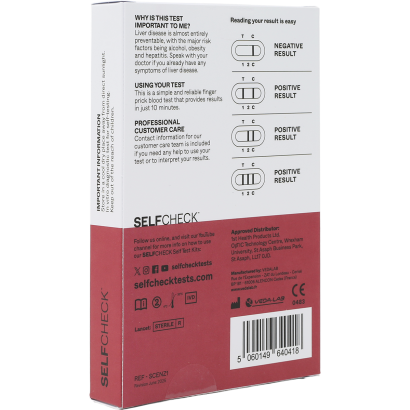
The test device uses coloured lines to show whether your ALT or AST levels are raised. A blue line next to C (control) shows that the test has worked correctly (1,4).
Result | What you’ll see | What it means | What to do next |
|---|---|---|---|
Positive for ALT | Blue control line (C) and a coloured test line (T) for ALT only | Your ALT may be raised, which can suggest liver damage or inflammation. | Speak to your GP about further blood testing. |
Positive for AST | Blue control line (C) and a coloured test line (T) for AST only | Your AST may be raised. AST can rise due to muscle damage or strenuous exercise, so it doesn't necessarily mean you have a liver problem. | Speak to your GP about further blood testing. |
Positive for both | Blue control line (C) and coloured test lines (T) for ALT and AST | Both enzymes may be raised, which can suggest liver damage or inflammation, although other causes are possible. | Speak to your GP about further blood testing. |
Negative | Blue control line (C) with no coloured test lines (T) | Neither enzyme was detected above the test's threshold. This doesn't rule out liver disease. | If you have symptoms or risk factors, speak to your GP. |
Invalid | No blue control line (C), regardless of whether any test lines appear | The test hasn't worked correctly, so the result is unreliable. | Repeat the test using a new kit, following the manufacturer's instructions. |
Don't stop or change your prescribed medicines or make treatment decisions based on a home test result alone (4).
Raised ALT or AST levels can have several causes, so speak to your GP or pharmacist before making changes to your medicines, supplements or health management.
What are the limitations of the SELFCHECK Liver Health Test?
The SELFCHECK Liver Health Test is a useful way to check for raised liver enzymes at home, but it cannot tell you whether you have liver disease or what might be causing a problem.
There are several limitations to be aware of:
It only checks two liver enzymes. A full laboratory liver function test measures other substances that give your doctor more information about your liver health, which will be needed if you have a positive self-test result.
It may miss smaller increases. The test only gives a positive result when ALT or AST reaches 80 IU/L. Your enzyme levels could still be higher than normal, even if your test result comes back negative.
It cannot rule out liver disease. Some liver conditions do not cause raised ALT or AST levels, even when liver damage is present. This means a negative result doesn't necessarily mean your liver is healthy.
The test should be used as an initial screening tool rather than a replacement for medical advice or laboratory testing.
-
Yes, the SELFCheck Liver Health Test allows you to check for raised ALT and AST enzymes using a finger-prick blood sample at home. However, it does not provide a complete liver function assessment. A laboratory test may be needed to investigate your liver health further.
-
This liver function test kit provides a positive or negative result for raised ALT and AST, without showing their exact levels. A laboratory liver function test measures specific enzyme levels and usually includes additional markers, such as bilirubin, albumin and ALP.
-
A positive result means the test has detected ALT or AST at or above its stated threshold of 80 IU/L. This may indicate liver cell damage, but it can also have other causes. Your GP can arrange further tests to investigate the result.
-
The test requires a small finger-prick blood sample, so you may feel a brief sharp sensation when collecting it. Some people may find this sensation uncomfortable, but the process is generally quick, and any discomfort is usually short-lived.
-
There is no specific routine retesting interval. How often you need your liver health checked depends on your medical history, risk factors and any previous results. Your GP can advise whether repeat ALT AST home blood testing or laboratory monitoring is appropriate.
-
Yes, the SELFCHECK Liver Health Test is a self-testing medical device, not a medication, and you do not need a prescription to buy one. You can find it alongside other self-testing kits available from Oxford Online Pharmacy.
SELFCHECK. Liver Health Test: ALT & AST liver function enzymes [Internet]. Revised 14 April 2026 [cited 2026 Oct 16].
NHS. Liver disease [Internet]. [cited 2026 Oct 16].
NHS. Alcohol-related liver disease (ARLD) [Internet]. [cited 2026 Oct 16].
SELFCHECK. SELFCHECK Liver Health Test – Data Sheet for HCPs [Internet]. Revised 15 August 2025 [cited 2026 Oct 16].
MyHealth Devon. Abnormal Liver Blood Tests [Internet]. NHS. [cited 2026 Oct 16].
- How often should you check your health?
- DIY health - tests for taking care of yourself at home
- Save on Your Treatment This January
- How blood affects erections: the science behind erectile dysfunction
- Why do ED medicines work for some people but not others?
- How do GLP-1 side effects compare between treatments?
- What is the Black Market for Prescription Medication?
- What is GLP-1, and what does it have to do with weight?
- What does Mounjaro do in the body?
- Oral semaglutide for Alzheimer’s: What the EVOKE trial results tell us
Authored on October 28, 2026

Robert Bradshaw (Pharmacist) — MRPharms BSc(Hons) Pharmacy
Superintendent Pharmacist
GPhC Number: 2036118
Reviewed on October 29, 2026
