

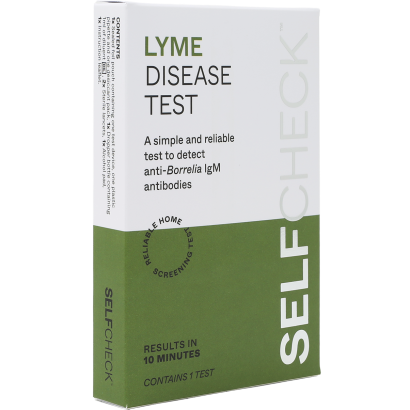
SELFCheck Lyme Disease Test
SELFCheck Lyme Disease Test Product information
£17.99
Product Information for SELFCheck Lyme Disease Test
What is the SELFCheck Lyme Disease Test?
The SELFCHECK Lyme Disease Test checks for immunoglobulin M (IgM), one of the first types of antibodies your immune system produces in response to Borrelia bacteria (1,2).
The test uses a lateral flow device, similar to a rapid COVID-19 test, to show whether these antibodies are in your blood. Unlike a laboratory blood test, it doesn't measure antibody levels or check for other antibody types, such as IgG, which usually develop later.
You’ll get your results at home in 10 minutes, without needing to send a sample to a laboratory (1). The manufacturer recommends testing two to six weeks after a suspected tick bite, as antibodies can take time to become detectable (1,2).
Tests for anti-Borrelia IgM: Antibodies your body produces after a bite by an infected tick
At-home testing: Uses a small finger-prick blood sample
Quick results: Read your result at home after 10 minutes
Simple result format: Coloured lines indicate whether antibodies have been detected
Single-use kit: One test per pack, with no laboratory return required
This is a screening test and cannot diagnose Lyme disease. Positive results suggest a possible infection that needs assessment by your GP. Negative results cannot rule out infection. If you have symptoms, seek medical advice rather than relying on a home test.
What is Lyme disease and how do you get it?
Lyme disease is a bacterial infection spread to humans through bites from infected ticks (3). Ticks are tiny spider-like creatures found in UK woodlands, parks and gardens. Not all ticks carry Borrelia bacteria, so a tick bite doesn't necessarily mean you'll develop Lyme disease (3).
If an infected tick has bitten you, one of the most recognisable signs is an expanding circular or oval rash around the bite, called erythema migrans. It often looks like a bullseye, but not always. It usually appears within one to four weeks of getting bitten, but can appear up to 3 months later (3).
If you develop the erythema migrans rash, speak to your GP rather than taking a home test. The rash is such a strong sign of Lyme disease that NICE recommends diagnosing and treating it without waiting for blood test results (4).
Not everyone develops a rash, and some people don't even notice being bitten. The SELFCHECK Lyme Disease Test can check whether your body has produced antibodies against Borrelia bacteria, although testing without symptoms isn't routinely recommended (4).
Left untreated, Lyme disease can sometimes cause serious complications affecting the joints, heart or nervous system (3,4).
When should you take a Lyme disease test?
The Lyme Disease Test is to be used two to six weeks after a suspected tick bite (1,2).
Testing too early can give you a false-negative result, even if you've been infected. This is because the test looks for IgM antibodies, rather than the Borrelia bacteria themselves. Your body can take two to four weeks to produce enough antibodies for the test to pick up.
The antibodies generally become easier to detect as the infection progresses. In the first two to four weeks, antibodies are detectable in around 40% to 60% of people with Lyme disease, but detection rates increase to around 70% to 90% in the following four to six weeks (2).
IgM levels can drop later on, so waiting longer than six weeks won't necessarily give you a more reliable result.
If you have symptoms of Lyme disease, don't wait to take the test. Speak to your GP urgently.
How accurate is the SELFCheck Lyme Disease Test?
In manufacturer testing, the SELFCHECK Lyme Disease Test produced the same result as laboratory antibody tests in around 89% of cases (2).
But the test can miss infections even when used within the recommended two-to-six-week window. During this period, the manufacturer reports a sensitivity of 53.8%, meaning the test may miss nearly half of positive cases and give a false-negative result (2). This is more likely the earlier you test.
False-positive results are also possible, where the test detects antibodies even though you don't have Lyme disease. This can happen when antibodies produced in response to other infections or autoimmune conditions react with the test (1,2).
For these reasons, a positive result needs medical assessment, while a negative result cannot completely rule out Lyme disease.
What are the limitations of the SELFCheck Lyme Disease Test?
The SELFCHECK Lyme Disease Test can accurately check for an early antibody response to Borrelia bacteria, but it does have limitations (1,2):
It doesn't check for all Lyme disease antibodies. Your body produces different antibodies at different stages of the infection. This test only looks for IgM, whereas laboratory tests can check for both IgM and IgG, which the body makes later.
It can miss an infection. If you test too early, your body may not have produced enough IgM antibodies to detect. IgM levels can also fall later in infection, meaning a negative result doesn't always rule out Lyme disease.
A positive test doesn't always mean Lyme disease. Antibodies produced in response to other infections, such as glandular fever and syphilis, or autoimmune conditions can sometimes react with the test and give a positive result.
It can't tell you if you currently have Lyme disease. Even if the test detects anti-Borrelia IgM antibodies, the test can't tell you when you were infected, whether the infection is still active, or whether you have fought it off.
When should you speak to a doctor?
Ask for an urgent GP appointment if you develop symptoms of Lyme disease, whether your home test is positive or negative. Symptoms to look out for include (3,4):
A circular or oval rash that gradually spreads
Fever, chills or flu-like symptoms
Persistent headaches or unusual tiredness
Muscle or joint pain
If your home test is positive but you feel well, contact your GP to discuss the result and whether further testing is needed.
Some complications of Lyme disease need more urgent attention. Seek urgent medical help if you develop facial weakness, a severe headache with a stiff neck, or a racing or irregular heartbeat. Call 999 if you have life-threatening symptoms.
SELFCheck Lyme Disease Test reviews
How to use SELFCheck Lyme Disease Test
How do you use the Lyme disease test kit?
The SELFCHECK Lyme Disease Test uses a small blood sample from your fingertip. Once you've collected your sample and prepared the test, you can read the result after 10 minutes (1).
Take a blood sample: Clean your fingertip and prick it using the lancet provided. Use the equipment in your kit to collect the amount of blood needed.
Prepare the test: Add your blood sample and the testing solution to the test device, following the instructions in your kit.
Read your result: Wait 10 minutes, then check the coloured lines to see your result.
Always follow the instructions included with your kit. These explain exactly how much blood and testing solution to use, and when to read your result. Not following the steps correctly could affect how accurate your result is.
Store the kit according to the temperature, packaging and expiry instructions provided by the manufacturer. Do not use it after its expiry date or if the packaging is damaged.
How do you read your Borrelia IgM home blood test results?
Once you’ve added your blood sample to the test, it moves through a test strip, and coloured lines indicate the result. The control line (C) must appear for the result to be valid.
Result | What you'll see | What it means | What to do next |
|---|---|---|---|
Positive | Control line (C) and test line (T) | Borrelia IgM antibodies may be present. This does not confirm Lyme disease. | Contact your GP promptly for assessment. |
Negative | Control line (C) only | No Borrelia IgM antibodies were detected. This does not rule out infection. | If you have symptoms or concerns, speak to your GP. |
Invalid | No control line (C), whether or not a test line appears. | The test hasn't worked correctly, so the result is unreliable. | Repeat using a new kit, following the instructions carefully. |
Side effects of SELFCheck Lyme Disease Test
-
Yes, the SELFCHECK Lyme Disease Test lets you check for anti-Borrelia IgM antibodies using a finger-prick blood sample. Positive results suggest an infection, but the test cannot diagnose Lyme disease. You’ll need to see your GP to get a diagnosis and treatment.
-
Yes, Borrelia IgM home blood test kits can give false-negative results, particularly if you take the test too soon after being bitten by an infected tick. You should speak to your GP if you have symptoms or concerns, even if your home test comes back negative (4).
-
Lyme disease is treated with antibiotics, but you won’t necessarily need them following a positive home test result. False positives are possible, so your GP will need to consider your symptoms and any further test results before deciding whether you need treatment.
-
The SELFCHECK Lyme disease test checks for IgM antibodies only and gives a positive or negative result at home within 10 minutes. NHS laboratory testing checks for both IgM and IgG antibodies, but you will need to wait for your result to come back from the lab (4).
-
The Lyme disease test is a blood test, so you will need to collect a small sample of your blood by pricking your fingertip. You may feel a brief sharp sensation when using the lancet, but any pain or discomfort is usually short-lived.
-
Yes, the SELFCHECK Lyme Disease Test kit is a self-testing medical device, not a medication, and you do not need a prescription to buy one. You can find it alongside other self-testing kits available from Oxford Online Pharmacy.
-
Yes, the SELFCHECK Lyme Disease Test kit is a self-testing medical device, not a medication, and you do not need a prescription to buy one. You can find it alongside other self-testing kits available from Oxford Online Pharmacy.
SELFCHECK. Lyme Disease Test: Borrelia IgM Antibody Home Blood Test. Updated 14 April 2026. Accessed 15 October 2026.
SELFCHECK. SELFCHECK Lyme Disease Test – Data Sheet for HCPs. Revised 15 August 2025. Accessed 15 October 2026.
NHS. Lyme disease.
NICE. Lyme disease: NICE guideline NG95. Published 2018.
- How often should you check your health?
- DIY health - tests for taking care of yourself at home
- Save on Your Treatment This January
- How blood affects erections: the science behind erectile dysfunction
- Why do ED medicines work for some people but not others?
- How do GLP-1 side effects compare between treatments?
- What is the Black Market for Prescription Medication?
- What is GLP-1, and what does it have to do with weight?
- What does Mounjaro do in the body?
- Oral semaglutide for Alzheimer’s: What the EVOKE trial results tell us
Authored on October 25, 2026

Reviewed on October 26, 2026

Robert Bradshaw (Pharmacist) — MRPharms BSc(Hons) Pharmacy
Superintendent Pharmacist
GPhC Number: 2036118