


-
 UK-registered clinical team
 -
Confidential & secure
-
No GP visit needed
-
Fast & discreet delivery


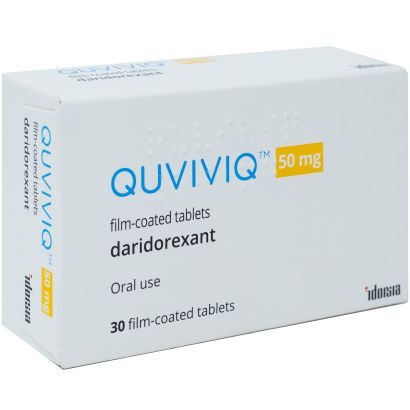

Quviviq (daridorexant) 50mg 30 tablets
Quviviq (daridorexant) 50mg 30 tablets Product information
£79.98
Helps you fall asleep, stay asleep, and wake feeling restored
Quviviq (Daridorexant) is a licensed treatment for adults who struggle to fall asleep or stay asleep, especially when it affects daily functioning and has lasted for 3 months or more.
It is a prescription-only medicine (POM).
Product Information for Quviviq (daridorexant) 50mg 30 tablets
About Quviviq
Quviviq 50mg tablets are used to treat chronic insomnia in adults. It contains the active ingredient Daridorexant, which is part of a new group of medications called Orexin Receptor Antagonists. These medications interact with the signals in the brain that keep you awake, helping you sleep better and feel more rested in the morning.
Quviviq is not suitable for occasional sleeplessness, jet lag, or sleep problems related to shift work.
It is prescribed only to adults aged 18 to 75 and will not be prescribed to those over 75 or anyone with a history of narcolepsy.
We typically prescribe up to 3 months of treatment. Data suggests there is no withdrawal or rebound insomnia after stopping [1].
What is Quviviq used for?
Quviviq is used to treat chronic insomnia in adults. This is when a person has difficulty falling asleep, staying asleep, or both, for 3 months or more, and the lack of sleep causes problems with concentration, mood, or fatigue during the day [2].
Please note:
It is not used to treat temporary sleep problems or jet lag and is not prescribed for those with sleep problems due to shift work.
How does Quviviq work?
Quviviq works by blocking Orexin, a chemical in the brain that keeps you awake. By reducing Orexin activity, Quviviq helps your brain to shift into sleep mode more easily and stay asleep longer.
It is different from traditional sleeping tablets, which work by sedating the brain. Quviviq works with your body’s natural sleep–wake cycle. It does not sedate your brain activity like more traditional sleeping tablets.
How long does Quviviq take to work?
You may begin to notice improved sleep within the first few nights. For others, it may take 2–3 weeks to feel the full benefit. It should be taken every night as prescribed.
Who can take Quviviq?
You may be suitable for Quviviq if you:
- Are aged 18–75
- Have had insomnia for 3 months or longer
- Have daytime problems due to poor sleep
- Are not pregnant or breastfeeding
- Are not taking certain other medications (see below)
Quviviq is not right for you if you:
- Are under 18 or over 75 years of age
- Have a history of hypersensitivity to Daridorexant or any components of Quviviq
- Have a history of narcolepsy
- Are using it for shift work or jet lag
- Are using certain medicines that strongly affect how your liver processes drugs. These are known as strong CYP3A4 inhibitors or inducers
How do I take Quviviq?
Take one 50mg tablet about 30 minutes before going to bed.
Only take Quviviq when you can get at least 7 hours of sleep.
- Swallow the tablet whole with water
- Do not take with a heavy meal
- Do not take more than once per night
Important note: If you miss a dose, skip it and wait until the next night. Do not double up.
Quviviq (daridorexant) 50mg 30 tablets reviews
How to use Quviviq (daridorexant) 50mg 30 tablets
You must always take medicine as recommended by your prescribing doctor.
The recommended dose of Quvivic is one 50-mg tablet every night, 30 minutes before bed.
Avoid taking this medication with a large meal, as it may affect absorption, which can reduce the tablet's effectiveness.
Side effects of Quviviq (daridorexant) 50mg 30 tablets
Like all prescription medicines, Quviviq can cause side effects, although not everyone will experience them.
Common side effects (may affect more than 1 in every 100 users) include:
- Headache
- Somnolence (daytime sleepiness)
- Fatigue
- Dizziness
- Nausea
Serious but rare side effects:
- Complex sleep behaviours, such as sleepwalking or sleep-driving
- Sleep paralysis, hallucinations, and cataplexy-like symptoms
- Mood changes and suicidal thoughts, mainly in patients with a history of depression
These figures show that most side effects are mild and uncommon (affecting around 1 in every 1000 users), with more serious ones being rare but important to monitor.
Avoid driving or operating machinery until you know how the medicine affects you.
Seek medical help if you notice mood changes, confusion, or worsening sleep.
Read more about taking Quviviq in the Directions for Use section and remember to always fully read the Patient Information Leaflet that comes with the medication.
Do not take Quviviq if you:
- Are over 75 years of age
- Have a history of narcolepsy
- Are using strong CYP3A4 inhibitors or inducers
- (e.g. Clarithromycin, Erythromycin, Fluconazole, Carbamazepine, Phenytoin, Ritonavir, Diltiazem, Verapamil)
- Have severe liver disease
Please speak to us with any questions you may have. We’re happy to help.
-
Quviviq is used to treat long-term insomnia in adults who have had symptoms for 3 months or longer.
-
It targets the brain’s wake signals rather than sedating the entire nervous system.
-
Take one tablet about 30 minutes before bedtime, when you can sleep for 7 hours.
-
No. Quviviq is not prescribed for short-term sleep problems or shift-related insomnia.
-
This is very unlikely. Studies show no withdrawal or rebound (recurring) insomnia after stopping Quviviq.
-
Avoid alcohol while taking this medication. It can increase drowsiness and side effects.
-
No. Quviviq is not recommended in pregnancy or breastfeeding.
-
Do not take extra. Skip the missed dose and take the next tablet as scheduled.
Important - Before taking any medication, it is always important to read the Patient Information Leaflet (PIL)
Quviviq (daridorexant) 50mg 30 tablets - Patient Information Leaflet
- Mignot E, Leger D, Fietze I, Pain S, Seboek Kinter D, Flamion B. Absence of withdrawal symptoms and rebound insomnia upon discontinuation of daridorexant in patients with insomnia. Sleep [Internet]. 2021 May [cited 2025 Jun 15];44(Suppl 2):A139.
- National Institute for Health and Care Excellence (NICE). Clinical Knowledge Summaries: Insomnia – Prescribing Information [Internet]. London: NICE; 2023 [cited 2025 Jun 15].
- Quviviq official website [Internet]. Idorsia; [cited 2025 Jun 15].
- Quviviq 50mg film-coated tablets. Patient Information Leaflet (PIL) [Internet]. London: EMC; [cited 2025 Jun 15].
- Quviviq 50mg film-coated tablets. Summary of Product Characteristics [Internet]. London: EMC; [cited 2025 Jun 15].
- British National Formulary (BNF). Daridorexant [Internet]. NICE; 2024 [cited 2025 Jun 15].
- Save on Your Treatment This January
- How blood affects erections: the science behind erectile dysfunction
- Why do ED medicines work for some people but not others?
- How do GLP-1 side effects compare between treatments?
- What is the Black Market for Prescription Medication?
- What is GLP-1, and what does it have to do with weight?
- What does Mounjaro do in the body?
- Oral semaglutide for Alzheimer’s: What the EVOKE trial results tell us
- What you need to know about Wegovy 7.2mg
- What is Finasteride and how does it work for hair loss?
Authored on July 16, 2025

Robert Bradshaw (Pharmacist) — MRPharms BSc(Hons) Pharmacy
Superintendent Pharmacist
GPhC Number: 2036118
Reviewed on July 16, 2025
