

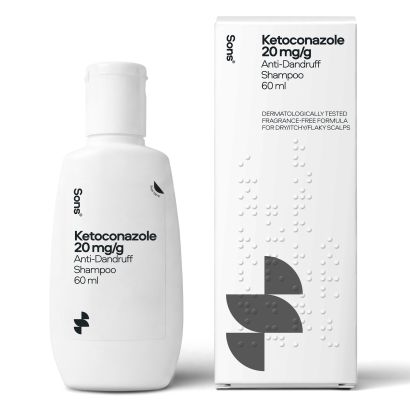
Sons Ketoconazole 2% Anti-Dandruff Shampoo
Sons Ketoconazole 2% Anti-Dandruff Shampoo Product information
£8.75 (£0.00 per )
Dandruff is very common in the UK, affecting a significant number of adults, although exact figures aren’t available. Scalp fungal infections are much less often in adults but both cause flaking, itching and irritation that can impact your day-to-day life.
Ketoconazole shampoo is an effective treatment for dandruff and fungal scalp infections and works by disrupting or destroying the yeast/fungus linked to dandruff and scalp infections, particularly Malassezia– a type of fungus that naturally lives on the skin which can overgrow and trigger an inflammatory response. It also reduces inflammation that causes itching and flaking (1).
Product Information for Sons Ketoconazole 2% Anti-Dandruff Shampoo
What is Ketoconazole anti-dandruff shampoo?
Sons Ketoconazole 2% shampoo is an anti-dandruff shampoo containing the active ingredient Ketoconazole– a pharmacological anti-fungal treatment for dandruff and fungal scalp infections.
How does Ketoconazole anti-dandruff shampoo work?
Ketoconazole shampoo works by targeting the yeast/fungus responsible for dandruff (Malasezzia) and fungal scalp infections.
Malasezzia is a yeast-like fungi that naturally lives on human skin, particularly oily areas such as your scalp. In some people, changes in Malasezzia levels or skin sensitivity can cause dandruff (pityriasis capitis) or an inflammatory skin condition called seborrheic dermatitis and other scalp problems (1).
Ketoconazole disrupts the fungus, preventing cell production so that the fungus is unable to grow properly. This mechanism keeps flaking, itchiness and irritation under control (2).
How quickly will Ketoconazole work to stop my dandruff?
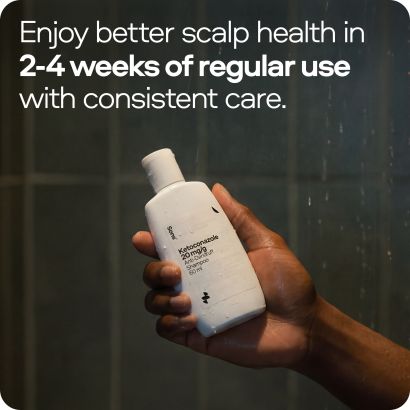
Most people start to notice an improvement in their symptoms within 2 weeks of starting treatment, with optimal results usually being achieved between 2 and 4 weeks when Ketoconazole is used consistently (2).
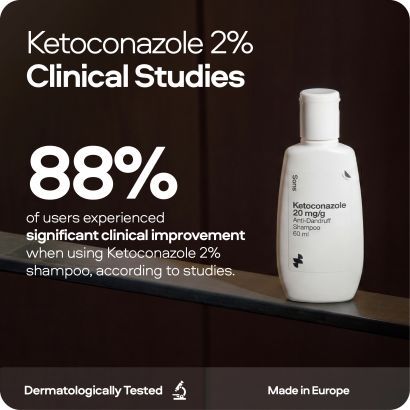
A clinical trial of 2% ketoconazole shampoo, the ketoconazole formulation significantly reduced both flakiness and Malassezia density from baseline after 2 and 4 weeks of treatment (2).
To get the best results:
Use twice a week (with at least 3 days between uses)
Leave it on the scalp for the recommended contact time before rinsing (see directions for use)
Stick with it for the full course, even if symptoms start to ease early
If you see no improvement after 4–6 weeks, speak to a pharmacist or your GP
Sons Ketoconazole 2% Anti-Dandruff Shampoo reviews
How to use Sons Ketoconazole 2% Anti-Dandruff Shampoo
To use Ketoconazole shampoo, wet your scalp and hair thoroughly using clean, warm water. Apply enough of the shampoo to your head so that when you lather it, it completely covers your scalp. Gently massage it in and leave it for between 3 and 5 minutes. This gives time for the active ingredient to be absorbed into your skin. Then rinse well with water until there is no shampoo left. Make sure to wash your hands after, to avoid getting the shampoo into your eyes and mouth (4).
How often should I use Ketoconazole shampoo?
For dandruff or seborrhoeic dermatitis, the usual recommendation is to use Ketoconazole shampoo twice each week for 2 to 4 weeks. After this time, if your symptoms have improved you may only need to use the shampoo once every 1 to 2 weeks to stop your symptoms returning.
Using Ketoconazole shampoo alongside steroid treatment
If your scalp is extremely red, inflamed or itchy, you may be recommended to use Ketoconazole shampoo alongside a topical steroid treatment. The steroid works to reduce inflammation and suppresses your immune system response. It is usually applied in a thin layer directly to the affected skin on your scalp (5).
Please note: If you are taking long-term topical steroids such as betamethasone or hydrocortisone, you should discuss how to use Sons Ketoconazole alongside your steroid treatment with your prescriber. Do not stop taking your steroids suddenly and without speaking to a medical professional first.
How should I store Ketoconazole shampoo?
Do not store Ketoconazole shampoo above 25°C.
Store in original packaging, with the lid tightly closed, out of the sight and reach of children.
Do not store in direct sunlight.
Do not use Ketoconazole shampoo after the expiry date which should be displayed on the label or carton. The expiry date is the last date of that month.
Do not dispose with your household waste. Instead, speak to your pharmacist about the best way to dispose of Ketoconazole shampoo (4).
Side effects of Sons Ketoconazole 2% Anti-Dandruff Shampoo
As with all medications, there are some side effects associated with Ketoconazole shampoo that you should be aware of, although not everyone gets them.
Uncommon side effects include:
Application site reactions, such as itching, irritation, blistering, redness, dryness, tenderness or burning sensation.
Inflamed hair follicles.
Hair loss or changes in hair texture.
Increased tear production.
Skin rash/dry skin.
Rare side effects include:
Change in taste.
Eye irritation.
Acne and/or dermatitis.
Flaking skin.
If you experience any symptoms of an allergic reaction, such as swelling of your throat, tongue, mouth or face, difficulty breathing or an extensive rash, discontinue use immediately and seek medical help (4).
You should not use Ketoconazole shampoo if you are allergic to any of the ingredients, including benzyl alcohol and sodium laurilsulfate (4). Patients with a known history of "multiple contact dermatitis" or sensitivity to detergents should perform a small patch test or consult a pharmacist specifically about the Sodium Laurilsulfate (SLS) content, as it is a known irritant.
-
Ketoconazole shampoo is used to treat dandruff and fungal scalp infections.
-
You should begin treatment by using this shampoo twice each week for 2 to 4 weeks. Once your scalp has improved, you may be able to use Ketoconazole just once every 1 to 2 weeks to prevent your symptoms from returning.
-
Most people start to notice an improvement in their symptoms within 2 weeks of starting treatment, with optimal results usually being achieved between 2 and 4 weeks when Ketoconazole is used consistently (2).
-
Yes, if your prescriber recommends you to. This may happen if you have particularly severe inflammation, dermatitis or irritation. Your prescriber will explain how to use both treatments alongside one another.
-
For most people, yes. However, you should always speak to your prescriber first.
-
Yes, if you want to wash your hair between treatments, you can use your regular shampoo. However, we recommend trying to use gentle, fragrance-free varieties which won’t irritate your scalp further.
-
If your symptoms have not improved within 4 weeks, we recommend that you speak to your prescriber for further advice and support.
-
Ketoconazole shampoo contains benzyl alcohol and sodium laurilsulfate which may cause mild irritation/reactions. For a full list of ingredients, refer to the Patient Information Leaflet (PIL).
-
After the initial phase of treatment, many people choose to use Ketoconazole shampoo once every few weeks to help maintain a healthy scalp.
-
Although it can usually be used during this time, we recommend that you let your prescriber know if you are pregnant or breastfeeding before starting Ketoconazole anti-dandruff shampoo (4).
-
Ketoconazole anti-dandruff shampoo is generally approved for adults and children over the age of 12. If you have concerns about a younger child, speak to your prescriber (7).
Important - Before taking any medication, it is always important to read the Patient Information Leaflet (PIL)
Sons Ketoconazole 2% Anti-Dandruff Shampoo - Patient Information Leaflet
Kim GK. Seborrheic Dermatitis and Malassezia species: How Are They Related? The Journal of Clinical and Aesthetic Dermatology [Internet]. 2009 Nov [cited 2026 Aug 5];2(11):14.
Effect of ketoconazole 1% and 2% shampoos on severe dandruff and seborrhoeic dermatitis: clinical, squamometric and mycological assessments [Internet]. Dermatology; 2001.
Tao R, Wang R, Wan Z, Song Y, Wu Y, Li R. Ketoconazole 2% cream alters the skin fungal microbiome in seborrhoeic dermatitis: a cohort study. Clinical and experimental dermatology [Internet]. 2022 June [cited 2026 Aug 5];47(6):1088–96.
Pinewood Healthcare. Ketoconazole 2% w/w Shampoo: Patient Information Leaflet [Internet]. Dublin: Pinewood Healthcare; 2025 [cited 2026 Aug 05].
Mir-Bonafé JF, Piquero-Casals J, Prudkin L, Delgado J, Martínez JS, Briones VGP. Use of Topical Corticosteroids in the Treatment of Noninfectious Inflammatory Dermatoses of the Scalp: A Survey of Practicing Dermatologists and Dermatology Residents Using Delphi Methodology. Clinical, Cosmetic and Investigational Dermatology [Internet]. 2024 Mar 18 [cited 2026 Aug 5];17:671–81.
Tynes BE, Johnson C D, Vaish MH, Abbott B, Jelena Vučenović, Giustino Varrassi, et al. Ketoconazole Shampoo for Seborrheic Dermatitis of the Scalp: A Narrative Review. Cureus [Internet]. 2024 Aug 22 [cited 2026 Aug 5];.
NHS Choices. Who can and cannot use ketoconazole - Brand names: Daktarin Gold, Daktarin Intensiv, Dandrazol, Nizoral [Internet]. 2024 [cited 2026 Aug 5].
- What is Finasteride and how does it work for hair loss?
- Can stress really cause hair loss?
- What we ask (and why) before we prescribe
- Does Hollywood Typecast Bald Actors?
- Do you have to use hair loss treatment forever?
- What happens during our hair loss consultations?
- Topical vs oral hair loss treatments: What suits your lifestyle?
- What should you do if you don’t see results from hair loss treatment?
- Is it worth treating early-stage hair loss? What we know about timing
- Hair loss and mental health: Why it hits harder than you expect
Authored on August 25, 2026

Robert Bradshaw (Pharmacist) — MRPharms BSc(Hons) Pharmacy
Superintendent Pharmacist
GPhC Number: 2036118
GMC Number: 20399999
Reviewed on August 26, 2026
