

It can be frustrating to take Wegovy as prescribed and still not see the weight loss you expected.
Slow weight loss does not automatically mean the medicine is not working. Often, you simply need more time, a different Wegovy dose, or a few changes to how you are eating, moving or taking the medicine. Some people also respond more slowly to Wegovy than others.
This guide covers the most common reasons Wegovy may not seem to be working, practical solutions that can encourage the scales to move, and advice on when it’s worth speaking to your prescriber.
Learn more about Wegovy injections and the Wegovy pill at Oxford Online Pharmacy.
In this article:
Why is Wegovy not working for me?
Why am I gaining weight on Wegovy?
Does weight loss plateau on Wegovy?
How to speed up weight loss on Wegovy
Why is Wegovy not working for me?
There are several possible reasons Wegovy may not be working for you as expected.
You have not been taking Wegovy for long enough
Wegovy takes time to work, and the first changes most people notice are not on the scales.
What Wegovy does in the body is gradually change the signals involved in appetite and fullness. You may start feeling less hungry, get full more quickly or find it easier to leave food on your plate before you see any real change in your weight. Weight loss typically comes later, little by little (1,2).
Everyone responds at a different pace, so a slow start in your first month on Wegovy does not necessarily mean Wegovy is not working.
What to do: If you have only recently started GLP-1 treatment, keep taking Wegovy as prescribed to give the treatment time to work.
You’re still on your starting dose of Wegovy
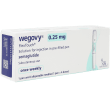
Wegovy injections start at 0.25mg Semaglutide once a week. Most people stay on this dose for four weeks before moving up to 0.5mg, but your prescriber may keep you on a lower dose for longer if you experience bad side effects of Wegovy (1).
It is possible to lose weight on 0.25mg depending on how your body reacts, although the effects may only be noticeable over a longer period of time. 0.25mg is the starting point in the Wegovy dosing schedule, and treatment is gradually increased over several months (1). Wegovy pills work in a similar way, starting at 1.5mg daily and slowly increasing (2).
If side effects repeatedly prevent you from moving up to a more effective dose, speak to your prescriber about whether continuing Wegovy is right for you.
What to do: Keep taking your starting dose exactly as prescribed and do not increase your dose early to try to speed up weight loss.
You haven’t yet reached the right Wegovy dose for you
Even once you move beyond the Wegovy starting dose, you need to work through several dose increases before reaching a longer-term maintenance dose.
The standard maintenance dose for Wegovy injections is 2.4mg Semaglutide, while Wegovy tablet doses increase through several stages before reaching 25mg (1,2). You do not necessarily need to reach the maximum dose, but some people need a high dose to see any real change in their weight.
The aim is not to increase as quickly as possible, but to find a dose that gives you a good response while remaining manageable for side effects. Wegovy dose increases are deliberately spaced out, so the process cannot be rushed (1,2).
What to do: Follow your prescribed schedule and speak to your prescriber if you are unsure whether your current dose is right for you.
You may need a higher-strength Wegovy option
If you have already reached the standard maintenance dose of Wegovy and are still losing less weight than expected, a higher-strength option may be suitable.
For Wegovy injections, 7.2mg once weekly is now available for some adults with obesity who need additional weight management after reaching 2.4mg (4). The new 7.2mg Wegovy can be considered after you have spent at least four weeks on the 2.4mg dose (1).
There is currently no Wegovy tablet dose above 25mg (2). If the Wegovy pill is not giving you enough benefit, your prescriber may discuss whether the higher-dose injection option could be appropriate and talk to you about switching from the Wegovy pill to Wegovy injections.
What to do: If you are already at the standard maintenance dose, speak to your prescriber about whether a different dose or formulation could be suitable.
You are not taking Wegovy correctly
Wegovy may not work as well if it is not taken exactly as instructed.
With Wegovy injections, make sure you are injecting the full dose under the skin once a week and using the pen correctly (1,5). If you are unsure whether a dose went in properly, ask your pharmacist or prescriber to check your technique.
The Wegovy pill is more sensitive to how you take it. It should be taken after an overnight fast, swallowed whole with a small amount of water, then followed by a wait of at least 30 minutes before you eat, drink or take other oral medicines (2,6).
Not taking the Wegovy pill correctly can reduce how much Semaglutide your body absorbs, how well the medicine works, and how much weight you lose.
What to do: Follow the exact instructions for your Wegovy formulation. If you are unsure whether you are taking it correctly, speak to your pharmacist or prescriber.
You are regularly missing Wegovy injections
Wegovy injections are taken weekly, which helps keep Semaglutide levels in your body steady from one dose to the next. Forgetting one dose is unlikely to undo your progress, but if you regularly miss injections, the effect on your appetite may become less consistent (1).
If you miss your weekly dose, you can usually take it as soon as you remember, as long as it is within five days. If more than five days have passed, skip the missed dose and take your next injection on your usual day. Never take an extra dose to make up for one you have missed (5).
What to do: Pick a regular injection day and set a reminder to help you remember. If you still keep forgetting, ask your prescriber whether Wegovy tablets may fit your routine better.
You are regularly forgetting to take Wegovy tablets
Forgetting tablets can affect how much weight you can lose on the Wegovy pill. The more often this happens, the more likely it is to affect your results (2).
Tablets are also less flexible than injections if you forget a dose. If you miss a tablet, skip that dose and take your next tablet the following morning as usual (6).
What to do: Take your tablet at the same time each morning and set an alarm to help you remember. If you still miss doses often, ask whether the Wegovy injection may suit you better than tablets.
You may still be eating out of habit
Wegovy works for weight loss by changing your hunger and fullness signals, making it easier to feel satisfied with smaller portions and eat less (1,2). However, it can take time to adjust to them.
You may still be eating the same portion sizes as before treatment, finishing meals automatically because there is food on your plate, or snacking at your usual times out of habit – even when you are less hungry than before. Eating beyond your hunger can make it harder to stay in a calorie deficit (7).
What to do: Try slowing down at meals and checking in with how hungry you actually feel. Don’t force yourself to finish a portion just because that was normal before treatment.
Your meals may not be filling enough
It’s normal to feel hungry on a GLP-1 between meals, but you should generally feel satisfied with smaller portions on Wegovy (1,2). If you are still hungry soon after eating, or you find yourself snacking a lot between meals, your main meals may not be filling enough.
Protein and fibre can both help you feel fuller for longer, so try to include them in every meal. Good protein options include eggs, chicken, fish, Greek yoghurt, tofu, beans and lentils. For fibre, think vegetables, fruit, wholegrains, beans, lentils, nuts and seeds (8).
What to do: Read our guide to what to eat on Wegovy for a balanced meal plan designed to help you feel full while supporting weight loss.
You may be consuming hidden calories
If your main meals are balanced and filling but your weight still is not moving, it is worth looking at what you are eating and drinking between them.
Drinks can be particularly easy to overlook. Sugary drinks, high-calorie coffees, and even lots of fruit juice can add a surprising amount to your daily intake. While you can drink on GLP-1s, alcohol is another source of extra calories, so it is worth cutting back if weight loss has slowed (8,9).
You do not need to count calories on a GLP-1, but if you are struggling to work out where extra calories are coming from, tracking for a few days can help you spot patterns in drinks, snacks, sauces and portion sizes (10).
What to do: Look for easy swaps, such as lighter snacks, fewer sugary drinks and less alcohol, where these are adding more calories than you realised.
You may need a little more movement
Wegovy helps make a calorie deficit easier by reducing your appetite, but movement still matters because it increases the amount of energy your body uses (1,2,7).
Even small changes such as walking 30 minutes each day, taking the stairs, standing up regularly and sitting less add up and support weight loss. Resistance training can also be useful while taking Wegovy, as it helps you maintain muscle as you lose weight (10-12).
The most important thing is to try to move regularly. If there is a sport or type of exercise you enjoy, lean into that, as it’s more likely that you’ll keep doing it consistently.
What to do: Find realistic ways to move more each day and choose activities you actually enjoy enough to keep doing regularly.
Your calorie needs may have changed
If Wegovy helped you lose weight at first but your progress has slowed, it may be because your body now needs fewer calories than it did when you started.
This is a normal part of weight loss and doesn’t mean Wegovy has stopped working. As you lose weight, your body generally uses less energy, so the same portions that created a calorie deficit earlier in treatment may no longer do so (13).
What to do: Keep listening to your hunger and fullness signals and be prepared to adjust your portions, meals or activity as your weight changes.
Another health condition may make weight loss harder
Sometimes, another health condition can make it harder to lose weight. For example, being pre menopausal, having certain thyroid conditions or PCOS can affect your hormones, metabolism, appetite or energy levels. Other changes in your health can change how active you are, how hungry you feel or how much energy your body uses (3).
For most people, slow progress on Wegovy will have a simpler explanation. But an underlying health condition is something to consider if your results are much slower than expected and you have noticed other changes in your health.
What to do: If you are taking Wegovy correctly but still struggling to lose weight, speak to your prescriber. They can decide whether anything needs investigating.
Wegovy may not work as well for some people
Someone can take Wegovy correctly, follow their dosing schedule, reach an appropriate dose, eat well and move regularly – but still not lose much weight.
Unfortunately, some of the factors that affect weight loss are outside your control. Appetite and weight are controlled by lots of different biological signals, not only GLP-1. Genetics may also affect how strongly you respond to Wegovy (14).
NICE recommends considering stopping Wegovy pills or injections if you have lost less than 5% of your starting weight after six months of treatment, as the Wegovy may not be effective for you (15).
What to do: If you are seeing little change after several months on Wegovy, speak to your prescriber. They can review your treatment and see if another weight loss medication may suit you more.
Why am I gaining weight on Wegovy?
The only thing that feels worse than not losing weight on Wegovy is putting weight on.
If your weight is consistently going up over several weeks while taking Wegovy, that is worth looking into. The same things that can slow weight loss can also lead to weight gain, such as missed doses, eating more than you realise, moving less or a change in your health.
However, weight loss rarely happens in a straight line, and one higher weigh-in is usually nothing to worry about. Your weight naturally moves up and down day to day because of things like:
Water retention
Constipation
Salty meals
Hormonal changes
Having more food or fluid in your body than usual
The scales are not the be-all and end-all of progress either. If you are building muscle while losing fat, your weight may change less than expected even though your body composition is improving. Changes in your waist measurement, how your clothes fit and how you feel can be just as important as the number on the scales.
If you are genuinely gaining weight on Wegovy over several weeks, speak to your prescriber or take a look at our Wegovy patient support.
Does weight loss plateau on Wegovy?
Weight loss can plateau on Wegovy, and it can happen at any point during treatment as your calorie needs change. This can happen as a result of weight loss itself, or because you are exercising less.
If you’re still a way off your goal weight and you have stopped losing weight, you may need to adjust your food intake or activity levels to overcome the weight loss plateau. You may also want to speak to your prescriber about whether your current Wegovy dose is right for you.
Plateaus can also happen as you get closer to your target weight, as seen in the STEP 5 trial. At that stage, your body may be settling into a lower, more stable weight, so further losses can become slower. It may be worth checking whether your goal weight is too low or still realistic for you.
How to speed up weight loss on Wegovy
There is no safe shortcut for making Wegovy produce rapid weight loss. You should never take extra Wegovy or increase your dose earlier than prescribed in hopes of faster results (1,2).
Instead, focus on getting the most from your treatment safely:
Take Wegovy correctly and consistently. Follow your dosing schedule, avoid missed doses and make sure you are using your injection or tablet correctly (1,2,5,6).
Give your dose time to work. You may still be moving through the dose-escalation stages or may not yet have reached the dose that works best for you (1,2)
Listen to your appetite. Wegovy should make it easier to feel satisfied with less food, so pay attention to when you are genuinely hungry and when you are comfortably full (1,2).
Look at the whole of your diet. Build filling meals around protein and fibre, and watch for hidden calories from snacks, alcohol, sugary drinks, sauces and other extras (8-10).
Keep moving regularly. Walking more, sitting less and doing exercise you enjoy all increase the amount of energy you use. Resistance training also helps you maintain muscle (11,12).
If you are taking Wegovy as prescribed and still not seeing the weight loss you expected, it may be time to speak to your prescriber. They can look at your dose, adherence, other medicines and health conditions, and decide whether anything needs to change.
Learn more about Wegovy injections and the Wegovy pill at Oxford Online Pharmacy.
References
Novo Nordisk Limited. Wegovy 2.4 mg solution for injection in pre-filled pen - Summary of Product Characteristics. electronic Medicines Compendium. Updated September 2026.
Novo Nordisk Limited. Wegovy 1.5 mg tablets - Summary of Product Characteristics. electronic Medicines Compendium. Updated June 2026.
NHS. Overweight and obesity in adults. Updated 2026.
Medicines and Healthcare products Regulatory Agency. Single-dose 7.2mg semaglutide (Wegovy) pen approved to treat adult patients with obesity. GOV.UK; 2026.
Novo Nordisk Limited. Wegovy 2.4 mg FlexTouch solution for injection in pre-filled pen – Patient Information Leaflet. electronic Medicines Compendium. Updated September 2026. Medicines.org.uk
Novo Nordisk Limited. Wegovy 1.5 mg tablets – Patient Information Leaflet. electronic Medicines Compendium. Updated June 2026. Medicines.org.uk
National Institute for Health and Care Excellence. Overweight and obesity management: physical activity and diet. NICE guideline NG246. London: NICE.
NHS. Healthy eating when trying to lose weight. Better Health.
NHS. Calories in alcohol.
NHS. Calories and weight loss. Better Health.
Department of Health and Social Care. UK Chief Medical Officers' physical activity guidelines. GOV.UK. Updated 10 July 2026.
Binmahfoz A, Dighriri A, Gray C, Gray SR. Effect of resistance exercise on body composition, muscle strength and cardiometabolic health during dietary weight loss in people living with overweight or obesity: a systematic review and meta-analysis. BMJ Open Sport Exerc Med. 2025;11(3).
Rosenbaum M, Leibel RL. Adaptive thermogenesis in humans. Int J Obes (Lond). 2010;34(Suppl 1).
Su QJ, Ashenhurst JR, Tran W, et al. Genetic predictors of GLP1 receptor agonist weight loss and side effects. Nature. 2026;653:770-775.
National Institute for Health and Care Excellence. Overweight and obesity management. NICE guideline NG246. London: NICE; 2026.
Garvey WT, Batterham RL, Bhatta M, et al. Two-year effects of semaglutide in adults with overweight or obesity: the STEP 5 trial. Nat Med. 2022;28:2083-2091.