


-
 UK-registered clinical team
-
Confidential & secure
-
No GP visit needed
-
Fast & discreet delivery

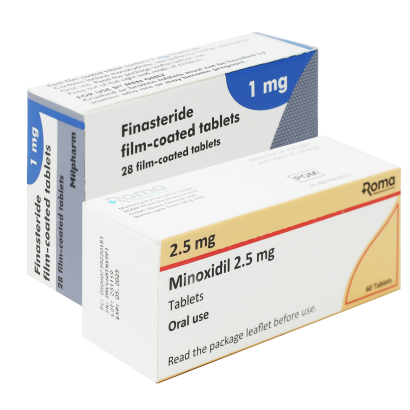
Finasteride + Minoxidil Tablets 6 Month Treatment Pack
Finasteride + Minoxidil Tablets 6 Month Treatment Pack Product information
£169.98
Product Information for Finasteride + Minoxidil Tablets 6 Month Treatment Pack
Our Oral Finasteride + Oral Minoxidil Treatment Pack combines two medicines used to treat male pattern hair loss: Finasteride 1mg tablets and Minoxidil 2.5mg tablets.
Finasteride targets dihydrotestosterone (DHT), the hormonal driver of male pattern baldness, to stop hair loss. Minoxidil improves blood flow to the follicles to support hair growth. Using both together treats hair loss from both angles and may provide greater improvements than either treatment alone.
Receive a month’s supply of Finasteride 1mg and oral Minoxidil 2.5mg
Combines two clinically proven hair loss medicines that work in different ways
In one study, effectively improved or stabilised hair loss in 92% of men after one year (1)
Prescription-only hair loss treatment following an online clinical assessment
Our clinicians will only prescribe this combination when they consider it clinically appropriate for you.
What is Oral Finasteride + Oral Minoxidil treatment?
The Oral Finasteride + Oral Minoxidil bundle is a treatment pack for men with male pattern baldness, also known as androgenetic alopecia. In the UK, Finasteride and Minoxidil tablets are both prescription-only medicines, and you will receive a month's supply of both medications:
Finasteride 1mg tablets. Licensed in the UK as a treatment for male pattern hair loss in men. Finasteride is used to help increase hair growth and prevent further hair loss (2).
Minoxidil 2.5mg tablets. Licensed in the UK to treat severe high blood pressure (hypertension), but lower-dose oral Minoxidil for hair loss can be prescribed off-label* (3).
*Using a licensed medicine in a different way from what it was originally approved for, such as for a different condition or at a different dose.
How do oral Finasteride and Minoxidil work for hair loss?
The main difference between Minoxidil and Finasteride tablets is how they work, which is why they may be prescribed together for hair loss.
Finasteride targets DHT
Finasteride works for hair loss by blocking an enzyme called type II 5-alpha reductase, which converts testosterone into dihydrotestosterone (DHT) (2).
Men who are genetically more likely to have male pattern hair loss have hair follicles that are more sensitive to DHT, and they respond by gradually becoming smaller. The hairs the follicles produce become shorter and finer until some follicles eventually stop producing visible hair altogether.
By reducing DHT levels in the scalp and bloodstream, Finasteride can slow this process, stop further hair loss, and may allow affected follicles to produce stronger hair (2).
You can find out more about DHT and how it affects hair loss.
Minoxidil acts directly on hair growth
Minoxidil doesn’t block DHT. It is a vasodilator, meaning it widens blood vessels and may increase blood flow around the hair follicles. This increased blood flow is thought to support hair growth.
But it is believed to do more than that. Oral Minoxidil tablets for hair loss are thought to act directly on the hair follicles and affect the hair growth cycle. It may encourage follicles to move from the resting phase into the active growth phase and help them remain in this growth phase for longer (3).
Why combine oral Minoxidil and oral Finasteride?
Finasteride vs Minoxidil is not necessarily a case of choosing one or the other. Because the two medicines work differently, they can be prescribed together to treat male pattern baldness.
Taking them together targets male pattern hair loss from two directions. Finasteride primarily helps slow or prevent further hair loss, while Minoxidil encourages hair to grow. In other words, you’re helping to protect the hair you have while supporting thicker, healthier growth.
Evidence now suggests that using Finasteride and Minoxidil together may help men achieve greater improvements in their hair (4-6). Minoxidil is available as a topical treatment, but some men find taking both medications orally as daily tablets is more convenient.
How effective are oral Minoxidil and Finasteride together?
Studies looking at Finasteride and Minoxidil effectiveness suggest that using both medicines together may work better than using either treatment alone.
In one study, 94.1% of men using oral Finasteride with topical Minoxidil improved after 12 months, compared with 80.5% using Finasteride and 59% using Minoxidil alone (4). Other studies of combined Finasteride and Minoxidil have reported similar benefits (5,6).
There is less evidence for taking both medicines orally as tablets. But a 2025 study followed 502 men taking the same doses supplied in this treatment pack. The Finasteride and Minoxidil results after 12 months showed that (1):
92.4% had improved or stable hair
57.4% showed an improvement from where they started
This study didn’t compare the oral combination with either medicine alone, so we cannot say how much extra benefit comes from taking both as tablets. But consistency matters, and taking both treatments as daily tablets may make consistent long-term treatment easier for some men.
What results can I expect?
The results of Finasteride and Minoxidil vary from person to person, so the figures from studies cannot guarantee how much hair growth you will see. To get the best results, it’s important to stay consistent with treatment.
When starting Minoxidil, you may notice temporary increased hair shedding during the first few weeks of treatment. This can happen as hairs in the resting phase are shed and replaced as follicles move into a new growth cycle (7). It does not necessarily mean that treatment is not working.
Because male pattern hair loss is progressive, when you start treatment can impact your oral Minoxidil and Finasteride results. Our guide to treating early-stage hair loss looks at what we know about starting treatment before hair loss becomes more advanced and harder to reverse.
How long until you see results?
Hair growth is slow, so you should not expect an immediate change.
For Finasteride, 3 to 6 months of treatment is usually needed for visible results (2). You can read more about how long Finasteride takes to work and what to expect during treatment.
How long Minoxidil takes to work is similar, with noticeable changes typically seen after the first few months of continued daily treatment (8).
Using Finasteride and Minoxidil together may lead to greater improvements over time, but it does not necessarily mean you will see results faster. Because both work within the natural hair growth cycle, how long it takes for hair loss treatments to work is impacted by how fast hair grows.
Because hair grows in cycles, early changes to your hair are also not necessarily the oral Minoxidil and Finasteride results. Hair growth and thickness may continue to improve with consistent treatment, and it can take around 12 months to see fuller effects (2,8).
If you don’t see results from hair loss treatment despite taking both medicines consistently for several months, talk to your prescriber.
Who can use oral Finasteride and oral Minoxidil treatment?
Oral Finasteride and Minoxidil may be suitable for (2-3):
Adult men aged 18 and over
Men with male pattern baldness (androgenetic alopecia)
Men who want to reduce further hair loss and encourage hair growth
Both are prescription-only medicines, so our clinicians will check that you are suitable for both Finasteride and oral Minoxidil through a clinical assessment. As an off-label treatment, the benefits and risks of Minoxidil tablets will particularly be evaluated before deciding whether to prescribe it.
If oral Minoxidil is not suitable for you, using Finasteride and 5% topical Minoxidil may be an alternative. Topical Minoxidil is applied directly to the scalp, available as a scalp solution or foam. Our guide to oral Minoxidil vs topical Minoxidil explains the differences between the two.
Who shouldn’t use Oral Finasteride + Oral Minoxidil?
The combination of oral Finasteride and oral Minoxidil is not suitable for everyone.
Finasteride 1mg is licensed for male pattern hair loss in men and is not indicated for women or people under 18 (2). You should also not take this combination treatment if (2-3):
You are allergic to Finasteride, Minoxidil, or another ingredient in either medicine
You are already taking Finasteride or another 5-alpha reductase inhibitor such as Dutasteride
You have phaeochromocytoma
Other health conditions may not automatically prevent you from having treatment but can affect whether oral Minoxidil is suitable. This includes certain heart, blood pressure and kidney problems, which your doctor will consider as part of your assessment (3).
This is not a complete list of everything that may affect whether you can or cannot take Finasteride and Minoxidil tablets. Your prescriber will review your medical history and current medications before deciding whether this treatment pack is appropriate.
How to Use Oral Finasteride + Oral Minoxidil
Both medications included in this treatment pack are daily tablets:
Finasteride: take one 1mg tablet once daily
Minoxidil: take half a tablet daily for 14 days and then one tablet a day thereafter.
Take both medicines exactly as prescribed. You can take them both together at the same time each day if this is convenient for you.
Finasteride and Minoxidil can be taken any time of day with or without food, but aim to take it at the same time each day (9,10).
Swallow the tablet whole as directed and do not deliberately crush or break it.
Warning: Pregnant women or women who may become pregnant must not handle crushed or broken Finasteride tablets because the active ingredient can be absorbed through the skin and may affect the development of a male foetus (2).
Important: The doses stated in the licensed Minoxidil Patient Information Leaflet are for the treatment of severe high blood pressure, not hair loss (10). Oral Minoxidil is prescribed off-label for hair loss at lower doses, so always follow the instructions given by your prescriber rather than the hypertension dosing instructions in the leaflet.
Missed a dose of Oral Minoxidil + Oral Finasteride?
If you forget either tablet, skip the missed dose and take your next dose at the usual time (9-10).
Do not take two tablets to make up for a forgotten dose. If you regularly forget your medication or are unsure how to restart after missing several doses, contact Oxford Online Pharmacy for advice.
How to store Oral Finasteride + Oral Minoxidil
Finasteride and Minoxidil tablets should be stored below 25°C in their original packaging (9-10). Keep them out of the sight and reach of children.
Do not use either medication after the expiry date on the packaging.
Side effects
Side effects of oral Minoxidil tablets
Common side effects
The Patient Information Leaflet (PIL) supplied with Minoxidil tablets lists side effects including (3,10):
Increased heart rate
Increased hair growth or changes in hair colour
Fluid retention or swelling
Gastrointestinal problems
Dizziness or feeling faint
Shortness of breath or tiredness
Chest pain
Inflammation or fluid around the heart
Skin reactions, including rash
However, the frequencies and list of side effects given in the Minoxidil PIL are based on its licensed use for severe high blood pressure, where substantially higher doses may be used.
The most noticeable side effects of oral Minoxidil reported with low doses used for hair loss are increased facial or body hair and cardiovascular effects, such as light-headedness and an increased heart rate (8).
Serious side effects – When to seek help
Serious side effects appear to be uncommon when oral Minoxidil is used at low doses. In the same study of people taking Minoxidil tablets for hair loss, no life-threatening side effects were reported. Only 1.7% of people in this study stopped treatment because of side effects (11).
The licensed Minoxidil information lists serious heart and circulation problems, including fluid around the heart (3,10). These warnings largely come from its use at higher doses for high blood pressure, although serious cardiovascular effects have been reported at lower doses (8).
Seek urgent medical help if you develop:
Difficulty breathing or severe shortness of breath
Chest pain
Fainting
Significant or rapidly worsening swelling
A very fast or unusual heartbeat
Swelling of your face, lips, tongue or throat, or difficulty breathing, which may indicate a serious allergic reaction
If you develop persistent dizziness, ankle swelling or noticeable changes in your heartbeat that are not severe, contact our team for advice.
This is not a complete list of possible side effects. Read the Patient Information Leaflet supplied with your Minoxidil tablets for further information. The leaflet relates to Minoxidil's licensed use for high blood pressure, so the doses and side-effect frequencies may differ from those seen with the lower doses prescribed off-label for hair loss (10).
Side effects of Finasteride tablets
Finasteride 1mg does not have any side effects classified as common in the product information.
Uncommon side effects, which may affect up to 1 in 100 people, include (2,9):
Reduced sex drive
Difficulty getting or maintaining an erection
Ejaculation changes, including reduced ejaculate volume
Depression
Other side effects have been reported, but it is not known how often they occur. These include anxiety, testicular pain, blood in the semen, breast tenderness or enlargement, palpitations, reduced semen quality or infertility and sexual problems that continue after stopping treatment (2,9).
Serious side effects – When to seek help
Some side effects of Finasteride are serious and require medical attention. Never ignore the following:
Depression, suicidal thoughts or significant changes in your mood (2,12). Stop taking Finasteride and seek medical advice as soon as possible.
Signs of a serious allergic reaction, such as swelling of your face, lips, tongue or throat, or difficulty breathing: Stop taking Finasteride and seek urgent medical help (2,9).
Breast changes, including a lump, pain, enlargement or nipple discharge. Contact a doctor promptly. Breast changes and cases of male breast cancer have been reported (2,9).
It’s unlikely, but you may also experience sexual symptoms like erectile dysfunction and low libido continuing even after you stop treatment, sometimes called Post-Finasteride Syndrome (PFS) (2,12). If you experience side effects that do not improve after stopping Finasteride, speak to your doctor for advice and support.
This is not a complete list of possible side effects. Read the Patient Information Leaflet supplied with your oral Finasteride 1mg tablets for a full list of reported side effects and further safety information (9).
Advisory information
Oral Minoxidil warnings
Off-label treatment: Oral Minoxidil is prescribed off-label for hair loss, usually at lower doses than those used for its licensed treatment of severe high blood pressure. Your clinician will assess whether it is suitable for you and whether any monitoring is needed.
Blood pressure and heart rate: Oral Minoxidil can lower blood pressure and increase your heart rate (3). Your prescriber will decide whether your blood pressure, heart rate or other measurements need to be checked during treatment.
Heart problems: Tell your clinician if you have heart disease, heart failure, an abnormal heart rhythm or have previously had a heart attack. Oral Minoxidil can increase your heart rate and affect the cardiovascular system and may not be suitable (3).
Fluid retention: Minoxidil can cause your body to retain salt and water, leading to swelling or weight gain. Contact your prescriber if you notice persistent swelling or unexplained weight gain. Fluid around the heart and, rarely, cardiac tamponade have also been reported (3).
Blood-cell changes: Oral Minoxidil can reduce the number of white blood cells or platelets in your blood, which may make it harder to fight infections or cause you to bruise or bleed more easily than usual. Contact your doctor if you develop frequent infections or unusual bruising or bleeding (3).
Finasteride warnings
Mood changes: Tell your clinician if you have a history of depression or suicidal thoughts. If you develop depression, suicidal thoughts or significant mood changes while taking Finasteride 1mg, stop treatment and seek medical advice (2,12).
Fertility: Reduced semen quality and infertility have been reported in some men taking Finasteride 1mg, but most men experience this as a temporary effect of the medication. Improvement or a return to normal has been reported after stopping treatment (2).
Pregnancy: Women who are pregnant or may become pregnant should not handle crushed or broken Finasteride tablets because of the potential risk to a male baby. Intact coated tablets can be handled normally (2).
PSA tests: Finasteride can lower prostate-specific antigen (PSA) levels and affect the results of a PSA blood test. You must tell the healthcare professional arranging your test that you take Finasteride so they can take this into account when interpreting your results (2).
Taking Finasteride and Minoxidil tablets with other medicines
Tell your clinician about all medicines you take before starting treatment, including prescription and over-the-counter medicines. Below are some combinations that may be problematic:
Medicines that lower blood pressure: Oral Minoxidil can increase the blood pressure lowering effects of antihypertensives and other drugs that lower blood pressure. This may increase your risk of low blood pressure or dizziness when standing up (3).
Sympathetic-blocking medicines: Medicines such as guanethidine or betanidine can cause an excessive drop in blood pressure when taken with oral Minoxidil. Your clinician will check for potential interactions before prescribing (3).
Finasteride and other 5-alpha reductase inhibitors: Do not take Finasteride 1mg if you are already taking Finasteride 5mg or another 5-alpha reductase inhibitor, such as Dutasteride, for an enlarged prostate or another condition (2).
At Oxford Online Pharmacy, our independent doctors will consider your current medications alongside your health status and symptoms before prescribing the Oral Finasteride + Oral Minoxidil treatment pack to make sure it’s safe and suitable for you.
References
Johnson H, Huang D, Clift AK, Bersch-Ferreira Â, Guimarães GA. Effectiveness of Combined Oral Finasteride in Male Androgenetic Alopecia: A Retrospective Service Evaluation. Cureus. 2025;17(1):e77549.
Aurobindo Pharma - Milpharm Ltd. Finasteride 1mg tablets - Summary of Product Characteristics (SmPC). Electronic Medicines Compendium. Updated 17 March 2026.
Pfizer Limited. Loniten Tablets 2.5mg - Summary of Product Characteristics (SmPC). Electronic Medicines Compendium. Updated 6 February 2026.
Hu R, Xu F, Sheng Y, Qi S, Han Y, Miao Y, et al. Combined treatment with oral finasteride and topical minoxidil in male androgenetic alopecia: a randomized and comparative study in Chinese patients. Dermatol Ther. 2015;28(5):303-308.
Asad N, Naseer M, Ghafoor R. Efficacy of Topical Finasteride 0.25% With Minoxidil 5% Versus Topical Minoxidil 5% Alone in Treatment of Male Pattern Androgenic Alopecia. J Drugs Dermatol. 2024;23(11):1003-1008.
Suchonwanit P, Srisuwanwattana P, Chalermroj N, Khunkhet S. A randomized, double-blind controlled study of the efficacy and safety of topical solution of 0.25% finasteride admixed with 3% minoxidil vs. 3% minoxidil solution in the treatment of male androgenetic alopecia. J Eur Acad Dermatol Venereol. 2018;32(12):2257-2263.
Nohria A, Desai D, Sikora M, Mandal S, Shapiro J, Lo Sicco K. Combating “dread shed”: The impact of overlapping topical and oral minoxidil on temporary hair shedding during oral minoxidil initiation. JAAD International [Internet]. 2024 Mar 25 [cited 2026 Sept 2];15:220–4.
Gupta AK, Talukder M, Shemar A, Piraccini BM, Tosti A. Low-Dose Oral Minoxidil for Alopecia: A Comprehensive Review. Skin Appendage Disorders [Internet]. 2023 Sept 27 [cited 2026 Sept 2];9(6):423–37.
Aurobindo Pharma - Milpharm Ltd. Finasteride 1mg tablets - Patient Information Leaflet (PIL). Electronic Medicines Compendium.
Pfizer Limited. Loniten Tablets 2.5mg - Patient Information Leaflet (PIL). Electronic Medicines Compendium.
Vañó-Galván S, Pirmez R, Hermosa-Gelbard Á, Moreno-Arrones OM, Saceda-Corralo D, Rodrigues-Barata R, et al. Safety of low-dose oral minoxidil for hair loss: A multicenter study of 1404 patients. J Am Acad Dermatol. 2021;84(6):1644-1651
Medicines and Healthcare products Regulatory Agency. Finasteride and Dutasteride – updated safety warnings for psychiatric side effects and sexual dysfunction. GOV.UK. Published 11 May 2026.
Finasteride + Minoxidil Tablets 6 Month Treatment Pack reviews
- What is Finasteride and how does it work for hair loss?
- Can stress really cause hair loss?
- What we ask (and why) before we prescribe
- Does Hollywood Typecast Bald Actors?
- Do you have to use hair loss treatment forever?
- What happens during our hair loss consultations?
- Topical vs oral hair loss treatments: What suits your lifestyle?
- What should you do if you don’t see results from hair loss treatment?
- Is it worth treating early-stage hair loss? What we know about timing
- Hair loss and mental health: Why it hits harder than you expect
Authored on November 12, 2026

Robert Bradshaw (Pharmacist) — MRPharms BSc(Hons) Pharmacy
Superintendent Pharmacist
GPhC Number: 2036118
Reviewed on November 13, 2026
